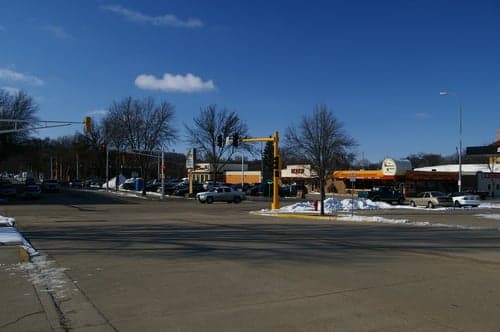
Photo: Wikipedia
Demographics of Valley City, ND
Affluence Level in Valley City, ND
A middle-class area roughly in line with national averages across income, home values, education, and employment.
People of Valley City, ND
The people of Valley City, North Dakota, today number 6,554 and form a predominantly white (88.7%), college-educated (30.0%) community with a modest foreign-born population of 3.0%. The city is characterized by a stable, family-oriented character rooted in its history as a railroad and agricultural hub, with a notably low population density that preserves a small-town feel. Distinctive identity markers include a strong Norwegian-German cultural heritage, a visible presence of East/Southeast Asian residents (2.0%) tied to the local university, and a small but growing Hispanic community (2.8%). The city’s population has remained relatively flat over the past two decades, reflecting a slow but steady demographic transition rather than rapid change.
How the city was settled and grew
Valley City was founded in 1874 as a railroad town on the Northern Pacific Railway, which drew the first wave of settlers—primarily Scandinavian immigrants, especially Norwegians and Swedes, along with German-Russian farmers. These groups were attracted by the promise of fertile land in the Sheyenne River Valley and the economic opportunities of the railroad. The original population clustered in the Downtown Historic District near the depot, where Norwegian and German immigrants built homes, churches, and businesses along Main Street. A second wave arrived in the early 1900s with the expansion of the state normal school (now Valley City State University), drawing educators and their families to the College Hill neighborhood, which remains a concentration of older, well-maintained homes and university faculty. By the 1920s, the city’s population had grown to over 4,000, with distinct ethnic enclaves: the West Side neighborhood became home to many German-Russian families who worked in the nearby flour mills and creameries, while the East Side near the river attracted Norwegian farmers who commuted to outlying homesteads. The city’s population peaked at around 7,500 in the 1960s before stabilizing.
Modern era (post-1965)
After the 1965 Immigration and Nationality Act, Valley City saw only modest demographic shifts, as its remote location and cold climate limited large-scale immigration. The most notable change was the arrival of East/Southeast Asian students and faculty at Valley City State University, primarily from Vietnam, Korea, and the Philippines, who settled in the University District around campus and in rental units near Central Avenue. This group now accounts for 2.0% of the population, with many graduates staying to work in local healthcare and education. The Hispanic population (2.8%) grew slowly from the 1990s onward, driven by agricultural labor in the surrounding Barnes County farmlands, with families settling in the South Side neighborhood near the industrial park and meatpacking facilities. The Black population (2.1%) is small and largely composed of professionals and students, with no distinct enclave. Domestic in-migration has been minimal, with most new residents coming from other parts of North Dakota or Minnesota, often drawn by jobs at the Lutheran Home of the Good Shepherd or the local hospital. The city’s racial composition has remained overwhelmingly white (88.7%), with the Indian subcontinent population (0.2%) being negligible and concentrated among a few university-affiliated families.
The future
The population of Valley City is likely to remain stable or decline slightly over the next 10–20 years, as outmigration of young adults to larger cities offsets any modest in-migration. The city is not homogenizing into a single identity but rather tribalizing into distinct enclaves: the College Hill and University District areas are becoming more diverse, with a mix of white, East/Southeast Asian, and Black residents, while the West Side and South Side remain predominantly white and older. The Hispanic community is expected to grow slowly, possibly reaching 4–5% by 2040, as agricultural and service-sector jobs attract more families. The East/Southeast Asian population is plateauing, as Valley City State University’s international enrollment has stabilized. The Indian subcontinent population is unlikely to grow significantly due to the lack of tech or medical research sectors. The overall trend is toward a slightly more diverse but still overwhelmingly white and aging population, with the median age rising as younger residents leave for Fargo or Bismarck.
For someone moving in now, Valley City is becoming a quieter, more stable version of its past—a place where the population is slowly diversifying but remains anchored by its Norwegian-German heritage and university presence. New residents should expect a tight-knit community where most social networks are established, but where the cost of living is low and the pace of life is deliberate. The city’s future is not one of rapid growth or dramatic change, but of gradual, manageable evolution.

* Values derived from national, state, county, city and local statistics and may differ in a specific area. Last updated: 2026-04-19T07:55:33.000Z
Narrative content on this page is AI-generated and may contain mistakes. Verify any details that matter before acting on them.
ReloMaps may earn a commission from affiliate links at no extra cost to you.

