Photo: Wikipedia
Demographics of Orange County
Affluence Level in Orange County
A middle-class area roughly in line with national averages across income, home values, education, and employment.
People of Orange County
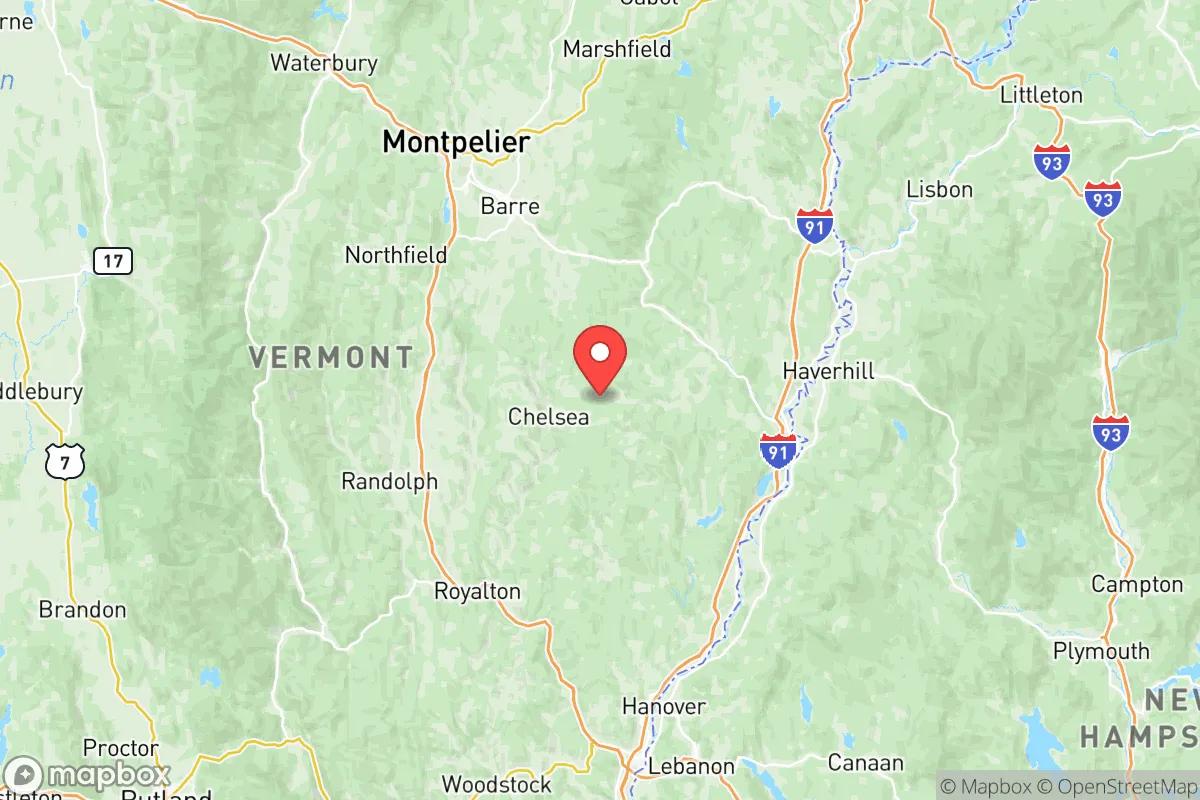
Orange County, Vermont, is one of the most demographically stable and culturally homogeneous places in New England. With a population of 29,594, it is 93.4% white and has a foreign-born share of just 0.5% — among the lowest in the nation. Its residents are concentrated in small towns like Randolph, Bradford, Chelsea, and Williamstown, where a strong sense of local identity, self-reliance, and agrarian tradition persists. The county’s character is defined not by rapid change but by continuity: a place where generational roots run deep, and where the population is slowly aging and shrinking rather than diversifying or booming.
Settlement & growth (pre-1960)
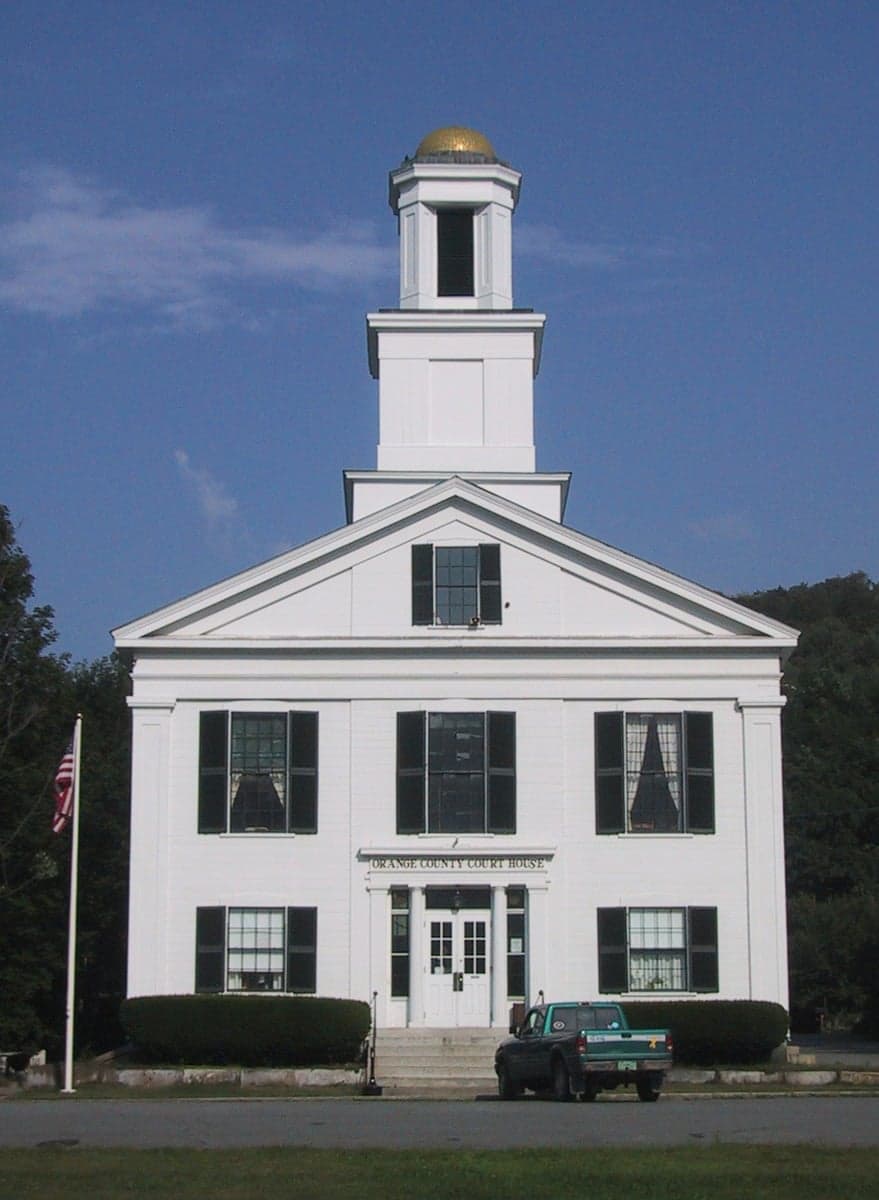
Before European settlement, the area now known as Orange County was part of the traditional territory of the Western Abenaki people, particularly the Cowasuck band, who lived in seasonal villages along the Connecticut River and its tributaries. They fished, hunted, and practiced small-scale agriculture, leaving behind place names like the Waits River and the town of Thetford. French explorers and fur traders passed through the region in the 17th and 18th centuries, but no permanent French settlements took root. The area was formally chartered by New Hampshire’s colonial governor Benning Wentworth in the 1760s and 1770s, with towns like Chelsea (chartered 1781), Randolph (1781), and Bradford (1770) receiving land grants to attract settlers.
The first major wave of settlers was overwhelmingly of English and Scots-Irish stock, arriving from southern New England and the Hudson Valley between the 1770s and the 1820s. They were drawn by the promise of cheap, fertile land in the White River and Waits River valleys. These early families — many bearing surnames still common in the county today — cleared forests, built stone walls, and established subsistence farms. By 1800, Orange County’s population had already reached roughly 15,000, concentrated in towns like Randolph, Chelsea, and Strafford. The county seat was established in Chelsea in 1781, and the region became a hub for sheep farming and wool production during the Merino sheep boom of the 1820s–1840s.
From the 1840s through the 1880s, a smaller but notable wave of Irish immigrants arrived, many fleeing the Great Famine. They settled primarily in the mill villages along the White River — towns like Randolph, where they worked in the woolen mills, and in the granite quarries of Barre (just across the county line in Washington County) and the smaller quarries in Williamstown. A handful of French Canadian families also crossed the border from Quebec during this period, drawn by mill and railroad work, settling in Bradford and Fairlee. However, Orange County never experienced the heavy French Canadian immigration that reshaped northern Vermont’s mill towns like Winooski and St. Albans. By 1900, the county’s population peaked at roughly 35,000, then began a slow decline as agricultural consolidation and the decline of small-scale farming pushed younger generations out to cities or westward.
Between 1900 and 1960, the county’s population stagnated and then fell, dropping to about 26,000 by 1950. No major new immigrant groups arrived during this period. The region remained overwhelmingly native-born white, with small clusters of Italian and Polish families in the railroad and quarry towns, but never in numbers large enough to form distinct ethnic enclaves. The dominant cultural identity remained that of old-stock Yankee Protestant, with a significant minority of Irish Catholic families in the mill villages. The construction of Interstate 91 in the 1960s bypassed most of the county’s towns, preserving their isolation and slowing suburbanization.
Modern era (post-1965)
The 1965 Hart-Cellar Act had almost no impact on Orange County. Unlike urban Vermont — Burlington saw a small but visible influx of Southeast Asian refugees in the 1980s and 1990s — Orange County’s foreign-born population remains negligible at 0.5%. The county did not attract the post-1965 waves of immigrants from Latin America, Asia, or the Indian subcontinent that transformed other parts of the United States. The Hispanic share is just 1.7%, the East/Southeast Asian share is 0.4%, and the Indian-subcontinent share is 0.1%. These populations are scattered across the county, with no identifiable ethnic enclaves or neighborhoods.
Domestic migration has been the more significant demographic force since 1965, though it has been modest in scale. Starting in the 1970s, a small but steady stream of back-to-the-land migrants — often college-educated, countercultural-leaning families from the Northeast — moved into rural Orange County, buying old farmhouses and establishing homesteads in towns like Brookfield, Tunbridge, and Vershire. This wave was culturally distinct from the old-stock Yankee population, introducing organic farming, alternative education, and a more liberal political sensibility. However, these newcomers were still overwhelmingly white and native-born, so they did not change the county’s racial composition. By the 1990s and 2000s, a second wave of domestic migrants arrived: telecommuters and remote workers from Boston, New York, and the Connecticut suburbs, drawn by lower housing costs and rural scenery. They concentrated in towns with good internet access and scenic appeal, such as Randolph, Thetford, and Norwich (though Norwich is in neighboring Windsor County).
Suburbanization has been minimal. Orange County has no major suburban developments or exurban subdivisions. The largest town, Randolph, has a population of roughly 4,700, and the county’s overall density is just 36 people per square mile. The population has remained essentially flat since 1970, hovering between 28,000 and 30,000. The college-educated share is 36.5%, reflecting the presence of Vermont Technical College in Randolph and the draw of the region for educated remote workers, but this is not translating into significant population growth or diversification.
The future
Orange County is likely to continue its trajectory of slow population decline and demographic homogenization. The county’s birth rate is below replacement level, and the population is aging: the median age is roughly 46, well above the national average. Young adults continue to leave for college and urban job markets, and few return. The foreign-born share is unlikely to rise significantly, as the county lacks the industrial or service-sector jobs that attract immigrants, and its rural character offers few of the ethnic community supports that draw newcomers to larger cities. The Hispanic and Asian shares may inch upward slowly, but from such a low base that they will remain statistically negligible for the foreseeable future.
The domestic in-migration of remote workers may continue, but it is unlikely to reverse the overall decline. These newcomers tend to be older, wealthier, and whiter than the national average, so they reinforce rather than disrupt the county’s existing demographic profile. The cultural divide between old-stock Yankees and back-to-the-land/telecommuter newcomers will persist, but it is a divide within a single racial and ethnic group, not a source of broader diversification. The county is not tribalizing into distinct ethnic enclaves; it is slowly homogenizing into an older, whiter, more educated version of itself.
For someone moving in now, Orange County offers a stable, safe, and culturally cohesive environment — but one that is also shrinking and aging. The kind of person who will thrive here is someone who values quiet, rural self-sufficiency, and who does not expect the demographic dynamism or ethnic diversity of a growing Sun Belt suburb or a coastal city. The county is becoming a place where continuity, not change, defines the human story.

* Values derived from national, state, county, city and local statistics and may differ in a specific area. Last updated: 2026-05-14T18:12:49.000Z
Narrative content on this page is AI-generated and may contain mistakes. Verify any details that matter before acting on them.
ReloMaps may earn a commission from affiliate links at no extra cost to you.

