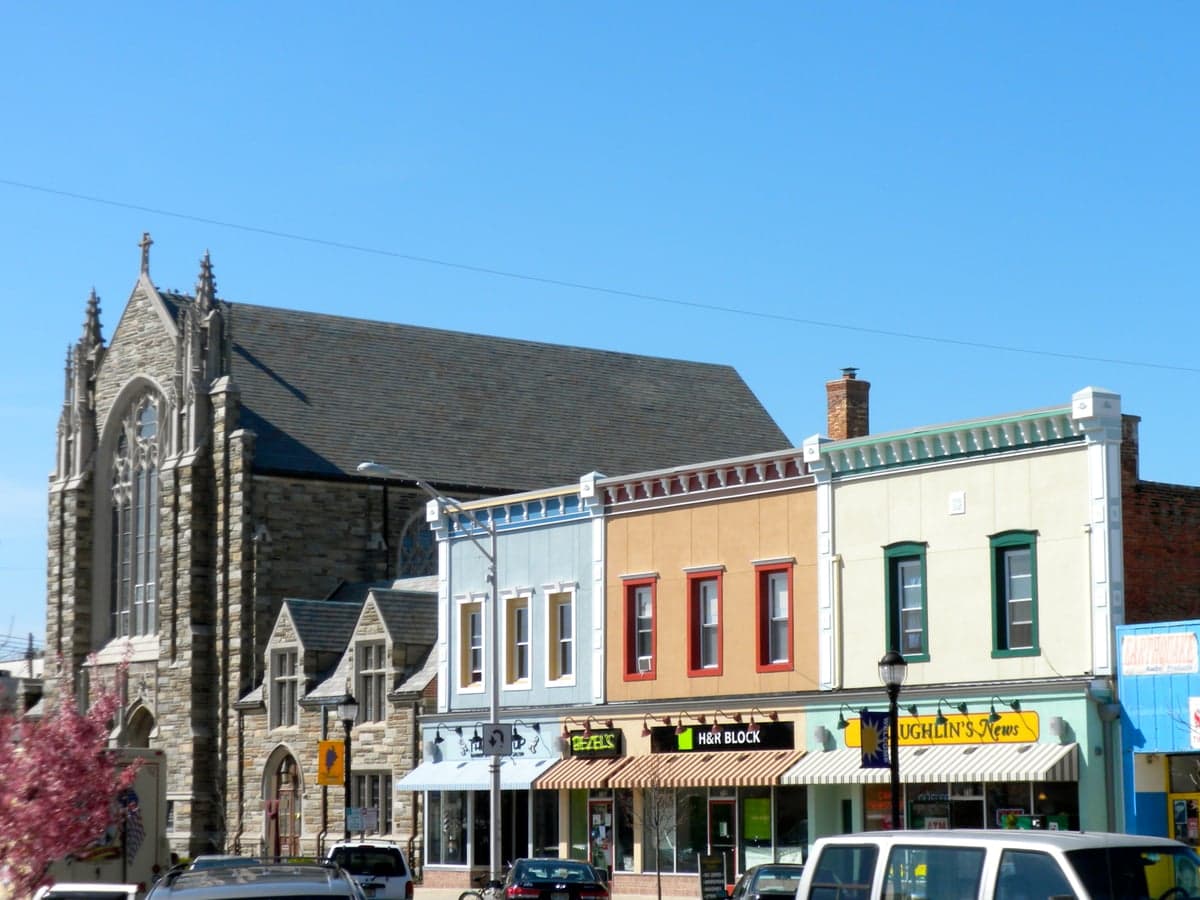
Photo: Wikipedia
Demographics of Vineland, NJ
Affluence Level in Vineland, NJ
A middle-class area roughly in line with national averages across income, home values, education, and employment.
People of Vineland, NJ
Vineland, New Jersey, is a city of 60,692 residents defined by its Hispanic-majority population (45.1%) and a significant White minority (38.5%), with a notable Black community (11.1%) and small but distinct Indian (1.1%) and East/Southeast Asian (0.3%) populations. The city’s character is shaped by its agricultural roots, a large working-class base, and a relatively low college attainment rate of 23.4%. Only 7.0% of residents are foreign-born, suggesting that the city’s ethnic diversity is largely driven by U.S.-born multi-generational families rather than recent immigration. Vineland feels less like a typical New Jersey suburb and more like a self-contained, blue-collar city with a strong sense of local identity and a growing Hispanic cultural influence.
How the city was settled and grew
Vineland was founded in 1861 as a planned agricultural community by Charles K. Landis, a land developer who purchased 30,000 acres of South Jersey pine barrens. Landis marketed the area to European immigrants and Northern farmers, promising fertile soil for fruit and vegetable farming. The earliest settlers were German and English farmers who established homesteads in what is now the Landis Avenue corridor, the city’s historic commercial spine. By the 1880s, Italian immigrants arrived in large numbers, drawn by work in the region’s thriving glass industry and truck farming. They settled in the North Vineland neighborhood, building tight-knit communities around Catholic parishes like St. Mary’s Church. A smaller wave of Polish and Russian Jewish immigrants arrived around 1900, establishing farms and small businesses in the East Vineland area, near the railroad line that connected them to Philadelphia markets. These groups formed the city’s White ethnic base for the next century.
Modern era (post-1965)
The post-1965 immigration reforms and the decline of Vineland’s glass and manufacturing industries reshaped the city’s demographics. Beginning in the 1970s, Puerto Rican and Dominican families moved into the South Vineland and West Vineland neighborhoods, drawn by affordable housing and agricultural jobs in the surrounding Cumberland County farmlands. By the 1990s, the Hispanic share of the population had surged past 30%, and it now stands at 45.1%. The Black population (11.1%) grew steadily from the 1980s onward, with many families settling in the central Vineland area around the city’s public housing complexes and near the Cumberland County College campus. The Indian community (1.1%) is a more recent arrival, largely concentrated in the northern Vineland neighborhoods near the Inspira Medical Center, where many work in healthcare and professional services. The East/Southeast Asian population (0.3%) remains tiny, with a handful of Vietnamese and Filipino families scattered across the city. The White population, once over 90%, has declined to 38.5%, with many older Italian and German families moving to outer suburbs like Millville or Buena Vista Township.
The future
Vineland’s population is trending toward a more homogenized Hispanic-majority identity, with the White share continuing to decline through out-migration and an aging demographic. The Hispanic population is largely U.S.-born (the foreign-born share is only 7.0%), meaning assimilation into English-speaking, mainstream American culture is well underway, though Spanish remains widely spoken in South Vineland and West Vineland. The Black and Indian communities are stable but not growing rapidly, while the East/Southeast Asian population is likely to remain negligible. The city is not tribalizing into starkly separate enclaves—rather, it is becoming a predominantly Hispanic working-class city with a residual White and Black presence. Over the next 10–20 years, Vineland will likely see further White flight to surrounding townships, a plateauing of the Hispanic share around 50–55%, and a slow increase in college attainment as younger residents pursue education at nearby Rowan University or Cumberland County College. For a conservative-leaning newcomer, Vineland offers a low cost of living and a family-oriented, church-going culture, but the political and cultural center of gravity is shifting toward a Hispanic-majority, Democratic-leaning electorate.
Vineland is becoming a solidly Hispanic, blue-collar city with a fading White ethnic past and a stable Black minority. For someone moving in now, the city offers affordable housing and a strong sense of community, but the demographic trajectory means that English-dominant, conservative-leaning residents may find themselves increasingly in the minority. The neighborhoods to watch are South Vineland (growing Hispanic), North Vineland (aging Italian and German), and the central area (mixed Black and Hispanic).

* Values derived from national, state, county, city and local statistics and may differ in a specific area. Last updated: 2026-04-29T21:12:45.000Z
Narrative content on this page is AI-generated and may contain mistakes. Verify any details that matter before acting on them.
ReloMaps may earn a commission from affiliate links at no extra cost to you.

