Demographics of Waynesboro City County
Affluence Level in Waynesboro City County
A middle-class area roughly in line with national averages across income, home values, education, and employment.
People of Waynesboro City County
Waynesboro City County, Virginia, is a small, historically working-class community of 22,574 residents, centered on the industrial Shenandoah Valley. Its population is 72.6% white, 11.0% Black, and 9.2% Hispanic, with a low foreign-born share of 2.4%, giving the area a distinctively American-born, multi-ethnic character rooted in generations of factory and farm work. The county is known for its tight-knit neighborhoods, a traditional Southern cultural identity, and a sense of place that is slowly evolving as newer Hispanic residents settle in.
Settlement & growth (pre-1960)
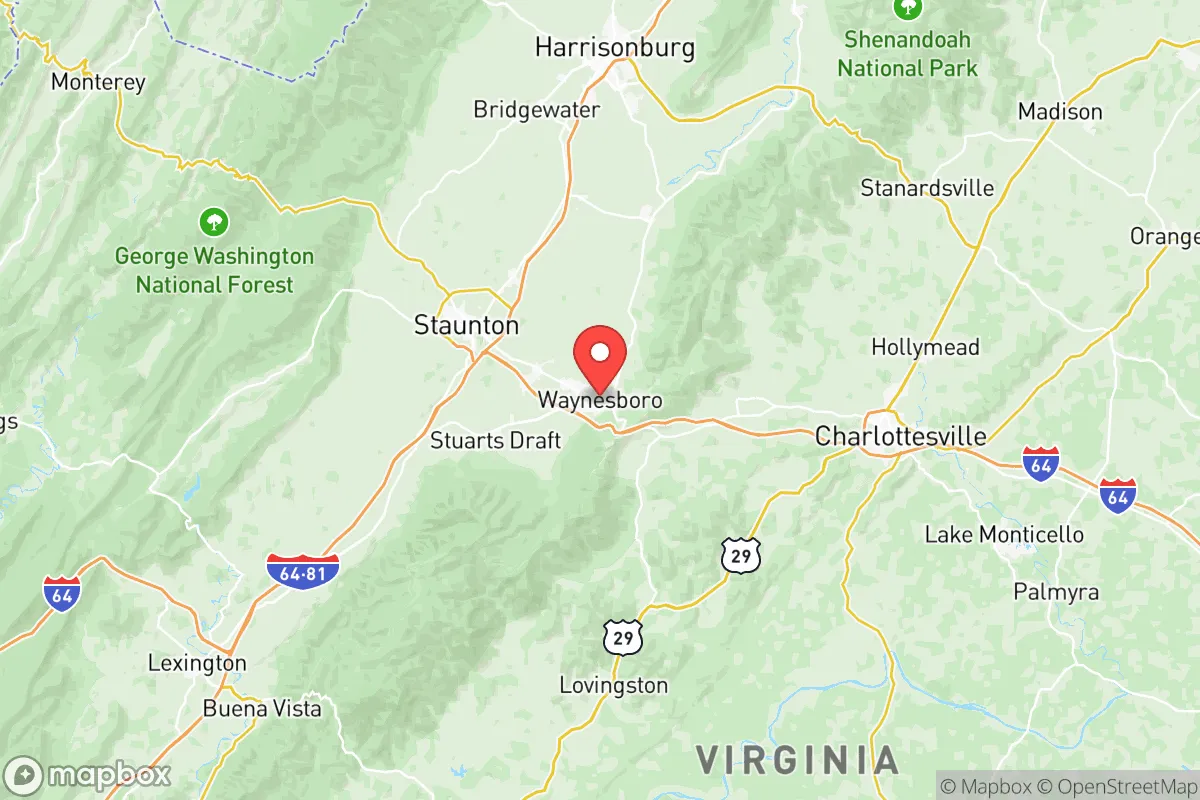
Before European contact, the Waynesboro City County area was part of the homeland of the Monacan people, a Siouan-speaking tribe who lived in the Piedmont and lower Shenandoah region. They were largely displaced by the early 1700s as English, Scots-Irish, and German settlers pushed westward along the Great Wagon Road. The first permanent white settlers, mostly Scots-Irish Presbyterians, arrived in the 1740s, taking up land grants along the South River. They founded the early settlement that became the Waynesboro City Center area, which remained a small crossroads until the arrival of the railroad in the 1850s.
The railroad transformed the economy and brought a second wave: German and English craftsmen and laborers who built the iron forges and mills. These workers concentrated in the Basic City district (annexed into Waynesboro in the 1920s) and along the Huguenot Road corridor. By the early 20th century, the DuPont plant (1919) and later General Electric (1940s) pulled in more workers—largely white Appalachian migrants from the surrounding counties, looking for steady industrial wages. African Americans, who had been in the area since slavery, moved into the county in greater numbers during the Great Migration (1910–1970), seeking factory jobs. They formed a tight community in the Greenville neighborhood, an historic black enclave near the South River. The county also saw a small number of Italian and Polish immigrants who worked in the stone quarries and railroad yards, settling in the East End and Riverwood sections. By 1960, Waynesboro City County was an overwhelmingly white (over 90%), native-born community of around 18,000, with a Black population of roughly 8% and virtually no Hispanic or Asian presence. The Dust Bowl Okies did not reach this far east; instead, the county's growth came from natural increase and in-migration from rural Virginia.
Modern era (post-1965)
The 1965 Hart-Cellar Act had minimal direct effect on Waynesboro City County: the foreign-born share remains tiny at 2.4%, and the few immigrant arrivals have been primarily from Mexico and Central America, drawn by agricultural and service work. These Hispanic residents began arriving in significant numbers during the 1990s and 2000s, often settling in the West Main Corridor and the North Wayne area near the industrial parks. Today, the Hispanic population stands at 9.2%, making it the fastest-growing demographic segment. East/Southeast Asian communities are negligible at 1.8%, with a handful of Vietnamese and Filipino families concentrated in South Wayne and the Huguenot Road District; there is no measurable Indian-subcontinent population. African Americans now make up 11.0% of the county, a slight increase from 1960, with the Greenville neighborhood and the East End remaining their historical anchors. Suburbanization has been limited: the county has seen some spillover from commuters to Staunton and Charlottesville, but most new housing has been built in low-density subdivisions in Basic City and Riverwood. The overall white share has declined from 90%+ to 72.6%, driven partly by an aging Anglo population and partly by Hispanic growth, but the county remains culturally rooted in its Southern working-class traditions.
The future
The population of Waynesboro City County is projected to remain relatively stable, hovering around 22,000–23,000 over the next 20 years. The Hispanic share will likely continue rising—possibly reaching 15–18%—as younger families form and new arrivals come for lower housing costs and jobs in logistics and healthcare. The Black population is expected to hold steady or grow modestly through domestic migration from the Richmond and Hampton Roads areas. The white population will continue aging and slowly decline in percentage. No major influx of East/Southeast Asian or Indian immigrants is anticipated due to the lack of high-skilled employment sectors. The area is not homogenizing into a single melting pot; instead, distinct enclaves—the Hispanic West Main Corridor, the historically Black Greenville, and the broadly white North Wayne and Basic City—will likely persist. In-migration, mostly from other parts of Virginia and the Midwest, is culturally compatible with the existing population and will be absorbed without radical change. The county will remain a quiet, family-oriented community with a traditionalist ethos, gradually becoming more tri-ethnic but not radically diverse.
For someone moving to Waynesboro City County now, the place offers a stable, affordable, and culturally conservative environment where community ties run deep. The demographic trends mean a resilient but slowly diversifying population, with enough change to refresh the local economy without overwhelming the area's historic character. Newcomers should expect to find a welcoming but homogeneous social fabric, where most neighbors have deep generational roots and the main growth demographic is Hispanic families integrating into the local workforce and schools.

* Values derived from national, state, county, city and local statistics and may differ in a specific area. Last updated: 2026-06-01T13:46:42.000Z
Narrative content on this page is AI-generated and may contain mistakes. Verify any details that matter before acting on them.
ReloMaps may earn a commission from affiliate links at no extra cost to you.

