
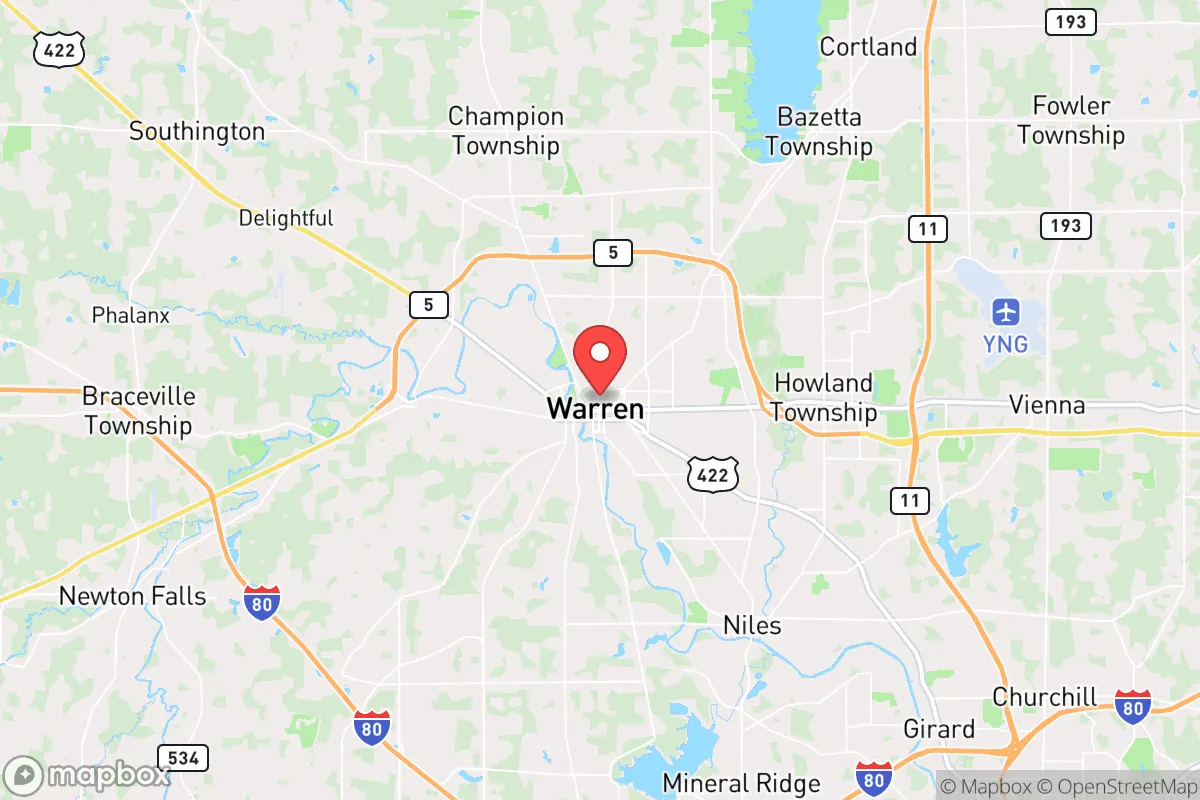
Photo: Wikipedia
Personal Sovereignty in Warren, OH
Viable for self-reliance. Generally workable, though some barriers may limit total independence.
What does Personal Sovereignty tell us?
Personal Sovereignty measures your capacity for self-reliance and independence with minimal government friction. Higher scores mean fewer barriers between you and the way you want to live... but it assumes you have the space you need and good neighbors.
What does this tell us?
Personal Sovereignty measures your capacity for self-reliance and independence with minimal government friction. Higher scores mean fewer barriers between you and the way you want to live... but it assumes you have the space you need and good neighbors.
State Policy
Energy independence: Importer (40% of energy produced in-state)
Personal Liberty
Homesteading

Personal Liberty Analysis
Warren, Ohio, offers a mixed but increasingly favorable environment for personal sovereignty, particularly for those who prioritize self-reliance and minimal government interference. While Ohio is not a libertarian paradise, the state’s legal framework and local culture in Trumbull County provide a solid foundation for individuals and families seeking to live with fewer constraints than in coastal or deep-blue jurisdictions. The key is understanding where Warren’s local ordinances and Ohio’s state laws align with—or diverge from—the principles of autonomy, self-defense, and economic freedom that matter most to a conservative, survivalist-minded audience.
Tax burden and regulatory posture: How Ohio compares to neighboring states
Ohio’s overall tax burden is moderate, ranking near the middle of all states, but Warren residents benefit from a relatively low cost of living and a state income tax that has been gradually reduced. The state’s flat income tax rate is currently around 3.5%, with local income taxes in Warren adding roughly 2%—a combined burden that is manageable compared to high-tax states like New York or California. Property taxes in Trumbull County are also reasonable, with effective rates around 1.5% of assessed value, meaning a $150,000 home would incur about $2,250 annually. Ohio does not tax Social Security benefits, and it offers a modest deduction for retirement income, which is a plus for those planning long-term self-sufficiency. On the regulatory side, Ohio is generally business-friendly, with a right-to-work law (though not a full “right-to-work” state in the strictest sense) and limited occupational licensing compared to the Northeast. However, Warren’s local zoning and building codes can be more restrictive than rural areas, so anyone planning to build a workshop, bunker, or off-grid structure should check with the city’s building department before committing. Overall, the tax and regulatory climate in Warren is better than the national average for personal sovereignty, but not as favorable as states like Texas or Florida—though those states have their own trade-offs in housing costs and climate.
Self-defense and gun law specifics: What Warren residents can and cannot do
Ohio is a “shall issue” state for concealed carry, and since 2022, it has also allowed permitless carry for adults 21 and older who are legally allowed to possess a firearm. This means Warren residents can carry a concealed handgun without a permit, though a permit still offers reciprocity with other states. Ohio does not have a “red flag” law, which is a significant plus for those concerned about government overreach into firearm ownership. The state also has a “stand your ground” law, meaning there is no duty to retreat before using deadly force in self-defense if you are in a place where you have a legal right to be. However, Warren is in Trumbull County, which has a history of higher crime rates than the state average, so the practical need for self-defense is real. Magazine capacity is not restricted, and there is no state-level assault weapons ban, though local ordinances in Warren do not add any additional restrictions. For preppers, this means you can legally stockpile firearms and ammunition without fear of sudden confiscation—provided you comply with federal laws. The only notable limitation is that Ohio prohibits carrying firearms into certain government buildings, schools, and private businesses that post signs, so situational awareness is key. Overall, Warren’s gun laws are among the most permissive in the Midwest, making it a viable location for those who view armed self-defense as a cornerstone of personal sovereignty.
Self-reliance and homesteading viability: Lot sizes, zoning, and off-grid feasibility
Warren itself is an urbanized city with smaller lots, typically ranging from 5,000 to 10,000 square feet in residential zones. This limits large-scale homesteading within city limits, but the surrounding Trumbull County offers more acreage. Unincorporated areas of the county allow lots as small as 1 acre for residential use, while agricultural zones permit parcels of 5 acres or more. Zoning in Warren is fairly standard for a Rust Belt city—no backyard chickens without a permit, and livestock is generally prohibited within city limits. However, just a 15-minute drive outside Warren, in townships like Howland or Bazetta, you’ll find more lenient rules. Off-grid feasibility is mixed: Ohio’s building codes require connection to the electrical grid for new construction, but solar panels are allowed as supplemental power. Rainwater collection is legal without a permit, though it’s limited to non-potable uses like irrigation. Composting toilets are permitted in rural areas with septic systems, but not in city sewer districts. For a serious prepper, the best strategy is to buy land in the county—preferably 5+ acres—where you can build a self-sufficient homestead with a well, septic, and solar backup. Warren’s location in the Mahoning Valley also means abundant water resources and fertile soil, which is a major advantage for gardening and small-scale farming. The main regulatory hurdle is the Ohio EPA’s oversight of septic systems and wells, but these are one-time costs, not ongoing restrictions.
Personal liberties: Parental rights, medical autonomy, speech, and property
Ohio has strong protections for parental rights, including a law that requires schools to notify parents of any medical or mental health services provided to students. Parents have the right to opt their children out of sex education and any curriculum they find objectionable. The state also has a “Parents’ Bill of Rights” that reinforces the primacy of parental authority in education and healthcare decisions. Medical autonomy is more complicated: Ohio has not expanded Medicaid to cover elective procedures like gender transition for minors, and the state has passed laws restricting certain medical interventions for children. However, vaccine mandates are largely absent in the private sector, and there is no state-level requirement for COVID-19 boosters. On speech, Ohio’s laws align with the First Amendment, and Warren has no local ordinances restricting political expression or assembly. Property rights are generally strong, with no statewide rent control and limited eminent domain abuse. The biggest concern for property owners is the city’s nuisance ordinances, which can be used to force cleanup of properties that appear “unkempt”—a potential issue for preppers who store supplies or equipment visibly. Home-based businesses are allowed with a permit, but restrictions on signage and customer traffic apply. Overall, Warren offers a solid baseline for personal liberties, though it’s not as free as rural Idaho or Montana. The key is to stay informed about local ordinances and to engage with the community to protect these rights.
In the broader context of personal sovereignty, Warren, Ohio, sits in a favorable middle ground. It avoids the extreme government overreach seen in states like California or New York, but it doesn’t offer the libertarian-leaning policies of states like New Hampshire or Alaska. For a conservative-leaning individual or family focused on self-reliance, Warren provides a workable environment—especially if you’re willing to live just outside city limits to maximize autonomy. The combination of permissive gun laws, moderate taxes, and strong parental rights makes it a viable relocation option for those who value freedom but need to stay within the Rust Belt for work or family reasons. The trade-offs are manageable: you’ll deal with some local zoning and a state income tax, but you won’t face the kind of regulatory hostility that makes prepping a legal minefield elsewhere. In short, Warren is a place where you can build a sovereign life—if you’re strategic about where you plant your flag.

* Values derived from national, state, county, city and local statistics and may differ in a specific area. Last updated: 2026-04-21T19:38:34.000Z
Narrative content on this page is AI-generated and may contain mistakes. Verify any details that matter before acting on them.
ReloMaps may earn a commission from affiliate links at no extra cost to you.

