 Popular
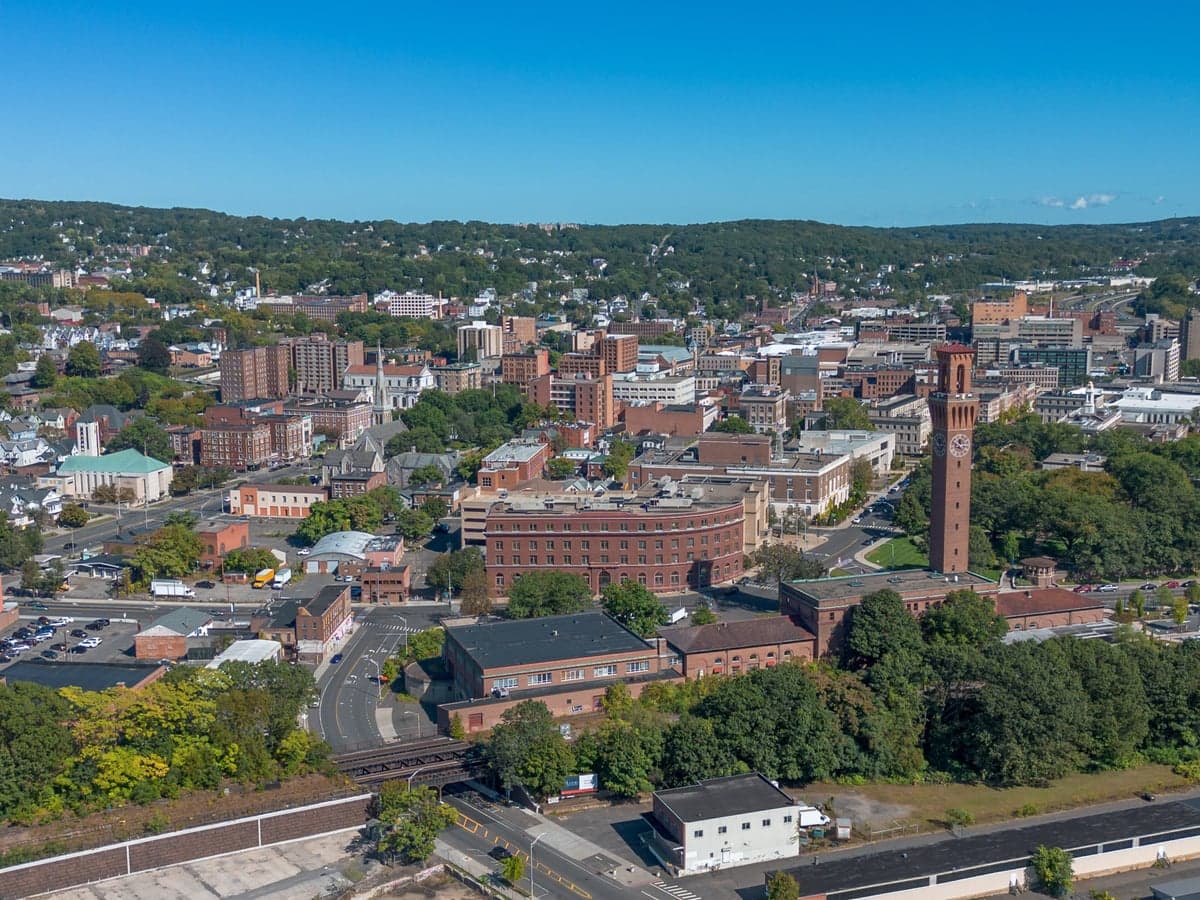
Photo: Wikipedia
Demographics of Waterbury, CT
Affluence Level in Waterbury, CT
A low-income area with significant economic hardship. Household wealth and educational attainment are well below national averages.
People of Waterbury, CT
The people of Waterbury, Connecticut today form a dense, majority-minority urban population of 114,356, characterized by a near-even split between Hispanic (37.5%) and Black (23.7%) residents alongside a shrinking White cohort (30.5%). The city is notably less educated than the state average, with only 17.0% of adults holding a bachelor’s degree, and its foreign-born share of 9.4% is modest for a post-industrial New England city. Distinctive identity markers include a strong working-class ethos rooted in brass and manufacturing, a visible Puerto Rican and Jamaican presence, and a lingering Italian-American cultural footprint in neighborhoods like the North End and Bunker Hill.
How the city was settled and grew
Waterbury’s original population was drawn by water power and brass. Settled in the 1670s as a farming community, the city exploded after the 1800s when the Scovill Manufacturing Company and others turned the Naugatuck River into an industrial engine. Irish immigrants arrived first in the 1840s, digging canals and building the railroad, and settled in the Brooklyn neighborhood (the flatlands south of downtown). They were followed by French Canadians in the 1860s, who clustered in East End around St. Anne’s Church, and then by Italians from southern Italy and Sicily after 1890, who dominated the North End and Bunker Hill hillsides. By 1910, Waterbury was the “Brass City,” and its population peaked at 107,000 in 1930, overwhelmingly White and European-born. Eastern European Jews and a small Black community (mostly railroad workers) also settled near the South End and Downtown during this era.
Modern era (post-1965)
The 1965 Hart-Cellar Act reshaped Waterbury’s population dramatically. The city’s White population, which was over 95% in 1960, began a long decline as manufacturing collapsed and families moved to suburbs like Middlebury and Wolcott. Into this vacuum came two major waves. First, Puerto Ricans began arriving in the 1960s and 1970s, drawn by remaining factory jobs and family networks, settling heavily in the South End and Downtown — areas that today are predominantly Hispanic. Second, Black migration from the American South and later from Jamaica and other Caribbean nations accelerated after 1980, concentrating in the East End and parts of the North End. The city’s Black share rose from roughly 5% in 1970 to 23.7% today. The Asian population remains small (0.6% East/Southeast Asian, 1.8% Indian), with Indian families mostly living in the West End near the Naugatuck Valley Community College corridor. The foreign-born share (9.4%) is lower than in Connecticut’s coastal cities, reflecting Waterbury’s weaker draw for new immigrants compared to Bridgeport or Hartford.
The future
Waterbury’s population is likely to continue its slow decline or stagnation, as out-migration of White and middle-class Black families to surrounding suburbs offsets modest Hispanic growth. The city is not homogenizing; rather, it is tribalizing into distinct enclaves. The South End is solidifying as a Puerto Rican and Dominican hub, while the East End is becoming increasingly Black and Afro-Caribbean. The North End retains a shrinking Italian-American core but is seeing Hispanic inroads. The Indian and Asian communities are small and stable, unlikely to drive major change. The next 10-20 years will likely see Waterbury become a majority-Hispanic city (projected 45-50% by 2040), with a Black population plateauing near 25% and White residents falling below 20%. New immigration will be modest, as the city lacks the job base to attract large numbers of foreign-born residents.
For someone moving in now, Waterbury is becoming a predominantly Hispanic and Black working-class city with a strong sense of neighborhood identity but limited economic mobility. The brass-era ethnic enclaves are giving way to newer ones, and the city’s future depends on whether it can retain its middle class and attract investment to its aging housing stock. It is not a melting pot, but a mosaic of distinct communities — a place where knowing the neighborhood matters as much as knowing the city.

* Values derived from national, state, county, city and local statistics and may differ in a specific area. Last updated: 2026-04-30T00:57:17.000Z
Narrative content on this page is AI-generated and may contain mistakes. Verify any details that matter before acting on them.
ReloMaps may earn a commission from affiliate links at no extra cost to you.

