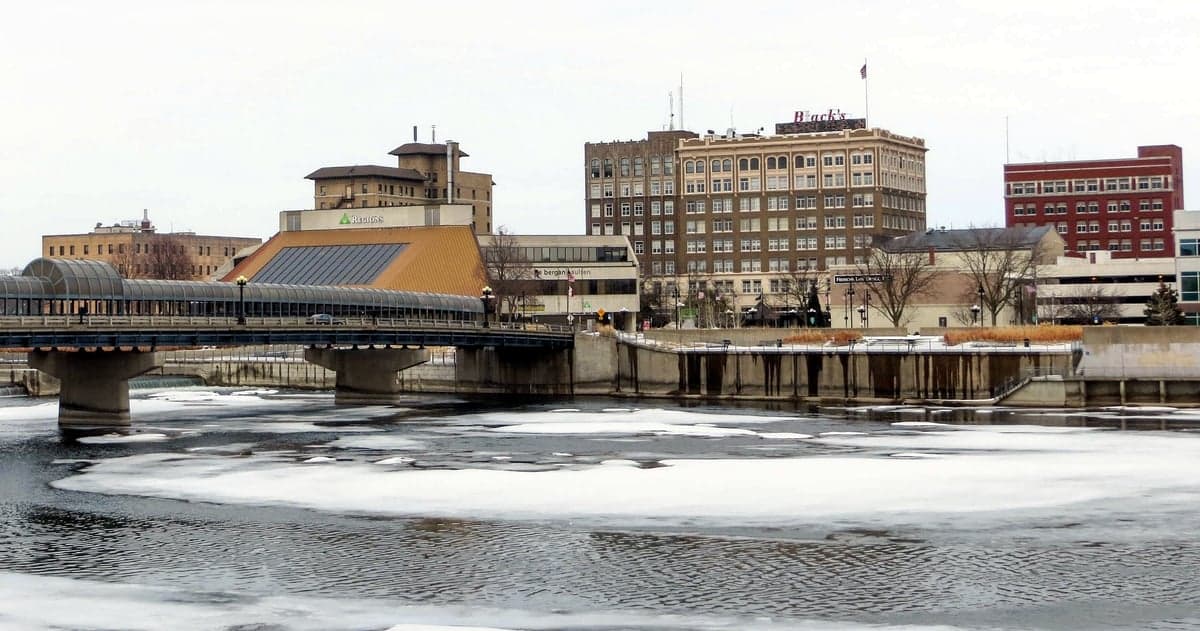
Photo: Wikipedia
Demographics of Waterloo, IA
Affluence Level in Waterloo, IA
A below-average socioeconomic profile. Incomes, home values, and educational attainment trail the U.S., with higher poverty and unemployment.
People of Waterloo, IA
The people of Waterloo, Iowa today form a working-class, racially diverse community of roughly 67,000, anchored by a strong manufacturing and agricultural processing base. The city’s identity is shaped by a 67% white population alongside a significant 17% Black community and a growing 7.6% Hispanic presence, creating a demographic mix that is notably more diverse than much of rural Iowa. With a foreign-born share of just 5.0% and a college attainment rate of 22.6%, Waterloo remains a place where blue-collar roots and family stability define daily life, though population has been slowly declining from a peak of over 75,000 in the 1970s.
How the city was settled and grew
Waterloo was founded in the 1840s along the Cedar River, initially drawing Yankee settlers from New England and upstate New York who were attracted by water power for mills. The real population boom came after the Civil War, when the Illinois Central Railroad established a major repair shop here in the 1860s, turning Waterloo into a railroad town. German and Irish immigrants arrived in large numbers through the 1870s-1890s, settling in the Old Third Ward neighborhood near the downtown rail yards and along the riverfront. By the early 1900s, the John Deere tractor works opened, cementing Waterloo as an industrial powerhouse and drawing a second wave of European immigrants—primarily from Scandinavia and Eastern Europe—who built homes in the Highland Park and East Side districts. The Great Migration brought the first significant Black population during World War I and especially World War II, as southern African Americans moved north for factory jobs at Deere and the Rath Packing Company. These families settled primarily in the West Side neighborhood, which became the historic core of Waterloo’s Black community, centered around the intersection of West 4th Street and Mobile Avenue.
Modern era (post-1965)
The post-1965 period reshaped Waterloo’s population through both domestic and international shifts. The 1965 Hart-Cellar Act opened immigration from Asia and Latin America, but Waterloo’s foreign-born growth remained modest compared to larger Iowa cities. The most notable change was the continued growth of the Black population, which rose from roughly 10% in 1970 to nearly 17% today, driven by ongoing migration from Chicago and the Mississippi Delta region. These families concentrated in the West Side and South Waterloo areas, though some middle-class Black families moved into previously white neighborhoods like Orange Township on the city’s northern edge. The Hispanic population, now 7.6%, began growing in the 1990s as Mexican and Central American workers arrived for jobs in meatpacking and construction, settling in the East Side near the industrial corridor along Highway 218. East/Southeast Asian residents (2.3%) are a smaller but stable presence, primarily Vietnamese and Lao families who arrived as refugees in the 1980s and 1990s, with a cluster near the Lincoln Park area. The Indian subcontinent population remains negligible at 0.3%, mostly professionals employed at the University of Northern Iowa or local hospitals. Suburbanization has been limited—Waterloo’s population has declined by about 11% since 1970, as many white families moved to the growing suburbs of Cedar Falls and Evansdale, leaving the city core more racially concentrated.
The future
Waterloo’s population is trending toward a slow, steady decline, with projections suggesting the city could fall below 65,000 by 2035. The white population is aging and shrinking, while the Black and Hispanic shares are growing modestly through both birth rates and continued migration. The Hispanic community is the fastest-growing segment, likely to reach 10-12% by 2035, and is gradually dispersing from the East Side into other neighborhoods like Highland Park. The Black population is stabilizing rather than expanding rapidly, with younger families increasingly moving to Cedar Falls for better schools. The East/Southeast Asian community is plateauing, as second-generation Vietnamese and Lao residents often leave for larger cities. The city is not tribalizing into distinct enclaves—neighborhoods are becoming more mixed, particularly in the central and eastern districts—but economic segregation is deepening, with the West Side and South Waterloo remaining lower-income while northern areas like Orange Township and Pleasant Valley retain a more middle-class, predominantly white character.
For someone moving to Waterloo now, the city offers a stable, affordable, and genuinely diverse community with strong manufacturing employment, but it is a place that has been slowly shrinking for decades. The population is becoming more Hispanic and more mixed overall, while the white and Black communities are both aging. New arrivals will find a city that values hard work and neighborliness, but one where economic opportunity is increasingly tied to the John Deere plant and healthcare sector, and where population decline means fewer services and a slower pace of life than in growing metro areas.

* Values derived from national, state, county, city and local statistics and may differ in a specific area. Last updated: 2026-04-30T01:32:15.000Z
Narrative content on this page is AI-generated and may contain mistakes. Verify any details that matter before acting on them.
ReloMaps may earn a commission from affiliate links at no extra cost to you.

