
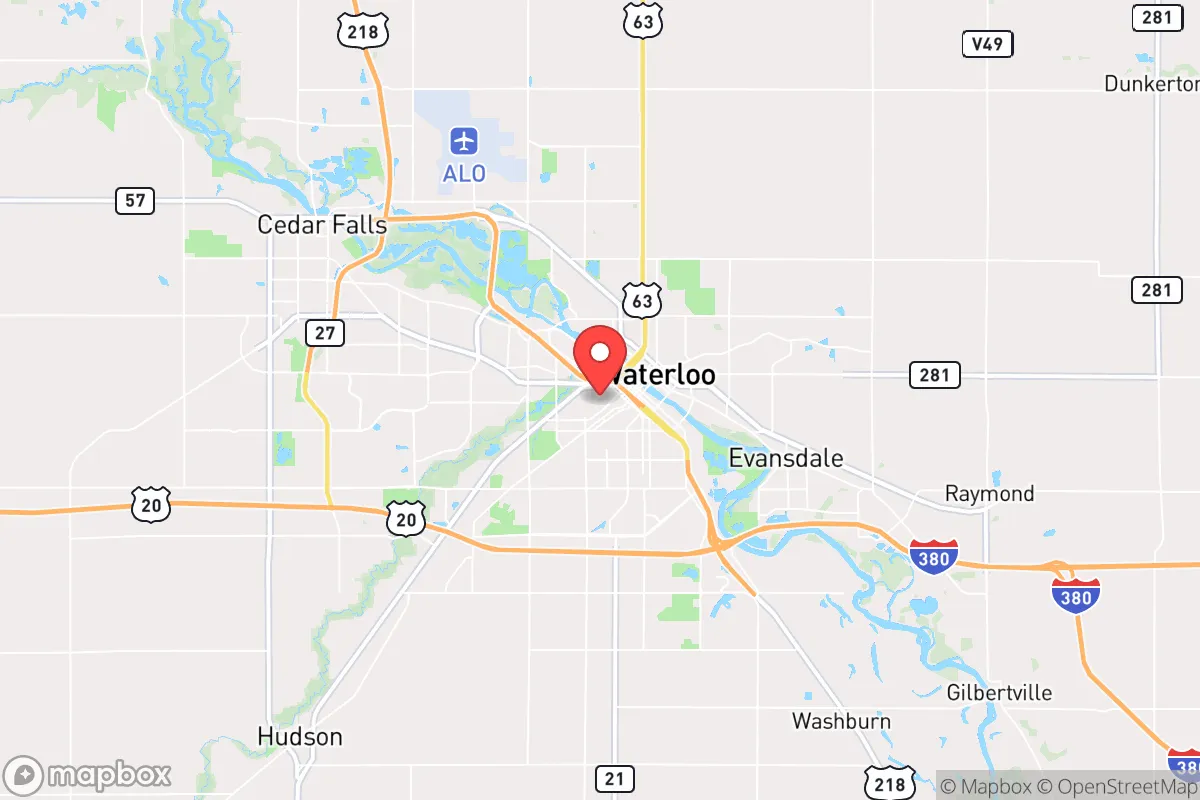
Photo: Wikipedia
Personal Sovereignty in Waterloo, IA
Viable for self-reliance. Generally workable, though some barriers may limit total independence.
What does Personal Sovereignty tell us?
Personal Sovereignty measures your capacity for self-reliance and independence with minimal government friction. Higher scores mean fewer barriers between you and the way you want to live... but it assumes you have the space you need and good neighbors.
What does this tell us?
Personal Sovereignty measures your capacity for self-reliance and independence with minimal government friction. Higher scores mean fewer barriers between you and the way you want to live... but it assumes you have the space you need and good neighbors.
State Policy
Energy independence: Importer (50% of energy produced in-state)
Personal Liberty
Homesteading

Personal Liberty Analysis
Waterloo, Iowa, offers a mixed but generally favorable environment for personal sovereignty, particularly when viewed through a survivalist or prepper lens. The city sits in a state that has historically valued individual rights, but local governance and demographic trends introduce some friction. For those seeking to minimize government overreach and maximize self-reliance, Waterloo provides a workable base—provided you understand where the local leash tightens and where it stays loose. The key is that Iowa’s state-level protections often override city-level impulses, giving residents a buffer against the kind of municipal overreach seen in more progressive enclaves.
Tax burden and regulatory posture: How much the state and city take
Iowa’s tax structure is a net positive for personal sovereignty, though not without its own creeping costs. The state has been phasing down its individual income tax to a flat 3.8% by 2026, which is competitive nationally and leaves more money in your pocket for supplies, land, or savings. Property taxes in Black Hawk County average around 1.5% of assessed value, which is moderate—not as low as some rural counties, but far from the punishing rates of coastal states. Waterloo itself adds a local option sales tax of 1%, bringing the total to 7%, which is reasonable for a city of its size. The regulatory posture is where the real story lies: Iowa has preempted many local ordinances on issues like firearm carry and rental property rules, meaning Waterloo cannot easily impose its own stricter regulations. This state-level preemption is a critical shield for anyone worried about city councils drifting toward control. However, building permits and zoning in Waterloo are standard for a mid-sized Midwestern city—expect inspections and fees, but nothing that would stop a determined homesteader from improving property. The overall tax and regulatory burden here is below the national average, making it a solid choice for those who want to keep more of what they earn and build without excessive red tape.
Self-defense and gun law specifics: What you can carry and where
Iowa is a constitutional carry state, and Waterloo residents benefit directly from that. Since 2021, any law-abiding adult 21 or older can carry a concealed firearm without a permit—no training, no fee, no government permission slip. This is a significant win for personal sovereignty, as it removes a bureaucratic hurdle that many states use to discourage carry. Open carry is also legal without a permit, though local practice in Waterloo leans toward concealed for practical reasons. The state has strong preemption laws, meaning Waterloo cannot pass its own gun bans, magazine limits, or registration schemes—a critical protection against the kind of municipal overreach seen in cities like Chicago or Denver. Stand-your-ground laws are in effect, with no duty to retreat in any place you are lawfully present. For preppers, this means you can defend your home, vehicle, or even a temporary shelter without worrying about a legal obligation to flee first. The only notable restriction is that private sales between individuals do not require a background check, but federal law still applies to dealers. For those building a survival armory, Iowa’s laws are among the most permissive in the Midwest, and Waterloo’s local government has little room to infringe on that. The practical takeaway: you can carry, store, and train with firearms here with minimal government interference, which is a cornerstone of personal sovereignty in uncertain times.
Self-reliance and homesteading viability: Lot sizes, zoning, and off-grid feasibility
Waterloo’s urban core is not a homesteader’s paradise, but the surrounding areas offer real potential for self-reliance. Within city limits, standard residential lots range from 6,000 to 10,000 square feet, which is enough for a substantial garden, a few chickens, and possibly a small greenhouse. Zoning allows for backyard chickens in most residential districts, though roosters are typically prohibited. The city does have building codes that require connection to municipal water and sewer in most areas, which limits true off-grid living within the city proper. However, Black Hawk County’s rural zoning is much more permissive. Just a 10- to 15-minute drive outside Waterloo, you can find parcels of 1 to 5 acres for $10,000 to $30,000, with fewer restrictions on rainwater collection, composting toilets, and alternative energy. The county does not have a blanket ban on off-grid systems, though you will need to navigate well and septic permits—which are standard but not prohibitive. For preppers, the sweet spot is buying land just outside the city limits, where you can build a self-sufficient setup while still having quick access to Waterloo’s hardware stores, medical facilities, and supply chains. The climate is a factor: growing season runs about 150 days, and the soil is fertile black dirt, ideal for food production. Winters are harsh, but that also means lower population pressure and less competition for resources. Overall, Waterloo offers a viable path to semi-self-reliance, especially if you are willing to drive a few miles for true homesteading freedom.
Personal liberties: Parental rights, medical autonomy, speech, and property
Iowa has been a battleground for personal liberties, and the current trajectory is favorable for those prioritizing parental rights and medical autonomy. The state passed a law in 2023 banning gender transition procedures for minors, which aligns with a conservative view of parental authority—parents retain the right to make medical decisions for their children within traditional bounds. School choice is strong, with Education Savings Accounts available to all Iowa families, allowing you to direct tax dollars to private or homeschool options. This is a direct check on government-run education and a win for parental sovereignty. On medical autonomy, Iowa does not have a state-level vaccine mandate, and COVID-era restrictions were lifted early compared to many states. However, the state does require certain immunizations for school attendance, with medical and religious exemptions available. For those concerned about medical privacy, Iowa’s health records laws are standard, but there is no specific shield law for alternative treatments. Free speech is protected under the Iowa Constitution, which the state supreme court has interpreted broadly, and there are no local hate speech ordinances in Waterloo that would chill political or religious expression. Property rights are strong: Iowa has no statewide rent control, and eminent domain is limited to public projects with fair compensation. Waterloo does have a rental inspection program, but for owner-occupied properties, you have wide latitude to use your land as you see fit, within zoning bounds. The overall picture is that Iowa, and Waterloo by extension, respects personal liberties more than most states, particularly in the realms of parenting, education, and speech.
In the broader landscape of American personal sovereignty, Waterloo, Iowa, sits in a solidly above-average position. It is not a libertarian utopia—you still have to deal with property taxes, building permits, and the occasional city ordinance—but the state-level framework provides strong protections against the kind of creeping government overreach that plagues many other regions. For a single individual or parent with a prepper mindset, the combination of constitutional carry, low taxes, school choice, and accessible rural land makes Waterloo a strategic relocation option. The city itself is not the draw; the state’s legal environment and the affordability of nearby acreage are. If you are looking for a place where you can keep your options open, defend your family, and build a self-reliant life without constant government interference, Waterloo deserves a serious look—just be prepared to drive a few miles outside city limits for the full sovereignty package.

* Values derived from national, state, county, city and local statistics and may differ in a specific area. Last updated: 2026-04-30T01:32:15.000Z
Narrative content on this page is AI-generated and may contain mistakes. Verify any details that matter before acting on them.
ReloMaps may earn a commission from affiliate links at no extra cost to you.

