Photo: Wikipedia
Political ClimatePolitical Climate in Waukee, IA
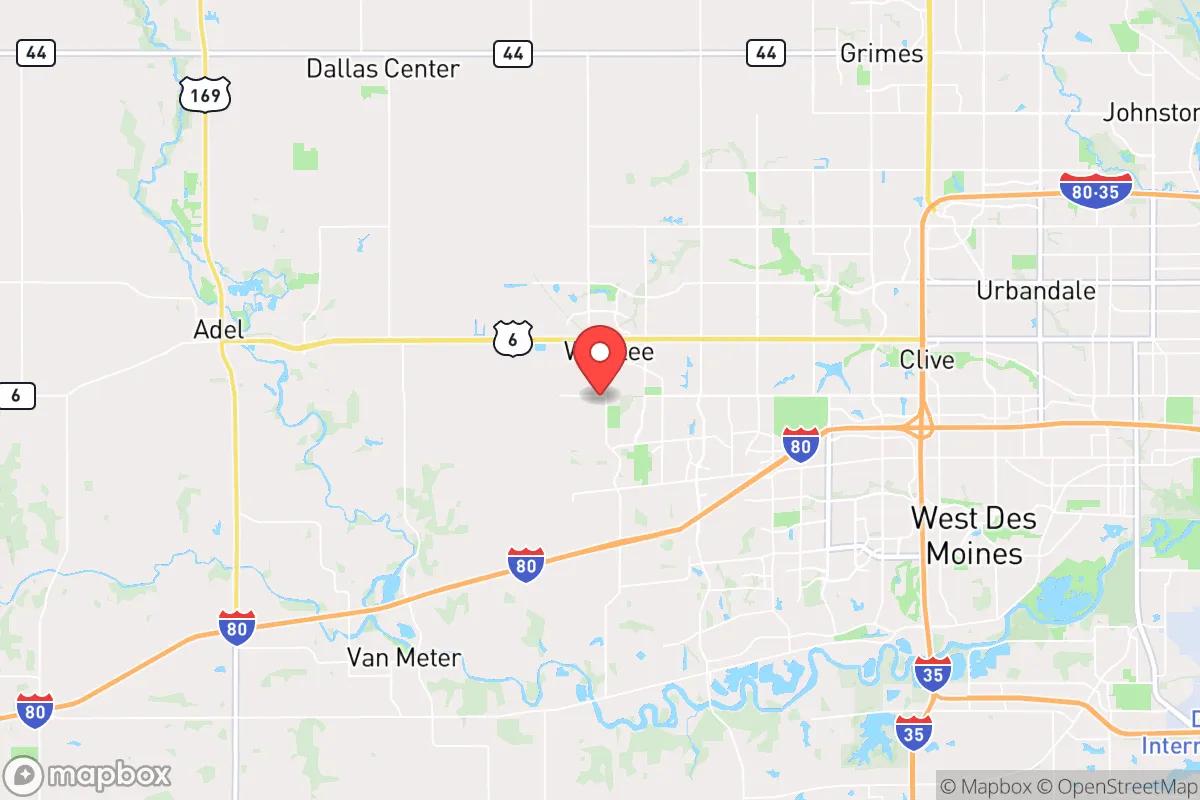
District shown is the primary district for this city’s centroid. Cities may span multiple districts.
Local Political AnalysisPolitical Analysis of Waukee, IA
Waukee has long been a solidly conservative community, but like much of the Dallas County suburbs, it's been drifting toward the center in recent years. The Cook PVI of R+2 tells the story—this isn't the deep-red stronghold it was a decade ago, when you could count on a 15-point Republican margin in most races. The rapid influx of new residents from blue states, especially around the new Kettlestone and Shops at Prairie Trail developments, has nudged the political needle. You still see plenty of Trump signs in the older neighborhoods south of Hickman Road, but the newer subdivisions west of Alice's Road are starting to look more like a purple patchwork.
How it compares
Drive ten miles east into West Des Moines, and you'll hit a noticeably more liberal vibe—especially around the Valley Junction area and the western suburbs near Jordan Creek. West Des Moines has a Cook PVI of D+1, and its city council has openly embraced progressive zoning policies and diversity initiatives that would never fly in Waukee. Head north to Adel, and you're back in deep-red territory (R+12), where the county supervisors still push back hard on state mandates. Waukee sits right in the middle—conservative enough that the school board still fights curriculum battles, but liberal enough that you'll see a few "In This House We Believe" signs mixed in with the "Don't Tread on Me" flags. The contrast is starkest at the ballot box: in 2020, Waukee precincts went for Trump by about 8 points, while neighboring Clive precincts were essentially tied.
What this means for residents
For those of us who moved here to escape the overreach we saw in larger cities, the shift is concerning. The city council has started floating proposals for more stringent rental inspections and a "complete streets" plan that could dictate how you use your own driveway. The school board, once reliably conservative, now has a 4-3 split that's led to debates over library book policies and whether to adopt the state's new social studies standards. Property taxes have climbed 22% since 2020, partly to fund the new public safety building and the aquatic center—projects that sound nice but feel like the thin edge of the wedge for more government control. The real worry is that as Waukee grows, the old hands-off ethos gets replaced by the same kind of regulatory creep that drove people out of Des Moines in the first place.
On the cultural front, Waukee still holds the line in some important ways. The city's annual Fourth of July parade remains proudly patriotic, with veterans leading the march and no political litmus tests for floats. The local Chamber of Commerce leans heavily pro-business, and you won't find any of the "sanctuary city" nonsense that's popped up in Iowa City or Ames. But the long-term trajectory is what keeps me up at night. If the current growth pattern holds—another 10,000 residents by 2030, mostly from out of state—Waukee could easily flip to a D+1 or D+2 PVI within a decade. That would mean more ordinances, more fees, more telling you what you can do with your own property. For now, it's still a place where you can keep to yourself and live free, but the window is closing faster than most folks realize.

State Political ClimatePolitical Climate in Iowa
State Political AnalysisPolitical Environment in the State
Iowa has long been a reliably Republican state in presidential elections, but its political landscape is more nuanced than a simple red-state label suggests. The state voted for Donald Trump by 8 points in 2020 and 13 points in 2024, a significant rightward shift from 2012 when it was a true swing state (Obama won it by 6 points). Over the past 15 years, the GOP has consolidated control at the state level, holding the governorship, both U.S. Senate seats, and supermajorities in the state legislature. However, the state’s political identity is shaped by a sharp urban-rural divide, with Democratic strongholds in a few metro areas and deep-red dominance everywhere else.
Urban vs. rural divide
The political map of Iowa is a study in contrasts. The state’s two largest metros—Des Moines and Iowa City—are the primary engines of Democratic votes. Polk County (Des Moines) has trended blue, voting for Biden by 18 points in 2020 and Harris by 16 points in 2024. Johnson County (Iowa City), home to the University of Iowa, is the state’s most liberal enclave, consistently delivering 70%+ margins for Democrats. In contrast, the rest of the state is overwhelmingly Republican. Rural counties like Sioux, Lyon, and Plymouth in northwest Iowa routinely vote 75-80% Republican. The suburbs around Des Moines, such as Ankeny and Waukee, have become competitive battlegrounds—Ankeny voted for Trump by just 2 points in 2024, while Waukee flipped from Trump in 2020 to Harris in 2024 by a razor-thin margin. The Cedar Rapids metro (Linn County) is a Democratic-leaning area, but surrounding Benton and Jones counties are deep red. The state’s third-largest city, Davenport (Scott County), is a true swing area—it voted for Trump by 2 points in 2024 after backing Biden by 4 points in 2020.
Policy environment
Iowa’s policy environment under Republican control has been aggressively conservative. The state enacted a flat income tax of 3.8% in 2023, down from a top rate of 8.53% in 2018, with a path to a 3.5% flat rate by 2026. Property taxes are relatively low, with a statewide average effective rate of 1.29%. The state has no inheritance or estate tax. On education, Iowa passed a universal school choice program in 2023 (HF 68), allowing any family to use state funds for private school tuition—a major win for parental rights. The state also banned teaching of critical race theory and gender identity in K-12 classrooms (HF 802, 2021). Healthcare policy has been mixed: Iowa expanded Medicaid under the Affordable Care Act, but the state has not adopted a state-based exchange and has limited abortion access to 6 weeks (the “fetal heartbeat” law, SF 359, signed in 2023). Election laws were tightened in 2021 (SF 413), reducing early voting days from 29 to 20, requiring absentee ballot applications to be returned by mail, and banning drop boxes. Voter ID is required. The state also passed a constitutional amendment in 2022 affirming that the Iowa Constitution does not protect a right to abortion.
Trajectory & freedom
Iowa is moving decisively toward greater personal freedom in several key areas, but with some concerning trends. On gun rights, the state enacted permitless carry (SF 2379) in 2021, allowing any law-abiding adult to carry a concealed firearm without a permit—a strong expansion of Second Amendment rights. On parental rights, the 2023 school choice law and the 2021 ban on gender identity instruction in schools represent significant wins for family autonomy. However, the state has also seen government overreach in other areas. The 2023 law banning most abortions after 6 weeks (SF 359) was a major restriction on medical freedom, though it aligns with the state’s conservative values. On property rights, Iowa has not passed any significant eminent domain reform, and local zoning laws remain restrictive in some metro areas. The state’s tax cuts are a clear move toward economic freedom, but the flat tax still leaves room for future reductions. The biggest red flag for liberty-minded residents is the state’s increasing reliance on federal funds—Iowa receives about 35% of its state budget from the federal government, which could create vulnerabilities if federal policy shifts leftward.
Civil unrest & political movements
Iowa has seen relatively little civil unrest compared to coastal states, but there have been notable flashpoints. The 2020 Black Lives Matter protests in Des Moines and Iowa City were largely peaceful, though there were isolated incidents of property damage. The state’s agricultural economy has fueled a strong populist conservative movement, with groups like the Iowa Firearms Coalition and the Family Leader wielding significant influence in Republican primaries. Immigration politics have been a hot-button issue: in 2024, Governor Kim Reynolds deployed the Iowa National Guard to the Texas border, and the state passed a law (HF 2642) making it a crime for someone previously deported to re-enter Iowa—a direct challenge to federal authority. Election integrity remains a live issue: the 2021 voting law (SF 413) was framed as a response to concerns about absentee ballot fraud, though critics argue it suppresses turnout. There have been no major secession or nullification movements, but the state’s Republican leadership has increasingly asserted state sovereignty, particularly on immigration and gun rights. A new resident would notice the strong presence of conservative activism at county fairs, school board meetings, and local party events—politics here is personal and community-driven.
Projection
Over the next 5-10 years, Iowa is likely to become more Republican and more culturally conservative. The state’s population is aging and predominantly white, with limited in-migration from blue states compared to Texas or Florida. The Des Moines metro is growing, but its suburbs are trending rightward as young families move in from rural areas. The Democratic base is shrinking as rural counties lose population and the University of Iowa’s student body becomes less politically active post-graduation. The state’s flat tax and school choice policies will likely attract some conservative migrants, but the cold winters and lack of major coastal amenities limit the appeal. The biggest wildcard is the agricultural economy: if commodity prices stay strong, rural areas will remain solidly red; a downturn could fuel populist backlash against both parties. Expect the state to continue passing legislation on parental rights, gun rights, and tax cuts, but also to face increasing pressure from federal mandates on Medicaid and education. A new resident moving in now should expect to find a state that is reliably conservative, with a strong sense of local community and limited political drama, but also one that is increasingly homogeneous and resistant to cultural change.
For a conservative-leaning individual or family considering relocation, Iowa offers a stable, low-tax environment with strong protections for parental rights and gun ownership. The political climate is predictable and aligned with traditional values, but the state’s lack of demographic diversity and limited economic dynamism mean it may not offer the same opportunities for growth as faster-growing Sun Belt states. The bottom line: Iowa is a safe bet for someone who values stability, community, and conservative governance, but it’s not a place for those seeking rapid change or cultural vibrancy. If you’re looking for a state where your vote counts and your values are reflected in law, Iowa delivers—just don’t expect the weather or the economy to match the politics.
* Values derived from national, state, county, city and local statistics and may differ in a specific area. Last updated: 2026-10-10T16:29:20.000Z
Narrative content on this page is AI-generated and may contain mistakes. Verify any details that matter before acting on them.
ReloMaps may earn a commission from affiliate links at no extra cost to you.

