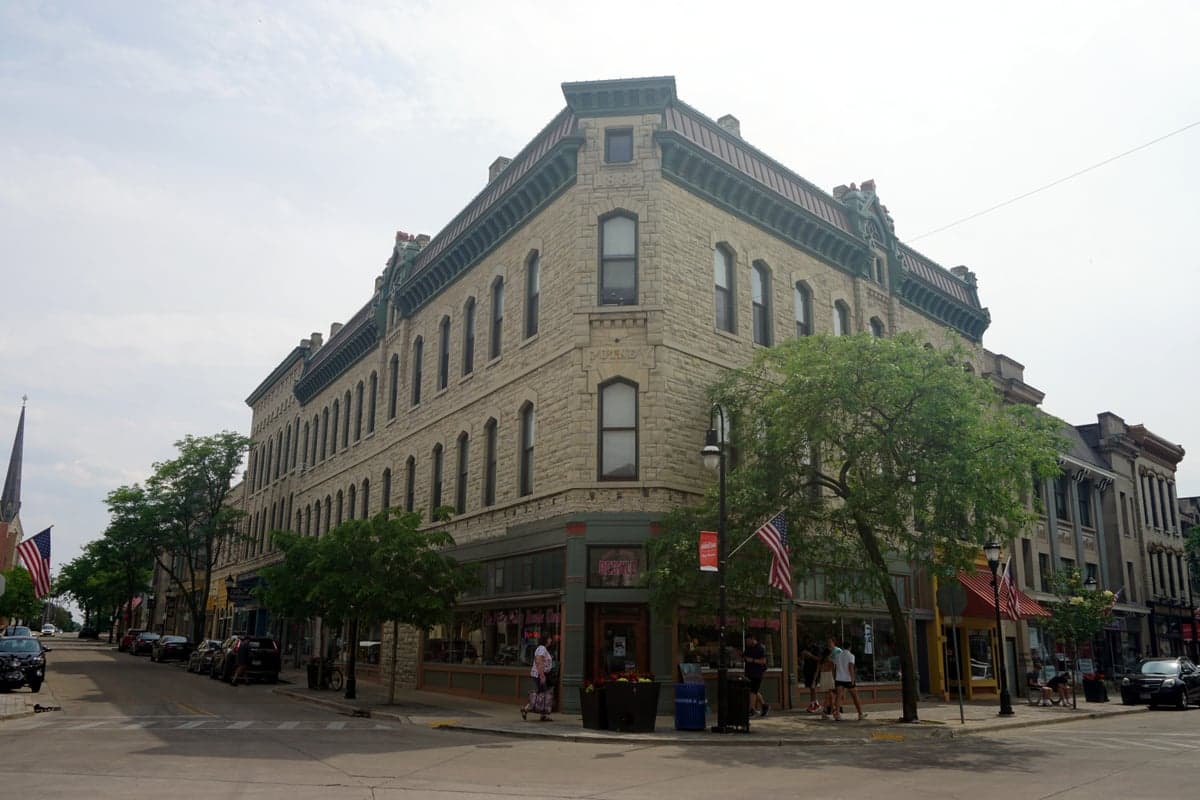
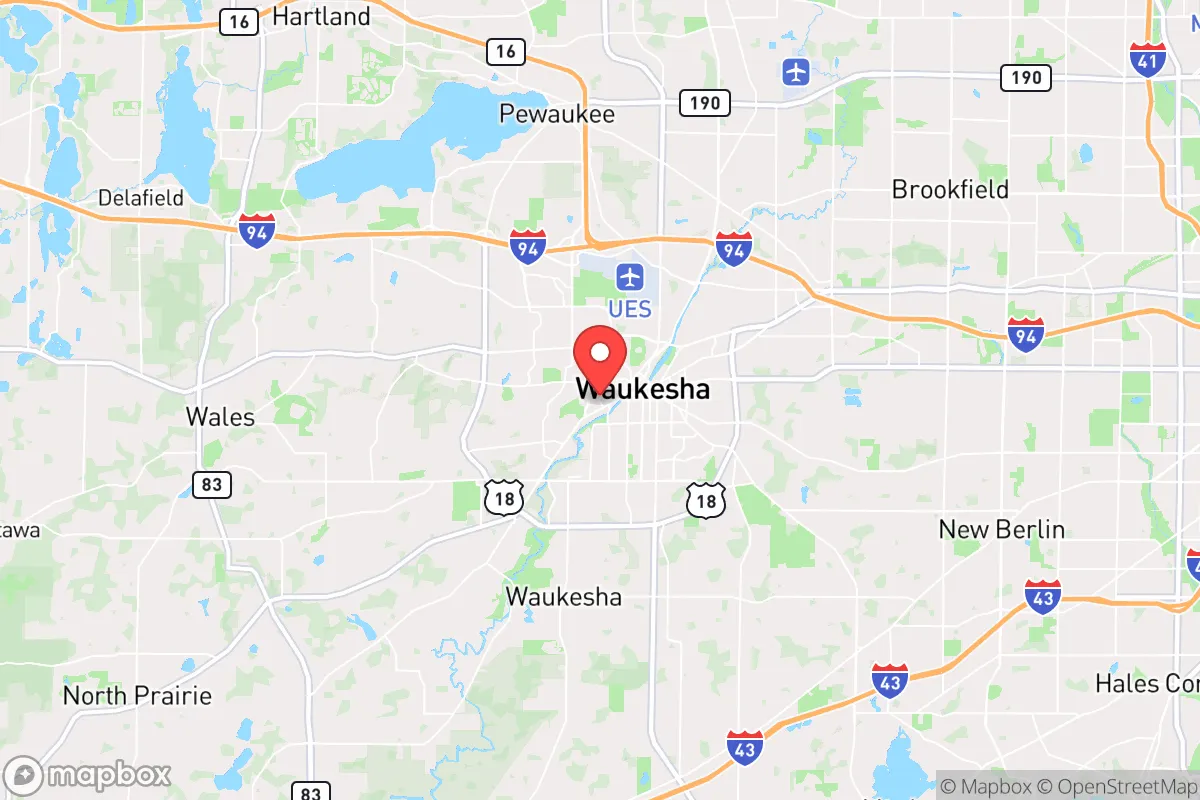
Photo: Wikipedia
Demographics of Waukesha, WI
Affluence Level in Waukesha, WI
A middle-class area roughly in line with national averages across income, home values, education, and employment.
People of Waukesha, WI
The people of Waukesha, Wisconsin today number 70,779, forming a predominantly white (78.3%) and politically conservative community with a growing Hispanic minority (12.2%) and a modest but rising East/Southeast Asian presence (1.4%). The city is denser and more diverse than its surrounding Waukesha County suburbs, yet retains a distinctly Midwestern, family-oriented character shaped by German and Irish Catholic roots. College attainment sits at 40.7%, above the national average, reflecting a professional-class tilt among newer arrivals. The foreign-born share is low at 3.8%, meaning most residents are native-born, and the city’s identity remains rooted in its historic role as a manufacturing and railroad hub rather than a magnet for international migration.
How the city was settled and grew
Waukesha’s population history begins with the Potawatomi and Menominee peoples, who ceded the land in the 1830s treaties. Yankee settlers from New England and New York arrived first, founding the village of Prairie Village (later renamed Waukesha) in 1834 along the Fox River. The real population surge came with German and Irish immigrants in the 1840s–1860s, drawn by the area’s fertile farmland and the construction of the Milwaukee & Mississippi Railroad (1851). These groups built the core of what is now Downtown Waukesha, establishing churches, breweries, and small factories. A second wave of German Lutherans and Polish Catholics arrived in the 1880s–1900s, settling in the East Side neighborhood near the railroad yards and the West Side around the spring-fed parks that made Waukesha a health resort destination (the “Spring City” era, 1870–1910). By 1900, the population had reached roughly 7,000, overwhelmingly white and European-born. The city’s industrial base—foundries, machine shops, and the Waukesha Motor Company (founded 1906)—anchored a stable working-class population through the mid-20th century, with neighborhoods like Lower Lincoln Avenue and Northview housing second- and third-generation German and Polish families.
Modern era (post-1965)
The post-1965 period reshaped Waukesha’s population through suburbanization and domestic in-migration rather than foreign immigration. The 1965 Hart-Cellar Act had limited local impact because the city’s industrial economy did not attract the large-scale refugee or labor flows seen in Milwaukee. Instead, Waukesha grew by absorbing white families leaving Milwaukee during the 1970s–1990s white flight, settling in newer subdivisions like Meadowbrook and Summit Avenue on the city’s west and north edges. This domestic in-migration reinforced the city’s conservative political character and kept the foreign-born share low (3.8% today). The Hispanic population began rising in the 1990s, driven by Mexican-origin workers in construction, landscaping, and food processing; they concentrated in the South Side near the Fox River and along Grandview Boulevard, where a small but visible Latino commercial corridor emerged. The East/Southeast Asian population (1.4%) is newer, largely tied to professional hires at Waukesha-based firms like GE Healthcare and Generac, and clusters in the Sunset Drive corridor near the Waukesha County Technical College. The Indian-subcontinent population (1.0%) is similarly professional and dispersed, with no single ethnic enclave. The Black population (3.2%) remains small and is concentrated in the Downtown and East Side rental stock, reflecting limited housing integration.
The future
Waukesha’s population is projected to grow slowly, reaching roughly 75,000–78,000 by 2040, driven by domestic in-migration from higher-cost parts of the Chicago-Milwaukee corridor rather than international immigration. The Hispanic share is likely to rise to 15–18% as younger families age into the school system and as the South Side corridor matures, but the city shows no signs of forming a large immigrant gateway. The white share will continue declining gradually, from 78.3% toward the low 70s, as older white residents age out and are replaced by a more diverse mix of younger professionals. The East/Southeast Asian and Indian populations will grow modestly, tied to the health-care and engineering sectors, but will remain small and geographically dispersed. The city is not tribalizing into distinct ethnic enclaves; instead, it is slowly homogenizing into a broader, moderately diverse suburban middle class. For a conservative-leaning mover, this means a stable, low-crime environment with a solid tax base and good schools, but with a gradually more diverse population that reflects regional trends rather than radical change.
Waukesha is becoming a whiter, more professional, and slightly more Hispanic version of its former self—a stable, family-oriented city where demographic change is slow and incremental, not disruptive. For someone moving in now, the city offers a predictable, low-immigration environment with strong schools and a conservative civic culture, but with enough diversity to avoid the insularity of smaller exurbs.

* Values derived from national, state, county, city and local statistics and may differ in a specific area. Last updated: 2026-04-21T10:22:50.000Z
Narrative content on this page is AI-generated and may contain mistakes. Verify any details that matter before acting on them.
ReloMaps may earn a commission from affiliate links at no extra cost to you.

