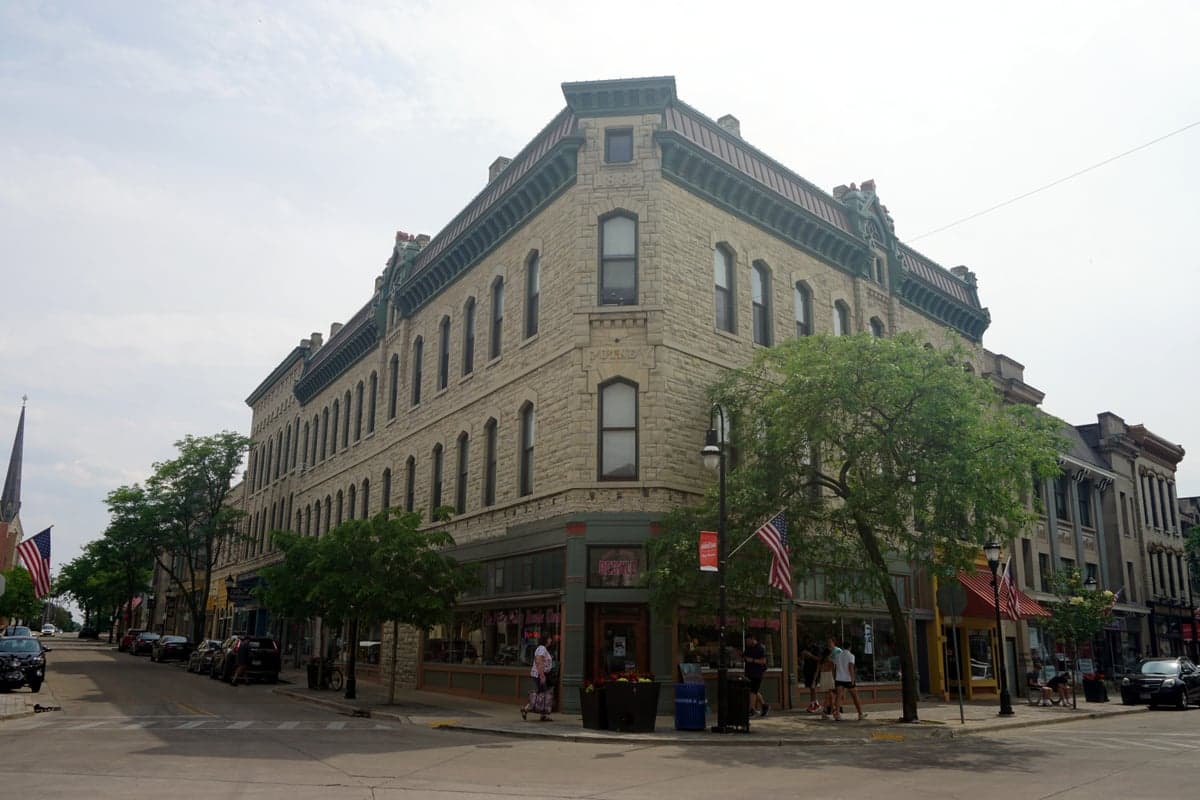
Photo: Wikipedia
Personal Sovereignty in Waukesha, WI
Moderate friction. Expect trade-offs in some aspect of personal liberty and independence.
What does Personal Sovereignty tell us?
Personal Sovereignty measures your capacity for self-reliance and independence with minimal government friction. Higher scores mean fewer barriers between you and the way you want to live... but it assumes you have the space you need and good neighbors.
What does this tell us?
Personal Sovereignty measures your capacity for self-reliance and independence with minimal government friction. Higher scores mean fewer barriers between you and the way you want to live... but it assumes you have the space you need and good neighbors.
State Policy
Energy independence: Importer (15% of energy produced in-state)
Personal Liberty
Homesteading

Personal Liberty Analysis
Waukesha, Wisconsin, offers a notably high degree of personal sovereignty compared to many Midwestern suburbs, largely due to the state’s preemption laws that limit local government overreach and a cultural ethos that prizes self-reliance. For the individual or family operating from a survivalist or prepper mindset, the key question is not whether the government will leave you alone—it’s how much friction you’re willing to accept in exchange for access to Milwaukee’s job market and amenities. The balance here leans toward freedom, but with specific, actionable caveats around zoning, taxation, and emergency preparedness that any strategic relocation must account for.
Tax burden and regulatory posture in Waukesha County
Wisconsin’s state-level tax structure is a mixed bag for the sovereignty-minded. The state imposes a progressive income tax with rates from 3.54% to 7.65%, which is higher than flat-tax states like Illinois or Indiana, but the burden is partially offset by relatively low property taxes in Waukesha County—around 1.7% of assessed value, compared to Milwaukee County’s 2.2%+. More critically, Wisconsin is a Dillon’s Rule state, meaning local governments only have powers expressly granted by the state. This has historically limited Waukesha’s ability to enact its own gun bans, rental restrictions, or energy mandates. The city itself maintains a moderate regulatory posture: no citywide plastic bag ban, no rent control, and no local paid-leave mandates. For the prepper, the absence of a local stormwater utility fee or carbon tax is a small but meaningful win. However, the state’s sales tax is 5% (plus 0.5% county), and vehicle registration fees are $85/year—neither oppressive, but not negligible. The real sovereignty cost is the income tax; a family earning $100,000 pays roughly $5,500 in state income tax, which funds programs many conservatives view as overreach. If you can structure your income as pass-through or relocate to a no-income-tax state like Tennessee or Florida, Waukesha’s appeal diminishes. For those staying, the trade-off is access to a robust local economy and low crime.
Self-defense and gun law specifics in Waukesha
Wisconsin is a shall-issue state for concealed carry, and Waukesha County’s sheriff’s office processes permits efficiently—typically within 30 days. There is no state-level assault weapons ban, no magazine capacity limit, and no universal background check law beyond federal requirements. Waukesha itself has no local ordinances restricting firearm possession beyond state law, meaning you can carry openly or concealed without a permit (permitless carry for residents 18+ took effect in 2023). The city does not maintain a gun registry or require safe storage. For the prepper, this is a strong environment: you can stockpile ammunition, build a defensive arsenal, and train on private property without bureaucratic interference. The one notable restriction is the state’s 48-hour waiting period for handgun purchases (enacted 2023), which applies to all dealers. Private sales between individuals remain unregulated. Stand-your-ground laws apply, and there is no duty to retreat in any place you have a legal right to be. Castle doctrine is strong. For those concerned about government overreach, Waukesha’s gun culture is a clear asset—local ranges like the Waukesha County Sportsman’s Club offer tactical training, and the county’s 2A sanctuary resolution (passed 2021) signals local resistance to federal encroachment.
Self-reliance and homesteading viability in Waukesha
Waukesha’s zoning code is the primary obstacle for serious homesteading. The city’s standard residential lots are 0.25 to 0.5 acres, with strict prohibitions on livestock (chickens are allowed only with a permit and limited to 4 hens, no roosters). Beekeeping is permitted but requires registration. For off-grid feasibility, the city requires connection to municipal water and sewer—no private wells or septic systems are allowed within city limits. Rainwater collection is legal but limited to 2,500 gallons per property. Solar panels are permitted but must meet HOA aesthetic guidelines in many subdivisions. The real opportunity lies in unincorporated Waukesha County, where lot sizes of 2-5 acres are common, and zoning is far more permissive. Towns like Genesee, Ottawa, or Summit allow chickens, goats, and even small-scale agriculture without permits. Off-grid solar is legal, though net metering rules (1:1 credit) make grid-tied systems more economical. For the prepper seeking true self-reliance, the city itself is a compromise; the county’s rural townships are where you can build a defensible property with a well, septic, and food production. The trade-off is commute time—20-30 minutes to downtown Waukesha, 40 to Milwaukee. Emergency preparedness infrastructure is solid: the county has a well-funded emergency management office, and the city’s water supply comes from deep aquifers (not Lake Michigan), reducing vulnerability to regional disruptions.
Personal liberties in Waukesha: parental rights, medical autonomy, speech, and property
Parental rights are strong in Wisconsin. The state’s Parental Bill of Rights (2023) explicitly affirms parents’ authority over medical decisions, education, and religious upbringing. Waukesha School District has been a flashpoint for curriculum battles, but the district’s current policy allows parents to opt children out of any sex education or controversial content without penalty. Homeschooling is deregulated: no notification required, no standardized testing, no curriculum approval. For medical autonomy, Wisconsin is a right-to-conscience state for healthcare workers, and there is no state vaccine mandate for adults. COVID-era mandates were largely local; Waukesha County never imposed a mask mandate, and the city’s emergency orders were minimal. For the prepper concerned about medical freedom, the key is that Wisconsin does not have a state-run health insurance exchange that penalizes alternative treatments—though insurance companies may still deny coverage for off-label or experimental therapies. Speech protections are robust: Wisconsin has no hate speech law that criminalizes protected speech, and Waukesha has no local noise ordinances that restrict political or religious expression beyond reasonable time/place/manner restrictions. Property rights are strong under state law, but local zoning can be restrictive. The city does not have rent control, and there are no local ordinances limiting short-term rentals (Airbnb) beyond standard business licensing. For the sovereignty-minded, the biggest property concern is the state’s use of eminent domain for private development, which has been challenged but upheld in Wisconsin courts. Overall, Waukesha offers a high degree of personal liberty relative to coastal suburbs, but it is not a libertarian paradise—state income tax and zoning remain the primary friction points.
For the strategic relocator prioritizing personal sovereignty, Waukesha presents a solid B+ environment—strong on guns, parental rights, and speech, but burdened by a progressive state income tax and city zoning that limits self-reliance. Compared to Milwaukee County, it is a clear upgrade; compared to rural Wisconsin counties like Price or Rusk, it trades lower taxes and more land for better infrastructure and job access. The optimal play for the prepper is to locate in unincorporated Waukesha County on 2+ acres, commute to the city for work, and leverage the county’s 2A sanctuary status and low crime. The state-level risks—potential future income tax hikes, climate mandates, or federal overreach—are real but manageable with proper legal structuring. In a world of increasing government encroachment, Waukesha remains a defensible redoubt, not a fortress.

* Values derived from national, state, county, city and local statistics and may differ in a specific area. Last updated: 2026-04-21T10:22:50.000Z
Narrative content on this page is AI-generated and may contain mistakes. Verify any details that matter before acting on them.
ReloMaps may earn a commission from affiliate links at no extra cost to you.

