
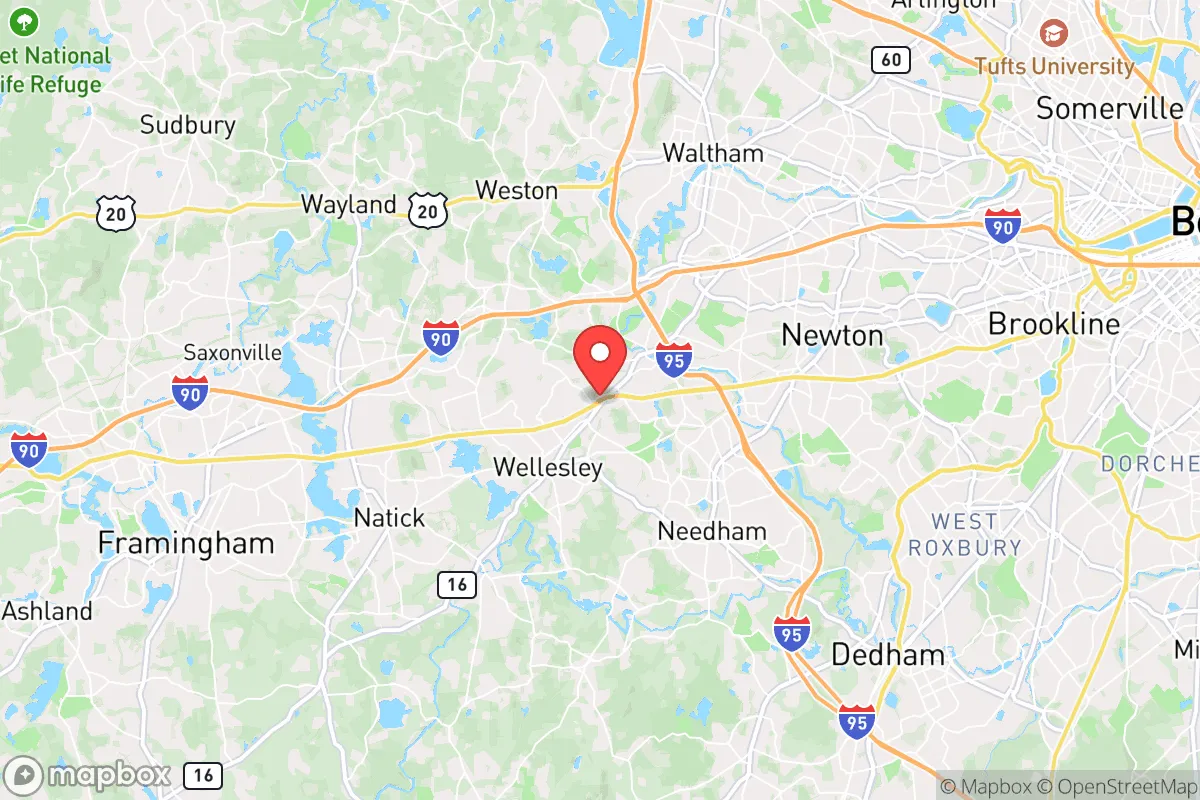
Photo: Wikipedia
Personal Sovereignty in Wellesley, MA
Viable for self-reliance. Generally workable, though some barriers may limit total independence.
What does Personal Sovereignty tell us?
Personal Sovereignty measures your capacity for self-reliance and independence with minimal government friction. Higher scores mean fewer barriers between you and the way you want to live... but it assumes you have the space you need and good neighbors.
What does this tell us?
Personal Sovereignty measures your capacity for self-reliance and independence with minimal government friction. Higher scores mean fewer barriers between you and the way you want to live... but it assumes you have the space you need and good neighbors.
State Policy
Energy independence: Importer (5% of energy produced in-state)
Personal Liberty
Homesteading

Personal Liberty Analysis
For the liberty-minded individual or family evaluating Wellesley, Massachusetts, the personal sovereignty environment is constrained by a dense web of state-level mandates and local ordinances that systematically limit individual decision-making. While the town offers exceptional public services and a high standard of living, the trade-off is a significant reduction in personal autonomy across taxation, self-defense, property use, and medical choice. This analysis examines the specific legal and regulatory realities that a strategic relocator must weigh against the area's considerable economic and educational advantages.
Tax burden and regulatory posture: what the state takes and controls
Massachusetts imposes one of the heaviest tax burdens in the nation, and Wellesley residents feel it acutely. The state's flat income tax rate of 5.0% (with an additional 4% surtax on income over $1 million, effective 2023) combines with a statewide sales tax of 6.25% and some of the highest property taxes in the country. Wellesley's property tax rate, while moderate for the region at roughly $11.50 per $1,000 of assessed value, applies to some of the most expensive real estate in the state—median home values exceed $1.5 million—resulting in annual tax bills that often surpass $20,000. The regulatory posture is equally aggressive: Massachusetts has a statewide building code, strict environmental regulations (including Title 5 septic rules that can force expensive upgrades on older homes), and a powerful state-level Department of Environmental Protection that routinely delays or blocks property modifications. For the prepper or survivalist, this means that even basic improvements like adding a backup generator, installing solar panels with battery storage, or building a root cellar require permits, inspections, and often professional engineering sign-offs. The state's "Right to Farm" law provides some protection for agricultural activities, but Wellesley's zoning bylaws effectively prohibit most livestock and commercial-scale gardening on standard residential lots. The cumulative effect is a system where the state and town hold significant leverage over how you use your property and income, leaving little room for independent action without bureaucratic approval.
Self-defense and gun law specifics: what you can and cannot do
For those prioritizing the right to self-defense, Massachusetts presents one of the most restrictive legal environments in the country. The state requires a License to Carry (LTC) for both open and concealed carry of handguns, and issuance is at the discretion of local police chiefs—a "may-issue" system that in practice becomes "shall-issue" in most suburban towns like Wellesley, but still allows for subjective denial. The application process includes a background check, fingerprinting, a 16-hour basic firearms safety course, and a fee of $100. The LTC must be renewed every six years. Long guns (rifles and shotguns) require a Firearm Identification Card (FID), also subject to local approval. The state bans "assault weapons" by name and feature, including the AR-15 platform and many common semi-automatic rifles, with a list that is updated periodically. Magazine capacity is capped at 10 rounds for all firearms. There is no state preemption of local gun laws, meaning Wellesley could theoretically pass its own restrictions, though it has not done so aggressively. Stand-your-ground laws do not exist; Massachusetts imposes a duty to retreat in public spaces before using deadly force, unless you are in your home (the "castle doctrine" applies, but with narrow judicial interpretation). For the survivalist, this means that stockpiling standard-capacity magazines, owning modern sporting rifles, or carrying a firearm for personal protection outside the home are all heavily restricted or illegal. The legal process for obtaining and maintaining firearms rights is time-consuming, expensive, and subject to the whims of local law enforcement. This is not a jurisdiction where self-reliance in personal defense is easily or legally achieved.
Self-reliance and homesteading viability: lot sizes, zoning, and off-grid feasibility
Wellesley's residential character is defined by large, well-maintained homes on generous lots—typically 0.5 to 2 acres in the more established neighborhoods—but the zoning code is explicitly designed to preserve a suburban aesthetic, not to enable self-sufficiency. The town's zoning bylaws prohibit keeping chickens, goats, or bees on most residential properties without a special permit, and even then, setbacks and noise restrictions are stringent. Vegetable gardens are allowed, but front-yard gardens are often restricted by homeowners' association covenants or town ordinances. Off-grid living is effectively impossible: the town requires connection to municipal water and sewer where available, and any structure must meet the state's energy code, which mandates grid-tied electrical systems. Solar panels are permitted but must be installed by licensed contractors and inspected; battery storage for backup power is allowed but subject to fire code restrictions. Rainwater collection is legal but limited to 250 gallons per property without a permit, and any system must be designed to prevent mosquito breeding. For the prepper seeking to reduce dependence on external systems, the regulatory environment actively discourages independence. The cost of land—Wellesley's average lot price exceeds $500,000—further limits the feasibility of acquiring acreage for homesteading. Nearby towns like Dover or Sherborn offer larger lots (2-5 acres) with more permissive agricultural zoning, but even there, state environmental regulations on wetlands, septic, and tree removal impose significant constraints. In Wellesley, the message is clear: self-reliance is a hobby, not a lifestyle, and the town's infrastructure is designed to keep you connected to the grid and the municipal system.
Personal liberties: parental rights, medical autonomy, speech, and property
Massachusetts has a strong legal framework for parental rights in education, but recent state-level actions have eroded some of that autonomy. The state's 2023 law requiring school districts to adopt policies supporting transgender students—including allowing them to use preferred names, pronouns, and facilities without parental notification—has created tension for parents who want to be informed about their child's gender identity decisions. Wellesley Public Schools have implemented these policies, and the district's curriculum includes comprehensive sex education that some parents find objectionable. The state does not have a robust parental opt-out mechanism for specific lessons, though parents can request alternative materials. Medical autonomy is similarly constrained: Massachusetts has universal healthcare mandates, and the state's Public Health Council has broad authority to impose vaccine requirements for school attendance (currently including COVID-19 for K-12 students, though with a religious exemption that is frequently challenged in court). The state's "Right to Try" law for terminally ill patients exists but is limited by FDA restrictions. Free speech is protected under the First Amendment, but Massachusetts has some of the nation's strictest anti-SLAPP laws, which can be used to silence critics of government or corporate actions. Property rights are heavily circumscribed: the state's "Chapter 40B" law allows developers to bypass local zoning for affordable housing projects, and the Community Preservation Act (adopted by Wellesley) imposes a 1.5% surcharge on property taxes to fund open space, historic preservation, and affordable housing—a direct transfer of property wealth to government-controlled projects. For the liberty-minded individual, these policies represent a steady encroachment on the traditional rights of parents, patients, and property owners, with the state assuming increasing authority over personal decisions.
In the broader context of Massachusetts and New England, Wellesley offers a relatively safe, well-managed environment with excellent schools and low crime, but the price of that stability is a significant surrender of personal sovereignty. Compared to states like New Hampshire or Texas, where tax burdens are lower, gun laws are more permissive, and property rights are stronger, Wellesley represents a high-cost, low-autonomy option. For the strategic relocator who prioritizes individual freedom over institutional convenience, the town's appeal is limited to those who can afford to work within the system—and who accept that the system will always have the final say. If your goal is to maximize personal independence, look elsewhere; if you can tolerate a managed existence in exchange for top-tier public services, Wellesley will meet your needs, but it will never let you forget who is really in charge.

* Values derived from national, state, county, city and local statistics and may differ in a specific area. Last updated: 2026-04-16T01:00:27.000Z
Narrative content on this page is AI-generated and may contain mistakes. Verify any details that matter before acting on them.
ReloMaps may earn a commission from affiliate links at no extra cost to you.

