
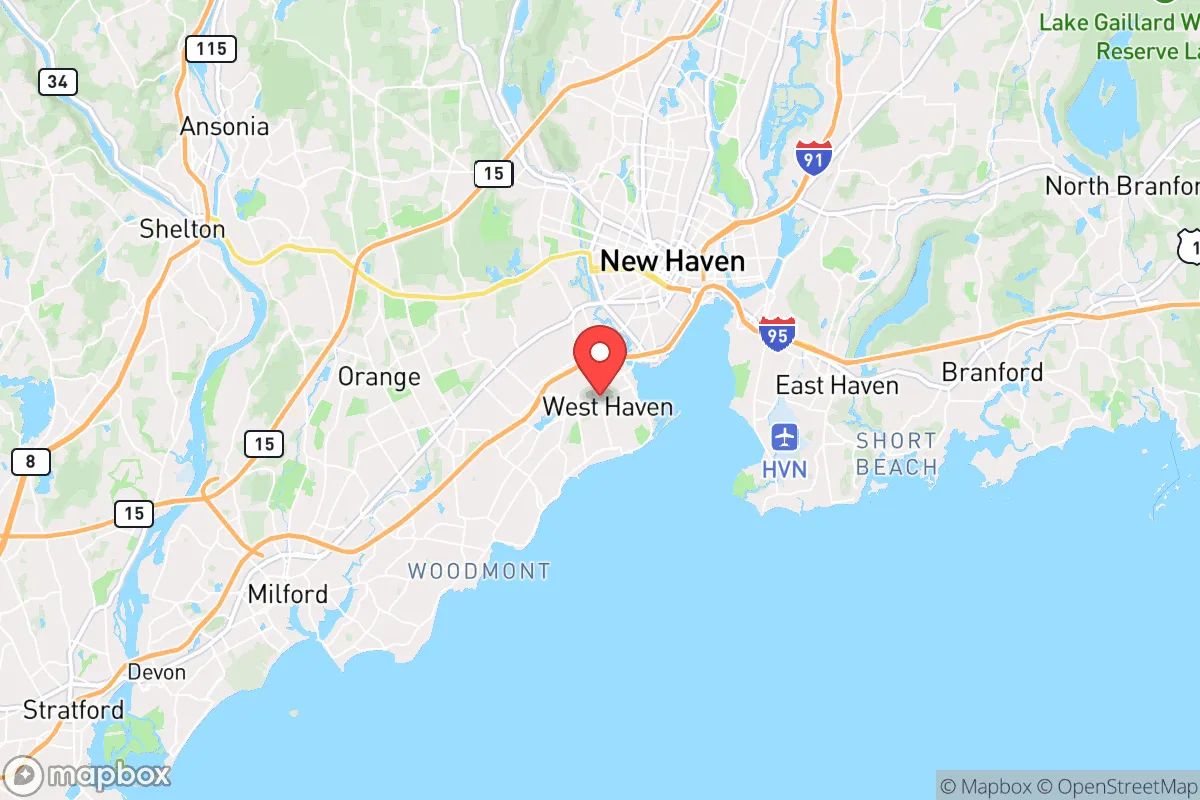
Photo: Wikipedia
Personal Sovereignty in West Haven, CT
Viable for self-reliance. Generally workable, though some barriers may limit total independence.
What does Personal Sovereignty tell us?
Personal Sovereignty measures your capacity for self-reliance and independence with minimal government friction. Higher scores mean fewer barriers between you and the way you want to live... but it assumes you have the space you need and good neighbors.
What does this tell us?
Personal Sovereignty measures your capacity for self-reliance and independence with minimal government friction. Higher scores mean fewer barriers between you and the way you want to live... but it assumes you have the space you need and good neighbors.
State Policy
Energy independence: Importer (5% of energy produced in-state)
Personal Liberty
Homesteading

Personal Liberty Analysis
West Haven, Connecticut, presents a challenging environment for personal sovereignty, where state-level mandates and a dense municipal footprint significantly constrain individual autonomy. For the survivalist or prepper, the calculus is stark: Connecticut’s aggressive regulatory posture on firearms, taxation, and property use creates a high-overhead, low-freedom baseline that requires deliberate workarounds. While West Haven itself offers some practical advantages—proximity to coastal resources and a working-class ethos—the overarching legal and fiscal framework tilts heavily toward government control, making it a location best approached with eyes wide open and a plan for mitigation.
Tax burden and regulatory posture: how Connecticut’s fiscal policies affect your autonomy
Connecticut carries one of the highest combined state and local tax burdens in the nation, and West Haven is no exception. The effective property tax rate hovers around 3.5% of assessed value, among the steepest in the state, meaning a modest $250,000 home carries an annual tax bill near $8,750. This directly reduces the capital available for self-reliance investments—land, supplies, or alternative energy systems. The state income tax is progressive, topping out at 6.99%, and applies to all earned income, including capital gains from any homestead business. Sales tax is 6.35%, with no exemptions for preparedness gear like generators or water filtration systems. Regulatory overhead is equally heavy: Connecticut mandates strict building codes, environmental reviews for any land modification near wetlands (which cover much of West Haven’s coastal edge), and a state-level income tax on any rental income from a secondary property. For the prepper, this means every dollar earned or spent is subject to multiple layers of government extraction, and any attempt to modify property for resilience triggers permitting delays and fees. The state’s overall business climate ranks near the bottom nationally, which suppresses local economic dynamism and limits off-grid income opportunities.
Self-defense and gun law specifics: what Connecticut’s firearm restrictions mean for your security
Connecticut’s gun laws are among the most restrictive in the country, and West Haven residents must navigate a dense web of statutes that directly impact self-defense capability. The state requires a permit to purchase any handgun or long gun, which involves an 8-hour safety course, a background check through the state’s NICS system, and a local police department interview—a process that can take months. Magazine capacity is capped at 10 rounds, and “assault weapons” as defined by state law (including many common AR-15 platforms) are banned for new purchases. Open carry is effectively prohibited without a specific endorsement, and concealed carry permits are issued at the discretion of local authorities, though West Haven’s police department generally follows state guidelines. Stand-your-ground laws do not exist; Connecticut imposes a duty to retreat in public spaces before using deadly force, even if you are lawfully carrying. For the survivalist, this means your primary defensive tool is limited to a bolt-action rifle or a 10-round handgun, and any defensive use of force will face intense legal scrutiny. The state also maintains a registry of all pistol permits, and private firearm sales must go through a licensed dealer with a background check. Preppers should factor in the cost and time of compliance, and consider non-firearm defensive measures—like reinforced doors, perimeter lighting, and canine security—as primary layers.
Self-reliance and homesteading viability: lot sizes, zoning, and off-grid feasibility in West Haven
West Haven’s dense suburban layout severely limits traditional homesteading. The median lot size is under 0.15 acres, and most residential zones prohibit livestock, beekeeping, or structures like chicken coops without special permits. Zoning codes require all dwellings to be connected to municipal water and sewer, effectively banning off-grid water systems or composting toilets. Rainwater collection is technically allowed but limited to 500 gallons per property, and any system must be registered with the health department. Solar panels are permitted but subject to historic district reviews in older neighborhoods, and battery storage systems must meet fire code inspections. For the prepper seeking true self-reliance, West Haven is a poor fit—you cannot raise food at scale, store significant water, or disconnect from utility grids. The best strategy is to treat a West Haven residence as a base camp for urban survival, with a focus on stockpiling non-perishable food, water filtration for municipal supply, and portable power systems. For serious homesteading, look to the rural towns of Litchfield County or the Quiet Corner, where lot sizes of 2+ acres and agricultural zoning are common. Within West Haven, the Allingtown and Savin Rock neighborhoods offer slightly larger lots (0.25–0.5 acres) and more lenient enforcement, but still fall far short of off-grid viability.
Personal liberties: parental rights, medical autonomy, speech, and property in a blue-state context
Connecticut’s legal environment on personal liberties reflects a strong progressive consensus, which directly impacts parental rights and medical autonomy. The state mandates comprehensive sex education in public schools, with no parental opt-out for specific content, and requires schools to adopt policies supporting transgender students’ chosen names and pronouns without parental notification. Vaccine mandates for school attendance are strict, with only medical exemptions allowed—no religious or philosophical exemptions. During the COVID-19 pandemic, Connecticut maintained one of the longest mask mandates in the Northeast, and the state retains emergency powers that could be used to reimpose such measures. Medical autonomy is further limited by a state-run health insurance exchange and mandates that all private insurance cover abortion and gender-affirming care. Free speech protections are generally robust under the First Amendment, but Connecticut has enacted laws against “hate speech” that some legal observers argue chill political expression. Property rights are constrained by strong eminent domain powers and a statewide property tax system that reassesses values annually, meaning your tax bill can rise sharply without any improvement to your land. For the conservative-leaning prepper, these policies create an environment where government overreach into family decisions, health choices, and property use is the norm, not the exception. The best defense is to stay informed, join local liberty-oriented groups like the Connecticut Citizens Defense League, and consider legal structures like LLCs for property ownership to add a layer of privacy.
Overall, West Haven offers a low-to-moderate personal sovereignty score relative to other areas in the Northeast. It is more restrictive than rural New Hampshire or upstate New York, but less oppressive than New York City or Boston. The tax burden and gun laws are the primary drags on autonomy, while the coastal access and proximity to regional trade routes offer some practical advantages for a prepper willing to work within the system. For the serious survivalist, West Haven is best viewed as a temporary or secondary location—a place to build skills and network while planning a move to a higher-sovereignty jurisdiction. If you must stay, focus on legal compliance, community building, and layered defensive strategies that don’t rely on firearms. The state’s grip is tight, but not unbreakable, and a determined individual can carve out a measure of freedom within the margins.

* Values derived from national, state, county, city and local statistics and may differ in a specific area. Last updated: 2026-04-19T07:03:44.000Z
Narrative content on this page is AI-generated and may contain mistakes. Verify any details that matter before acting on them.
ReloMaps may earn a commission from affiliate links at no extra cost to you.

