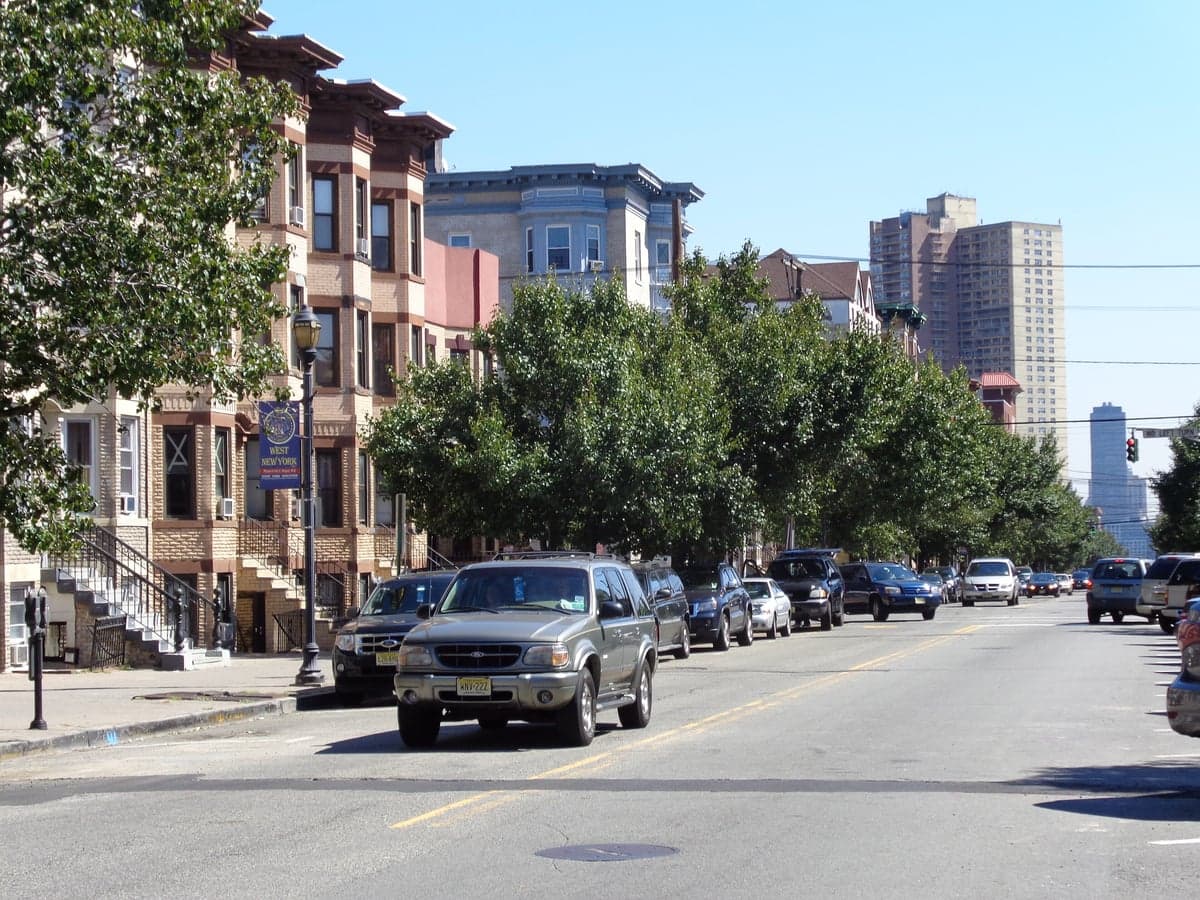
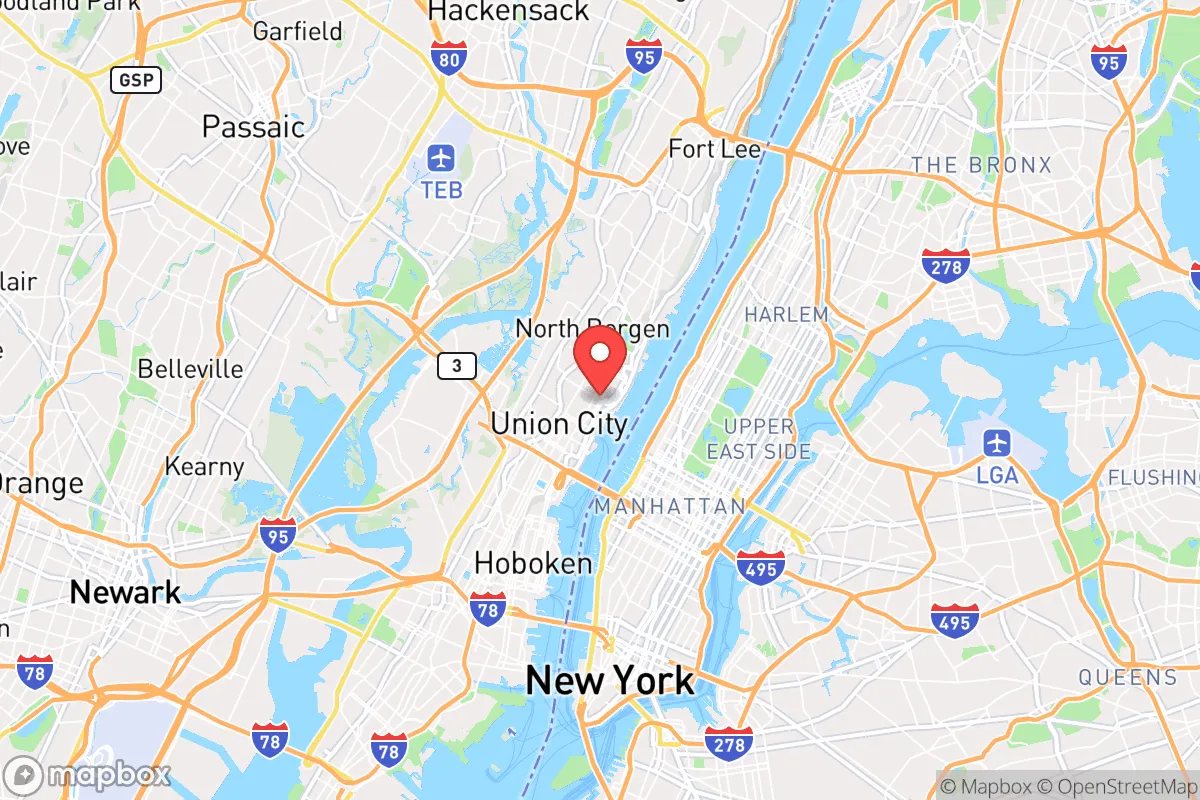
Photo: Wikipedia
Demographics of West New York, NJ
Affluence Level in West New York, NJ
A below-average socioeconomic profile. Incomes, home values, and educational attainment trail the U.S., with higher poverty and unemployment.
People of West New York, NJ
West New York, New Jersey, is a densely packed Hudson County city of 51,683 residents where 76.3% of the population identifies as Hispanic, making it one of the most heavily Latino municipalities in the Northeast. The city is a vertical immigrant gateway, with 31.2% foreign-born, a large Cuban-American and South American presence, and a growing East/Southeast Asian community that now accounts for 5.6% of residents. Its identity is defined by the clash between old-guard Cuban and Puerto Rican enclaves and newer waves of Dominican, Colombian, and Ecuadorian arrivals, all layered atop a historic German and Irish working-class foundation. For a conservative-leaning reader, West New York offers a case study in how dense, transit-oriented cities absorb and sort immigrant groups by neighborhood and generation.
How the city was settled and grew
West New York was originally part of North Bergen, carved out as an independent town in 1898 during the industrial boom along the Hudson River waterfront. The city’s early population was overwhelmingly German and Irish immigrants who worked in the embroidery and textile mills that lined the Palisades cliffs. These groups settled the Bergenline Avenue corridor, which remains the city’s commercial spine, and the Uptown district near 60th Street, where German social clubs and Catholic parishes anchored the community through the 1920s. A smaller wave of Italian immigrants arrived in the 1910s and concentrated in the Downtown area around 48th Street, near the ferry terminals that connected to Manhattan. By 1930, West New York was a solidly white, blue-collar city of about 37,000, with a strong union presence in the garment and shipping industries.
Modern era (post-1965)
The Hart-Cellar Act of 1965 triggered a demographic revolution. Cuban exiles fleeing Castro’s regime arrived in the late 1960s and 1970s, settling heavily in the Bergenline Avenue and 60th Street corridors, where they opened bodegas, bakeries, and travel agencies that still define the commercial landscape. Puerto Ricans, who had been migrating since the 1950s, concentrated in the Downtown and 48th Street areas, while a smaller Dominican wave in the 1980s filled the Uptown blocks near the North Bergen border. By 1990, the city was 65% Hispanic, and the white population had collapsed from 90% in 1960 to under 20%. The 2000s brought a surge of South American immigrants—Colombians, Ecuadorians, and Peruvians—who settled in the Central district between 52nd and 56th Streets, creating a distinct Andean commercial strip. The East/Southeast Asian population, now 5.6%, is a recent arrival, with Filipino and Vietnamese families moving into the Uptown and 60th Street areas, drawn by affordable two-bedroom apartments and proximity to Manhattan bus lines. The Indian-subcontinent population (1.9%) is smaller and more dispersed, with no single ethnic enclave, but clusters near the Bergenline Avenue transit hubs.
The future
West New York’s population is plateauing—it has hovered around 51,000 since 2010—but the composition is shifting. The Cuban-American cohort, now third- and fourth-generation, is aging and slowly moving to suburban Union and Middlesex counties, while newer Dominican and Central American arrivals fill the vacancies. The East/Southeast Asian share is growing steadily, up from 3.1% in 2010, and is likely to reach 8-10% by 2035 as Filipino and Vietnamese families continue to replace older Hispanic homeowners in the Uptown district. The city is not homogenizing; instead, it is tribalizing into distinct micro-neighborhoods: Bergenline Avenue remains Cuban and Colombian, Downtown is Puerto Rican and Dominican, and Uptown is becoming a pan-Asian and South American mix. The white population (13.8%) is stable but concentrated among elderly holdouts and a small number of young professionals in the 48th Street condos near the waterfront. For a conservative-leaning reader, the key trend is that West New York remains a high-density, immigrant-first city where English proficiency is lower than the national average (only 55% speak only English at home), and where public schools are 90% Hispanic and struggle with state funding gaps. The city is not gentrifying in the Hoboken or Jersey City sense—there is no significant white or affluent in-migration—but it is becoming more diverse within its Hispanic majority, with Ecuadorian and Dominican populations growing at the expense of the older Cuban base.
West New York is a dense, transit-rich immigrant city that is slowly diversifying beyond its Hispanic core, with East/Southeast Asian and Indian communities carving out small but stable niches. For a single person or parent moving in now, the city offers affordable rents (median two-bedroom around $1,800), a 15-minute bus ride to Manhattan, and a deeply established Latino culture—but also overcrowded schools, limited green space, and a political culture dominated by Hudson County machine politics. It is not a place of rapid change or upward mobility, but a stable, working-class enclave where new arrivals replace older ones in a predictable cycle.

* Values derived from national, state, county, city and local statistics and may differ in a specific area. Last updated: 2026-04-30T04:25:26.000Z
Narrative content on this page is AI-generated and may contain mistakes. Verify any details that matter before acting on them.
ReloMaps may earn a commission from affiliate links at no extra cost to you.

