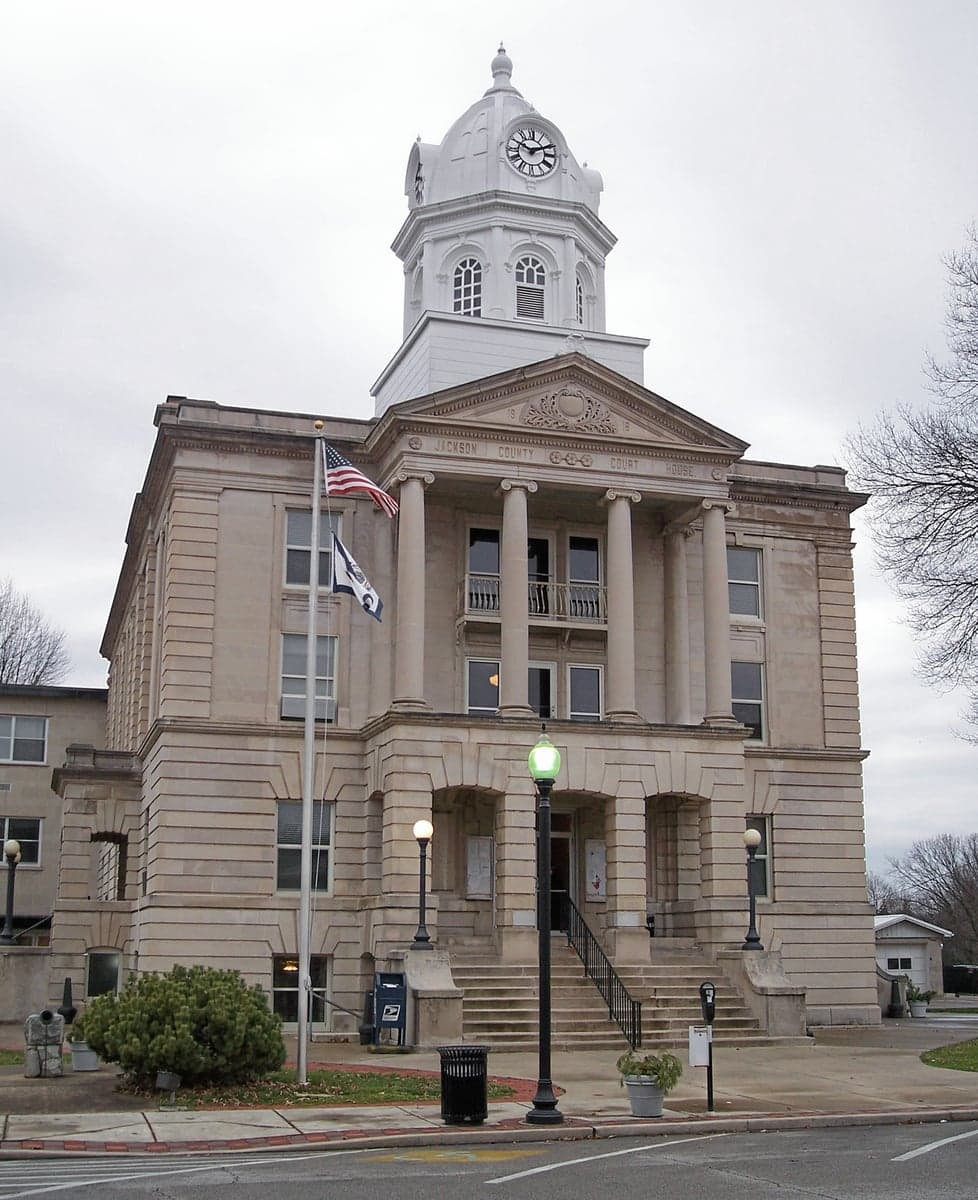
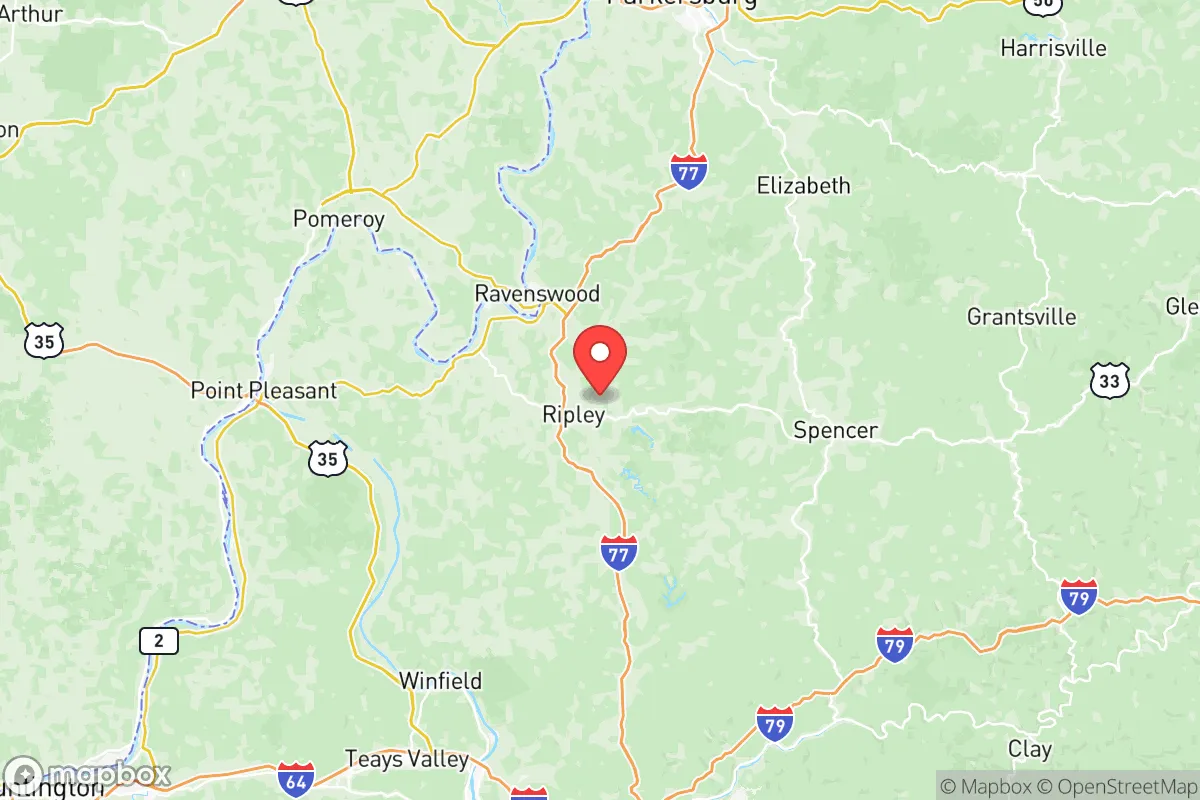
Photo: Wikipedia
Demographics of Jackson County
Affluence Level in Jackson County
A below-average socioeconomic profile. Incomes, home values, and educational attainment trail the U.S., with higher poverty and unemployment.
People of Jackson County
Jackson County, West Virginia, is home to 27,753 residents, a population that is 96.1% White and overwhelmingly native-born, with only 1.2% foreign-born. The county’s character is defined by its small-town, rural identity, anchored by the county seat of Ripley and the Ohio River town of Ravenswood, where a strong sense of local heritage and a slower pace of life prevail. With a college-educated rate of 19.4%, the population is largely working-class, employed in manufacturing, healthcare, and local services, and the area retains a distinctly Appalachian and Midwestern cultural blend.
Settlement & growth (pre-1960)
Before European settlement, the land that is now Jackson County was part of the hunting grounds of the Shawnee and Mingo nations, who used the Ohio River and its tributaries for travel and trade. The region was sparsely populated by Native peoples, with no permanent large villages within the county’s modern borders. French and British fur traders passed through in the 1700s, but no colonial settlements were established until after the American Revolution.
The first permanent wave of settlers arrived in the late 18th and early 19th centuries, primarily Scots-Irish and English pioneers moving west from Virginia and Pennsylvania. These families were drawn by the promise of cheap, fertile land along the Ohio River and the Big Sandy Creek. They established small farms and river landings, with the earliest communities forming at Ripley (founded 1832) and Ravenswood (laid out in 1835). The county was officially formed in 1831 from parts of Kanawha, Mason, and Wood counties, named after President Andrew Jackson. These early settlers were subsistence farmers, and the population grew slowly, reaching about 8,000 by 1850.
The second major wave came with the industrial expansion of the late 19th and early 20th centuries. The arrival of the Baltimore and Ohio Railroad in the 1850s, and later the Chesapeake and Ohio Railway, opened the county to outside markets. This spurred the growth of small towns like Gay, Evans, and Kenna, which served as shipping points for timber, coal, and agricultural goods. The discovery of oil and natural gas in the early 1900s brought a modest boom, attracting workers from other parts of West Virginia and neighboring Ohio. However, Jackson County never saw the large-scale immigration from Southern and Eastern Europe that characterized the coal fields of southern West Virginia. The population remained overwhelmingly native-born White, with a small number of Black families, mostly working as laborers or domestic servants, concentrated in Ripley and Ravenswood.
The post-World War II era brought a significant economic shift with the establishment of the Kaiser Aluminum plant in Ravenswood in the 1950s. This massive industrial facility drew workers from across the region, including many from the declining coal fields of southern West Virginia and from rural Ohio. The plant’s construction spurred a population increase, with Ravenswood growing into a company town. This period cemented the county’s working-class, union-oriented identity, distinct from the more agricultural communities to the east.
Modern era (post-1965)
The 1965 Hart-Cellar Act had minimal direct impact on Jackson County. The foreign-born population remains tiny at 1.2%, and the county did not experience the waves of immigration from Asia, Latin America, or the Middle East that reshaped urban and suburban America. The county’s demographic story since 1965 is primarily one of domestic migration and suburbanization.
The most significant change has been the decline of the industrial base. The Kaiser Aluminum plant, after decades of operation and labor disputes, saw major layoffs and eventual closure of its primary smelter in the early 2000s. This led to a period of population stagnation and out-migration, particularly among younger workers. The county’s population peaked at around 29,000 in the 1990s and has since declined slightly to 27,753. This out-migration has been partially offset by in-migration from the Rust Belt, particularly from Ohio and Michigan, as retirees and remote workers seek lower costs of living and a quieter lifestyle. These new residents tend to settle in the more rural areas around Cottageville and Statts Mills, as well as in the newer subdivisions on the outskirts of Ripley.
Suburbanization has been modest but noticeable. Ripley has expanded with new housing developments and big-box retail along US Route 33, serving as a regional commercial hub. Ravenswood, by contrast, has struggled with population loss and a shrunken tax base following the aluminum plant’s decline. The county’s racial composition has remained remarkably stable: 96.1% White, with a Black population of just 0.2% and a Hispanic population of 0.9%. The small East/Southeast Asian community (0.4%) is largely composed of a few families connected to the medical and academic sectors in the broader region. There is no measurable Indian subcontinent population. The county has not seen the formation of any ethnic enclaves; the few non-White residents are widely dispersed.
The future
Jackson County’s population is likely to continue a slow decline or plateau, mirroring trends across rural West Virginia. The population is aging, with a median age above the national average, and the out-migration of young adults for education and jobs in Charleston, Columbus, and beyond is a persistent challenge. The county is not homogenizing in a racial sense, as it is already extremely homogeneous. Instead, it is tribalizing along economic and cultural lines: long-time residents with deep family roots versus newer arrivals seeking a rural escape. This dynamic is most visible in the tension between the traditional, union-oriented identity of Ravenswood and the more conservative, small-business culture of Ripley.
Immigrant communities are not growing and are unlikely to do so, given the lack of economic opportunities and the county’s remote location. The small Hispanic and Asian populations are expected to remain negligible. The most significant demographic trend is the in-migration of remote workers and retirees from higher-cost states, a pattern accelerated by the pandemic. These newcomers are generally absorbed into the existing cultural fabric, though they may bring slightly more diverse political and social views. The next 10-20 years will likely see a continued slow population decline, with the county becoming older, more reliant on healthcare and service jobs, and increasingly defined by its role as a quiet, affordable haven within commuting distance of larger employment centers like Charleston and Parkersburg.
For someone moving in now, Jackson County offers a stable, culturally cohesive, and affordable environment, but one with limited economic dynamism and a shrinking population. It is a place where the past weighs heavily, and the future is one of gradual, quiet consolidation rather than explosive growth or dramatic change.

* Values derived from national, state, county, city and local statistics and may differ in a specific area. Last updated: 2026-05-13T12:34:43.000Z
Narrative content on this page is AI-generated and may contain mistakes. Verify any details that matter before acting on them.
ReloMaps may earn a commission from affiliate links at no extra cost to you.

