Photo: Wikipedia
Demographics of Westfield, NJ
Affluence Level in Westfield, NJ
A wealthy area with high-earning, well-educated households. Incomes, home values, and educational attainment meaningfully outpace national averages.
People of Westfield, NJ
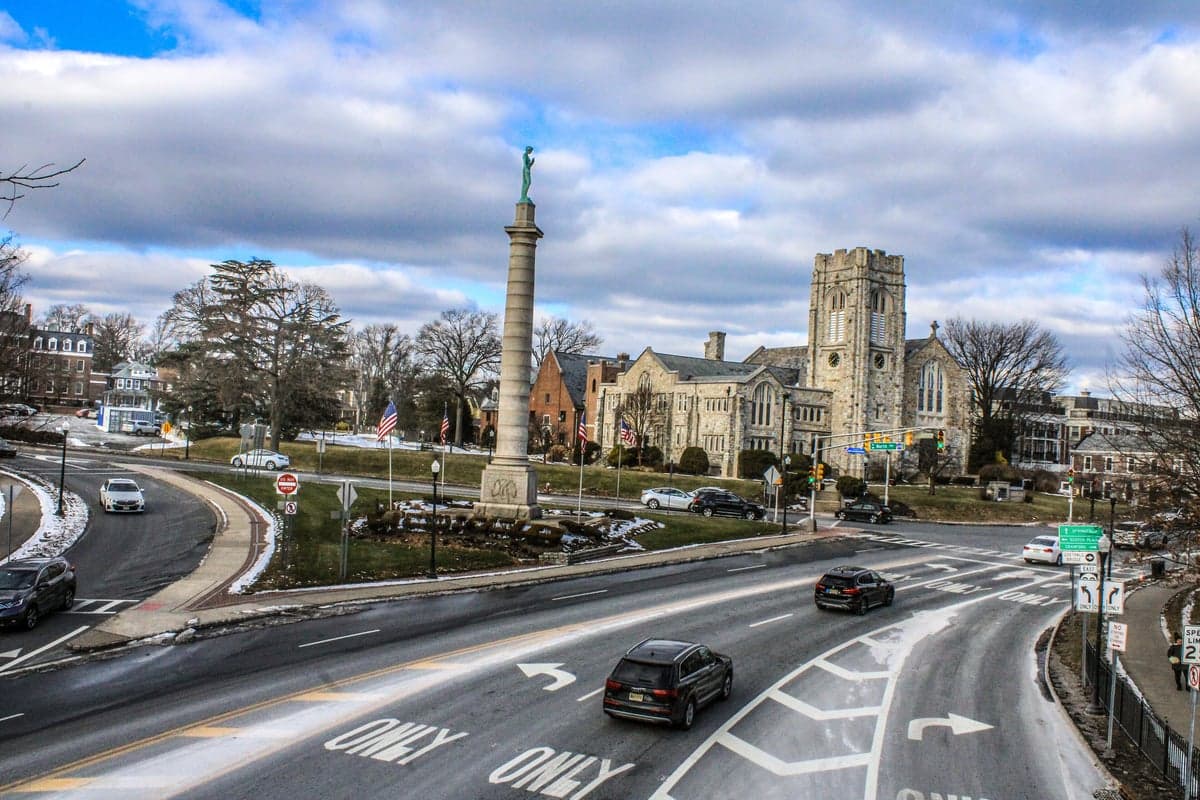
The people of Westfield, New Jersey form a community of roughly 30,760 residents that is notably well-educated (76.7% college graduates), predominantly white (76.5%), and marked by a strong sense of historic preservation and civic engagement. The city carries a distinct identity as a classic, affluent commuter suburb with a walkable downtown, a deep-rooted Yankee-Protestant and Irish-Catholic foundation, and a growing but still modest diversity that is reshaping some neighborhoods while leaving others largely unchanged. Its population density is moderate for a New Jersey inner-ring suburb, and the community’s character leans toward family-oriented stability, with a reputation for excellent public schools and a politically moderate-to-conservative tilt in local governance.
How the city was settled and grew
Westfield’s human history begins with the Lenape people, who inhabited the Rahway River valley before European contact. The first permanent European settlers arrived in the early 1700s, primarily English and Scottish Presbyterians from the New York and New England colonies, drawn by land grants in the Elizabethtown Tract. These families established farms and small mills along the river, and the settlement coalesced around what is now the Westfield Center historic district. The arrival of the Central Railroad of New Jersey in 1839 transformed the village into a commuter suburb for New York City, attracting a wave of Irish immigrants who built the railroad and later settled in the Fairview and Wyckoff Avenue areas, working as laborers and domestic servants. By the late 19th century, German and Italian immigrants arrived, establishing themselves in the North Side neighborhoods near the train station, where they opened small businesses and built the Catholic parishes that still anchor the community. The early 20th century saw a surge of upwardly mobile Protestant families—many of them executives and professionals—building large homes in the Mountain Avenue and Brightwood Park districts, cementing Westfield’s reputation as a wealthy, white-collar enclave. The city was formally incorporated in 1903, and by 1950 its population had reached roughly 21,000, overwhelmingly white and native-born.
Modern era (post-1965)
The post-1965 era brought gradual demographic change, though Westfield remained far more homogeneous than neighboring Elizabeth or Plainfield. The 1965 Immigration and Nationality Act opened the door to new arrivals, but Westfield’s high housing costs and established social networks limited in-migration. The most significant shift began in the 1990s and accelerated after 2000: East/Southeast Asian families—particularly Chinese and Korean professionals—began moving into the Tamaques Park and Mindowaskin Park neighborhoods, drawn by the school system and proximity to pharmaceutical and tech jobs in central New Jersey. Today, East/Southeast Asian residents make up 5.9% of the population, with a visible concentration in the eastern half of town. Indian-subcontinent families (2.9% of the population) have settled more thinly, with small clusters near the Scotch Plains border and along the South Avenue corridor. The Hispanic share (8.6%) has grown steadily since 2000, driven largely by Mexican and Central American families working in construction, landscaping, and service industries; they are most concentrated in the Westfield Gardens apartment complex area and the southern edge near Clark. The Black population remains very small at 1.7%, a figure that has barely changed since 1970, reflecting both the city’s high property values and a lack of affordable housing stock. The foreign-born share is just 5.0%, well below the New Jersey average of roughly 23%, indicating that most of Westfield’s diversity comes from second-generation and third-generation families rather than recent immigrants.
The future
Westfield’s population trajectory points toward slow, incremental diversification rather than rapid change. The white share has declined from roughly 90% in 1990 to 76.5% today, and that trend is likely to continue as older white residents age in place and younger, more diverse families move in—but the pace will remain modest due to the city’s high home prices (median well over $700,000) and limited new construction. The East/Southeast Asian and Indian communities are growing primarily through in-migration from other New Jersey suburbs and from within the existing professional class, not through direct immigration; this suggests assimilation into the broader suburban culture rather than the formation of distinct ethnic enclaves. The Hispanic population is the fastest-growing segment, but it is also the most economically diverse, with a growing middle-class component that may eventually spread beyond the apartment-heavy Westfield Gardens area. The city is not tribalizing into separate enclaves—most neighborhoods remain mixed by income and ethnicity—but the North Side and Brightwood Park areas remain overwhelmingly white and wealthy, while the southern and eastern edges are where most non-white families live. Over the next 10–20 years, Westfield will likely become a slightly more diverse version of itself: still majority-white, still highly educated, and still expensive, but with a visible and growing minority presence that is integrated into the community’s civic and school life rather than segregated.
For someone moving in now, Westfield offers a stable, family-oriented environment with excellent schools and a strong sense of local identity, but it is not a place of rapid demographic transformation. The city’s character is best suited to buyers who value historic homes, walkable downtown amenities, and a community where most neighbors share similar educational and professional backgrounds. The modest diversity that exists is real but concentrated; newcomers from non-white backgrounds will find a welcoming but still predominantly white social landscape, particularly in the older, pricier neighborhoods west of North Avenue.

* Values derived from national, state, county, city and local statistics and may differ in a specific area. Last updated: 2026-04-30T07:58:06.000Z
Narrative content on this page is AI-generated and may contain mistakes. Verify any details that matter before acting on them.
ReloMaps may earn a commission from affiliate links at no extra cost to you.

