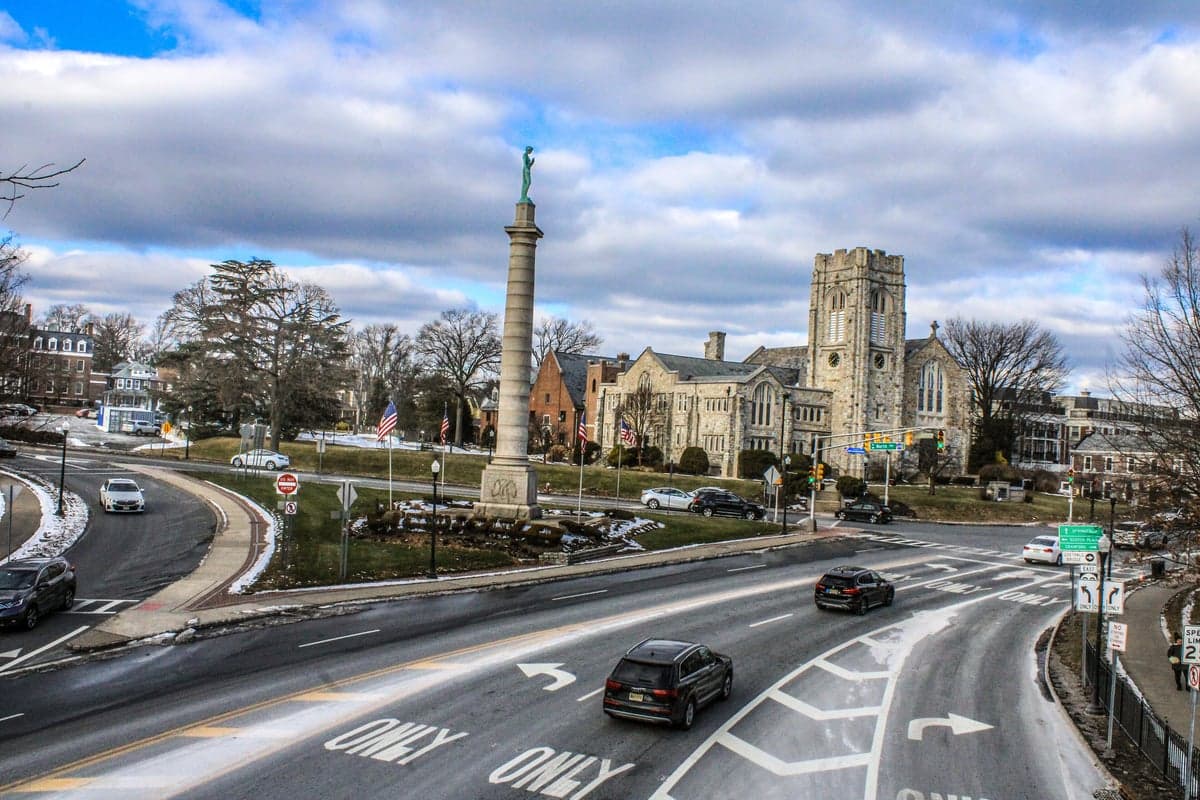
Photo: Wikipedia
Strategic Assessment of Westfield, NJ
High tactical risk. This location is likely close to major population centers, strategic targets, or sits in a high-disaster corridor. A retreat property and careful exit planning is required.
What does the Strategic Assessment tell us?
Our Strategic Assessment grades tactical survivability of an area. Major population centers, military targets, fallout zones, natural disasters, and border exposure all drive risk — lower exposure means a more defensible position in a crisis.
This is heavily inspired by Joel Skousen's Strategic Relocation book. Highly recommended you checkout the book ($)What does this tell us?
Our Strategic Assessment grades tactical survivability of an area. Major population centers, military targets, fallout zones, natural disasters, and border exposure all drive risk — lower exposure means a more defensible position in a crisis.
This is heavily inspired by Joel Skousen's Strategic Relocation book. Highly recommended you checkout the book ($)Strategic Pillars

Key Distances
Regional Safe Places
Below is our recommended "safe zones" in New Jersey and the surrounding area based on our strategic heuristics. For most people, it's unrealistic to live in a “safe zone” full-time due to work, family or other personal reasons. They tend to be more rural. However, many of these areas are perfect for second homes and retreat properties that double as a vacation home or even a short-term rental.
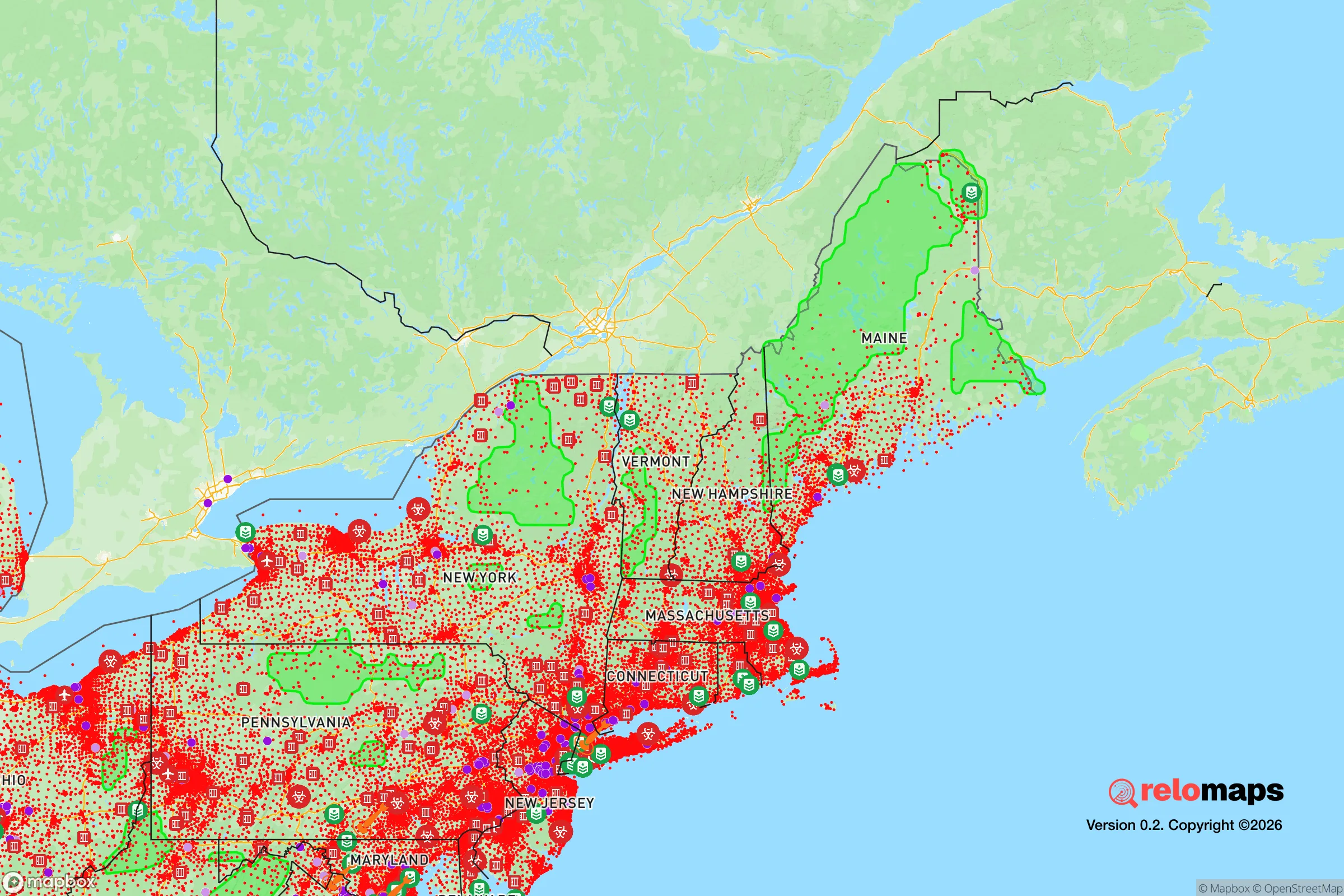
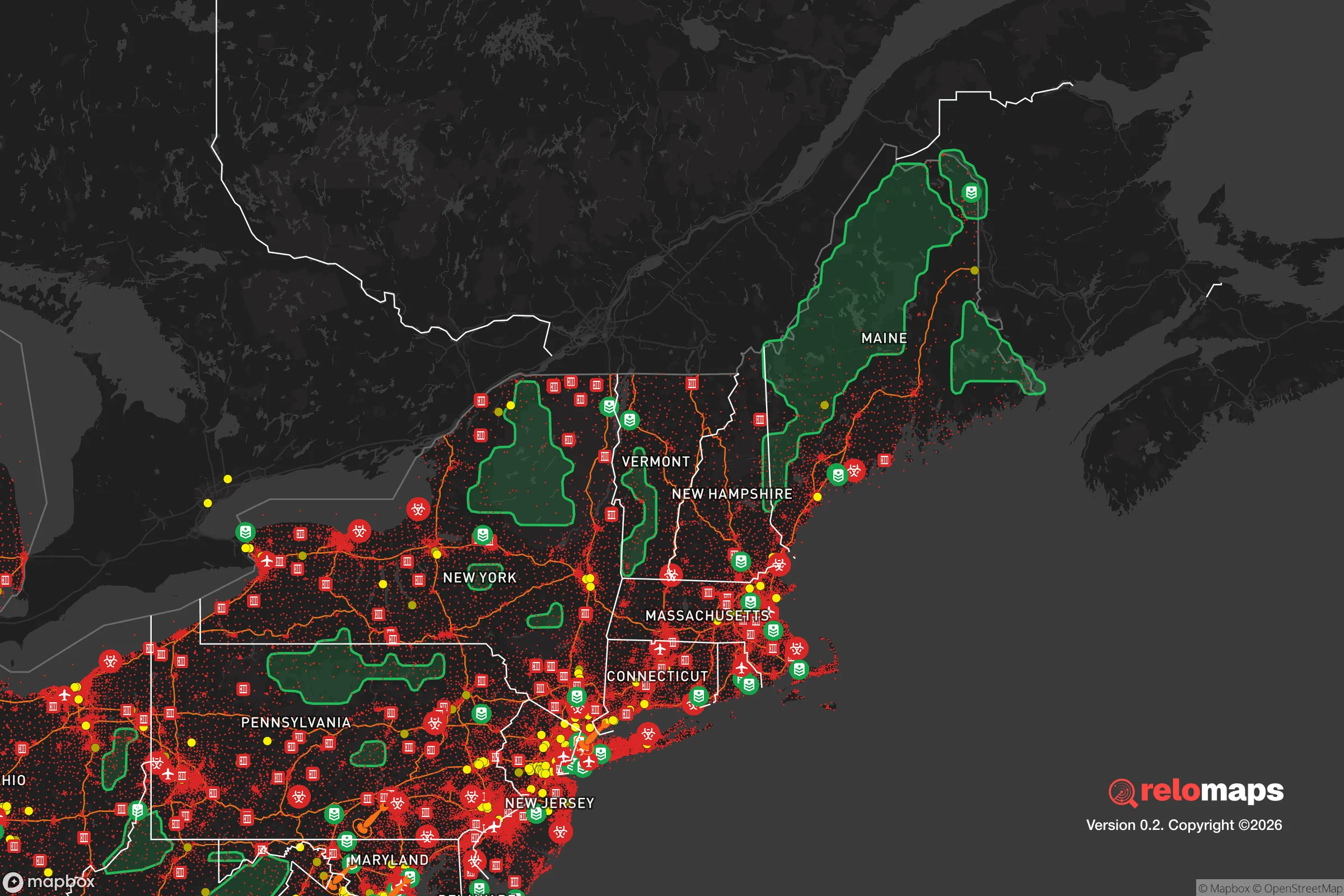


Important Note: For informational purposes only. This does not mean nothing bad ever happens in the green zones. Please use common sense. This is based on public data and modeled with AI. We tried to take a conservative approach but mistakes happen. We update this regularly as new information becomes available.
Solar Generator Recommendations
Backup power matters more here than in safer locations. We've picked three solar generators across budgets and capacity tiers — start with the budget unit if you only need a few essentials, or step up if you want to run a fridge and HVAC for days at a time.

Jackery Portable Power Station Explorer 300
Budget OptionPower on the Go: Weighing only 11 lbs, it's convenient to set up and store with book-sized foldable solar panels

BLUETTI Portable Power Station AC180
Designed for both indoor and outdoor scenarios, AC180 is highly capable as it has a robost capacity and continuous output power.

EF ECOFLOW DELTA Pro Ultra Power Station
Upgraded PickEcoFlow DELTA Pro Ultra is a whole-home energy system designed to grow with your family. Integrated with the Smart Home Panel 2, it scales to meet your evolving energy needs — keeping your home powered, intelligent, and secure through every stage of life.
We earn a commission, at no additional cost to you.
Strategic Assessment Analysis
Westfield, New Jersey, presents a complex strategic picture for the conservative prepper. Its immediate advantages—a strong local tax base, a walkable downtown, and a community that still values local governance—are real, but they sit directly in the shadow of one of the most densely populated and politically volatile regions in the country. The town’s resilience is not a given; it’s a conditional asset that depends entirely on the nature of the crisis and your ability to execute a plan before the surrounding region collapses inward. For the single individual or family looking to hold ground, Westfield offers a defensible island, but the surrounding waters are deep and dangerous.
Geographic position and natural advantages: a suburban redoubt with a critical flaw
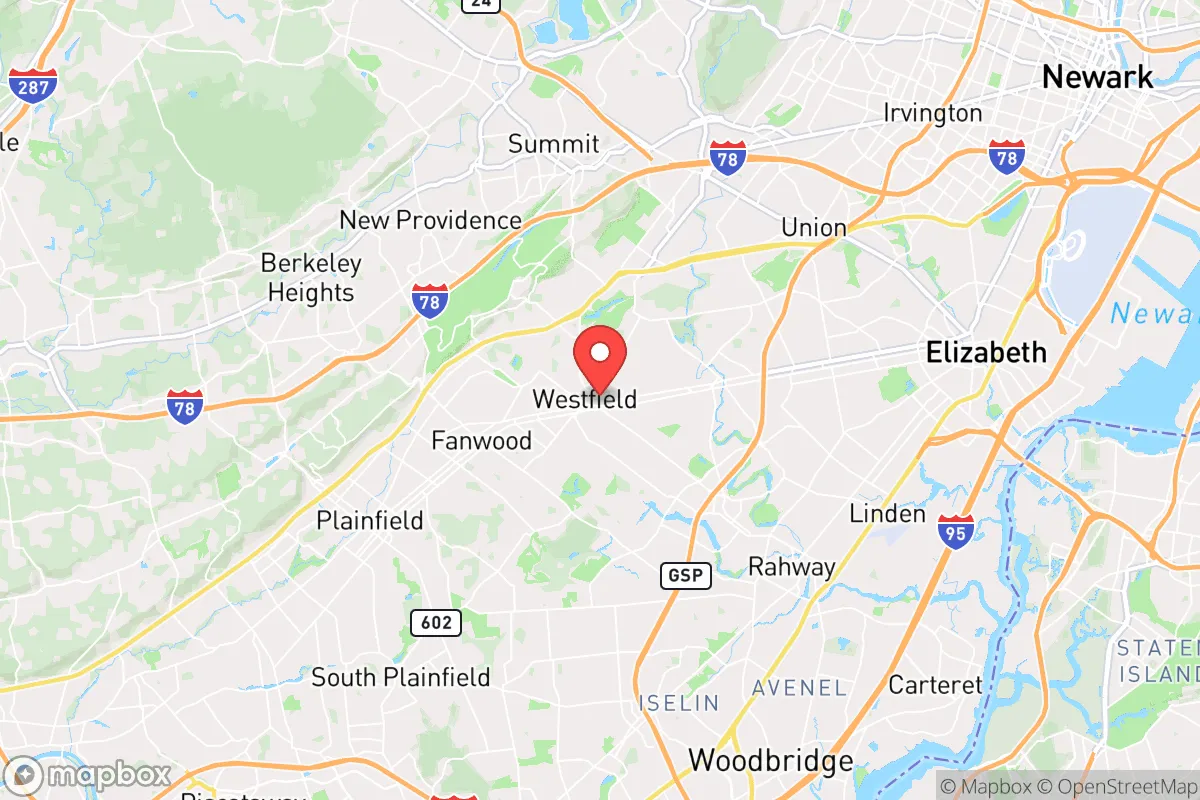
Westfield sits in Union County, roughly 20 miles southwest of Midtown Manhattan, placing it within the outer ring of the New York metropolitan area’s suburban sprawl. The town’s natural advantages are modest but meaningful. It lies on relatively high ground compared to the coastal flood zones of Jersey City and Hoboken, and the Watchung Mountains to the west provide a minor topographic buffer. The Rahway River runs through the town, but it’s a small, easily contaminated waterway—not a reliable long-term water source. The soil is decent for gardening, and many older homes have deep, usable backyards. The tree canopy is dense, offering some visual screening from main roads. However, the critical flaw is the town’s position within the "bowl" of the New York metro area. Any major event—a grid-down scenario, a biological release, or a coordinated attack on the Northeast Corridor—will see Westfield flooded with evacuees from Newark, Elizabeth, and the Hudson River waterfront. The town’s natural advantages are purely local; they offer no strategic depth against a regional collapse.
Risks, exposures, and proximity to fallout-relevant landmarks
This is where the analysis gets sobering. Westfield is within a 15-mile radius of Newark Liberty International Airport, Port Newark, and the Elizabeth Marine Terminal—all high-value targets for any adversary looking to cripple the U.S. supply chain. The town is also directly under the approach path for Newark’s runways, meaning any airborne incident—accidental or deliberate—could rain debris or contamination onto the community. The Rahway River and the nearby Arthur Kill waterway are potential vectors for chemical or biological agents released upstream. More concerning is the town’s proximity to the Linden Cogeneration Plant and the Linden Airport, both of which sit near large fuel storage facilities. A conventional or EMP attack on these targets could produce a cascading failure of power, fuel, and communications across the region. For the prepper, the key takeaway is that Westfield is not a remote sanctuary; it is a suburban buffer zone. The risk of being caught in a secondary effect—panic-driven evacuation, supply chain interruption, or localized contamination—is high. The town’s police and fire departments are competent, but they will be overwhelmed within hours of a major event in New York or Newark.
Practical resilience for a relocator: food, water, energy, and defensibility
For the relocator serious about self-sufficiency, Westfield offers a mixed bag. Water: The municipal supply comes from the Elizabethtown Water Company, which draws from the Raritan River and the Spruce Run Reservoir. This is a centralized, vulnerable system. A prepper should plan on at least two weeks of stored water per person, plus a Berkey or similar gravity filter for rainwater collection. The Rahway River is not potable without heavy filtration and boiling. Food: The town has a strong farmers’ market and several small grocers, but the major supermarkets (ShopRite, Kings) are located on main arteries that will gridlock in a crisis. A deep pantry and a garden are non-negotiable. The soil is workable, and many homeowners have space for raised beds. Energy: PSE&G is the utility provider, and the grid is reliable in normal times but fragile in a regional event. Solar panels with battery storage are a wise investment, but HOA restrictions in some neighborhoods may limit installation. A dual-fuel generator (gasoline/propane) is a more realistic first step. Defensibility: Westfield’s layout is a double-edged sword. The downtown is compact and walkable, which is good for community cohesion but bad for perimeter defense. The residential streets are narrow and winding, offering some natural chokepoints, but the town is crisscrossed by major roads (Routes 28, 124, and the Garden State Parkway) that will become evacuation corridors. A single-family home on a corner lot with a fenced backyard is the minimum defensible position. The town’s police force is well-regarded, but in a prolonged crisis, you cannot rely on them for protection. Your best defense is a low profile, a well-stocked home, and a network of like-minded neighbors.
The overall strategic picture for Westfield is one of conditional viability. It is not a bug-out location; it is a hold-in-place option for those who can afford the real estate and are willing to invest in serious prepping. The town’s conservative leanings—it votes reliably Republican in local and national elections—mean that the community is more likely to value self-reliance and mutual aid than many of its neighbors. But the proximity to New York and Newark is a permanent liability. If you are looking for a place to ride out a short-term disruption (a week-long power outage, a localized riot), Westfield is a solid choice. If you are planning for a long-term collapse, you need a secondary location farther west—perhaps in the Poconos or the Finger Lakes—and a plan to get there before the roads are clogged. Westfield is a good base for the prepared conservative, but only if you treat it as a forward operating base, not a final redoubt.

* Values derived from national, state, county, city and local statistics and may differ in a specific area. Last updated: 2026-04-30T07:58:06.000Z
Narrative content on this page is AI-generated and may contain mistakes. Verify any details that matter before acting on them.
ReloMaps may earn a commission from affiliate links at no extra cost to you.

