Photo: Wikipedia
Demographics of White Plains, NY
Affluence Level in White Plains, NY
An upper-middle-class area. Household wealth, education levels, and homeownership run ahead of national benchmarks.
People of White Plains, NY
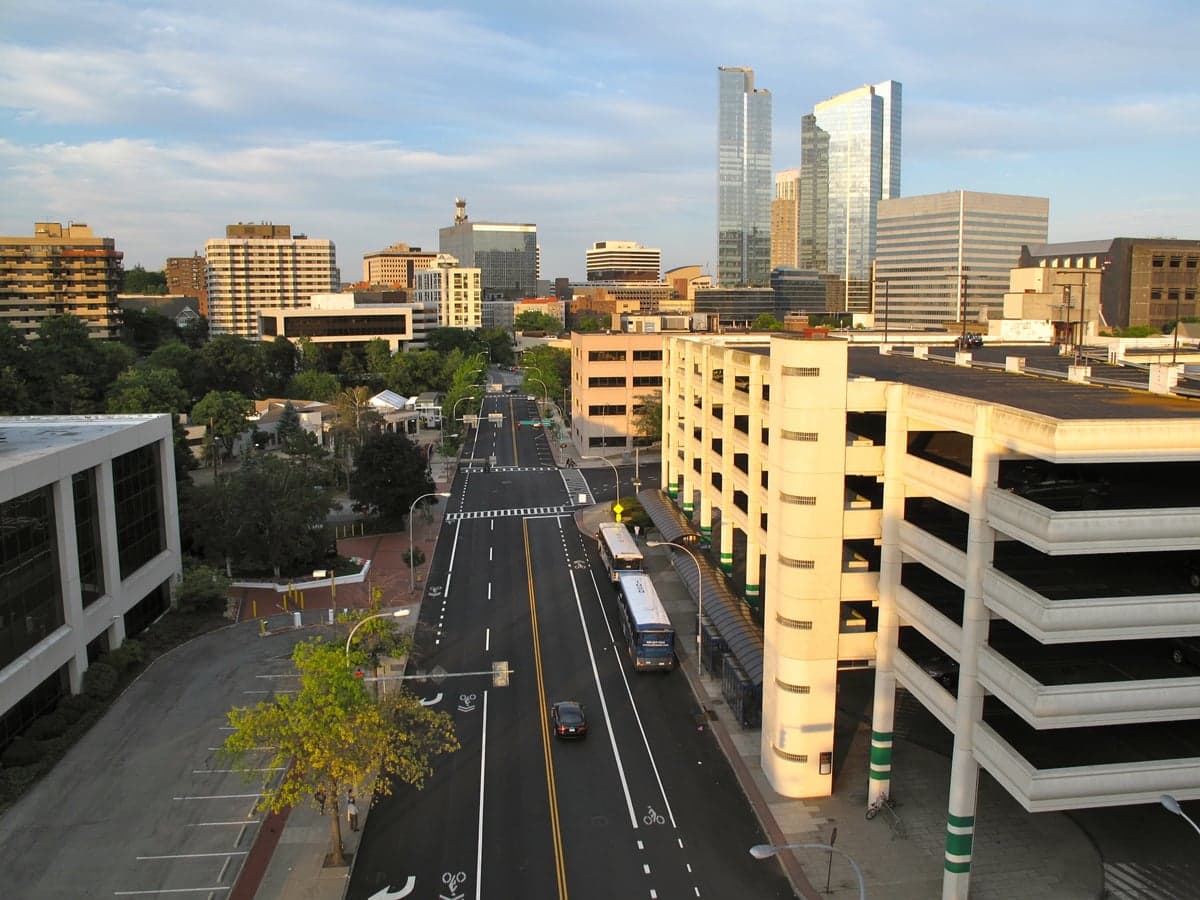
White Plains, New York, is a densely developed city of 59,818 residents that functions as the commercial and governmental hub of Westchester County. Its population is notably diverse and highly educated, with 53.3% holding a college degree, yet it retains a distinctly suburban character with historic neighborhoods that reflect distinct waves of settlement. The city's identity today is shaped by a majority-minority population — 43.9% White, 32.9% Hispanic, 11.4% Black, 4.7% East/Southeast Asian, and 3.7% Indian — and a foreign-born share of 12.8% that is lower than many nearby suburbs, suggesting a population that is increasingly native-born and second-generation.
How the city was settled and grew
White Plains was originally settled by English colonists in the 1680s, who purchased the land from the Weckquaesgeek tribe. The city's name derives from the white balsam trees that covered the area, and its early economy was agricultural, with the village serving as a market center for surrounding farms. The arrival of the New York and Harlem Railroad in 1844 transformed White Plains into a commuter suburb for Manhattan, drawing Irish and German immigrants who worked on the railroad and in local trades. These groups settled in the Fenway and Battle Hill neighborhoods, where modest worker cottages and rowhouses still stand. By the early 20th century, Italian and Eastern European Jewish immigrants arrived, establishing themselves in the Rosedale and Lake Street areas, often working as small business owners or in the growing downtown retail sector. The post-World War II boom brought a wave of upwardly mobile white families from New York City, who filled new suburban-style developments in Gedney Farms and Highlands, neighborhoods characterized by larger single-family homes on tree-lined streets.
Modern era (post-1965)
The Immigration and Nationality Act of 1965, combined with the broader suburbanization of Westchester County, reshaped White Plains' demographics significantly. Black families, who had been a small presence since the early 1900s, began moving into the Fenway and Battle Hill neighborhoods in larger numbers during the 1970s and 1980s, as older white residents aged and moved further north. Hispanic immigration — primarily from Puerto Rico, the Dominican Republic, and later Central America — accelerated in the 1980s and 1990s, with new arrivals concentrating in the Lake Street corridor and the area around Mamaroneck Avenue. These neighborhoods became commercial hubs for Latin American groceries, restaurants, and bodegas. East/Southeast Asian immigration, notably from China and Korea, began in the 1990s and has remained modest, with families settling in the Gedney Farms and Highlands areas, drawn by the strong school system. Indian immigration — from India, Pakistan, and Bangladesh — is a more recent phenomenon, accelerating after 2000, with professionals clustering in Rosedale and the downtown condominium towers. The city's white population has declined from roughly 70% in 1980 to 43.9% today, while the Hispanic share has grown steadily. The Black population has remained relatively stable, hovering around 11-12% since the 1990s.
The future
White Plains is not homogenizing; rather, it is tribalizing into distinct, stable enclaves. The Hispanic population, concentrated in the central and southern neighborhoods, is the fastest-growing segment, driven by both immigration and higher birth rates. This group is increasingly native-born, with second-generation families moving into the Fenway and Battle Hill areas, which are becoming more mixed. The white population, concentrated in the northern neighborhoods of Gedney Farms and Highlands, is aging and slowly declining, though it is being partially replenished by young professionals and empty-nesters moving into downtown luxury apartments. The East/Southeast Asian and Indian communities are small but growing, driven by corporate relocations to Westchester County's business parks; they are likely to remain concentrated in the higher-income northern and eastern sections. The foreign-born share of 12.8% is low for a diverse New York suburb, suggesting that assimilation is outpacing new immigration. Over the next 10-20 years, the city will likely become more Hispanic and more native-born, with the white share continuing a slow decline. The downtown area will densify further, while the historic single-family neighborhoods will remain stable.
For a conservative-leaning individual or family considering a move, White Plains offers a stable, well-run city with strong schools and a low crime rate relative to its density. The population is becoming more Hispanic and more native-born, but the city's historic neighborhoods remain distinct and largely safe. The key trade-off is between the convenience of a walkable downtown and the higher taxes and housing costs that come with Westchester County's services. The city is not becoming a homogenized melting pot; it is a collection of distinct, stable enclaves where a newcomer can find a neighborhood that matches their preferences.

* Values derived from national, state, county, city and local statistics and may differ in a specific area. Last updated: 2026-05-01T23:54:06.000Z
Narrative content on this page is AI-generated and may contain mistakes. Verify any details that matter before acting on them.
ReloMaps may earn a commission from affiliate links at no extra cost to you.

