 Popular
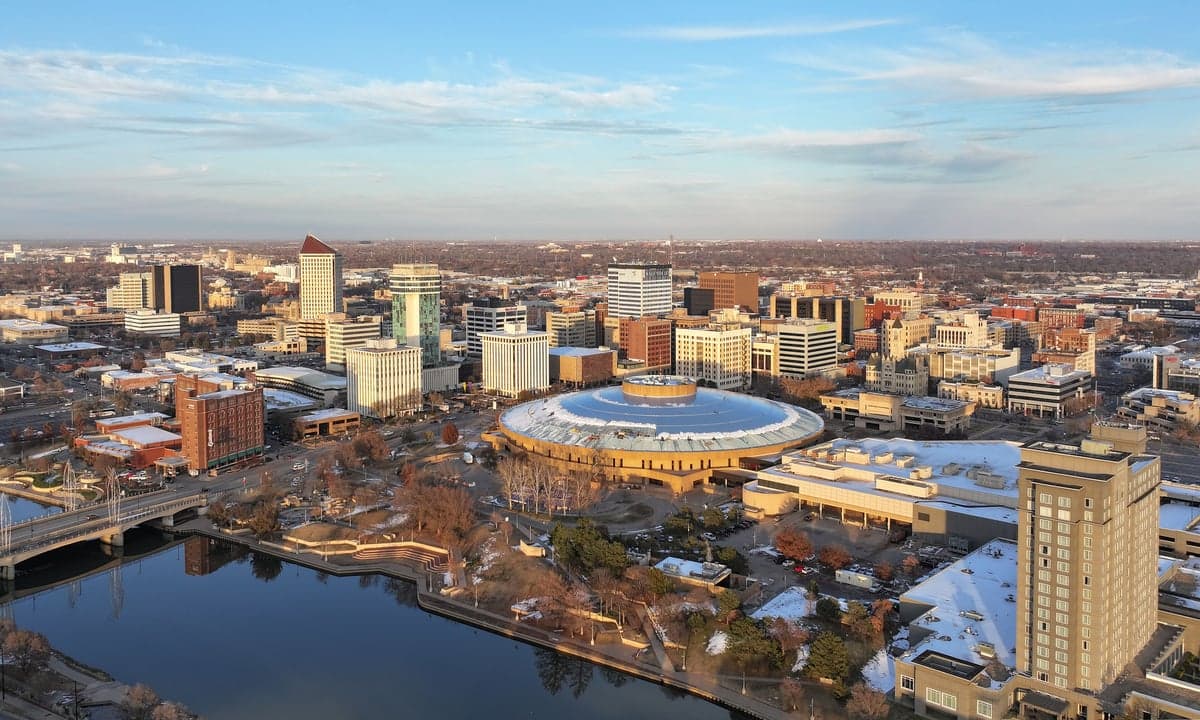
Photo: Wikipedia
Demographics of Wichita, KS
Affluence Level in Wichita, KS
A middle-class area roughly in line with national averages across income, home values, education, and employment.
People of Wichita, KS
The people of Wichita, Kansas today number 396,488, forming a city that is predominantly White (60.2%) with a substantial Hispanic minority (18.4%), a smaller Black population (9.6%), and growing East/Southeast Asian (4.1%) and Indian (0.7%) communities. The city’s character is shaped by its industrial roots—aviation and manufacturing—and a relatively low foreign-born share of 5.5%, which is below the national average. Wichita is denser than typical Great Plains cities, with a population concentrated in historic core neighborhoods and expanding suburban tracts, and it retains a distinctly Midwestern, blue-collar identity that is slowly diversifying.
How the city was settled and grew
Wichita’s population history begins with its founding in 1868 as a trading post on the Arkansas River, named after the Wichita people. The first major wave of settlers were Anglo-American cattle traders and merchants, drawn by the Chisholm Trail, which made Wichita a cowtown boomtown in the 1870s. These early residents built the Delano neighborhood (west of the river), which became a rough-and-tumble district of saloons and boarding houses for cowboys. By the 1880s, railroads replaced cattle drives, and German and Irish immigrants arrived to work in the rail yards and grain mills, settling in North Riverside and South Central neighborhoods. The city’s defining industrial wave came in the 1920s and 1930s, when the aircraft industry took root—companies like Beechcraft, Cessna, and Stearman (later Boeing) drew thousands of workers from the rural Midwest and the Dust Bowl states. These workers, mostly White and native-born, populated the College Hill and Eastborough districts, which remain stable, middle-class areas today. A smaller but significant Black population arrived during the Great Migration (1910–1970), primarily from Oklahoma and Arkansas, settling in the McAdams and Northeast neighborhoods, where they built churches and businesses despite segregation.
Modern era (post-1965)
After the 1965 Hart-Cellar Act, Wichita’s foreign-born population grew modestly, but the city did not see the large-scale immigration of coastal metros. The most notable post-1965 shift was the arrival of Southeast Asian refugees—Vietnamese, Laotian, and Cambodian—following the Vietnam War. These communities concentrated in the Planeview and South City neighborhoods, near the aircraft plants where many found work. Today, East/Southeast Asians make up 4.1% of the population, with a visible Vietnamese business corridor along South Broadway. The Hispanic population grew steadily from the 1980s onward, driven by Mexican immigrants and later Central Americans, drawn to meatpacking and construction jobs. They settled heavily in the South Central and West Wichita areas, where Spanish-language churches and tiendas are common. The Indian subcontinent population (0.7%) is smaller and more recent, arriving from the 1990s onward, largely as professionals in healthcare and engineering, and clustering in the East Wichita suburbs near the Kansas Turnpike. Domestic in-migration has been dominated by White retirees and remote workers from the coasts, drawn by low housing costs, who have pushed suburban growth into Andover and Goddard—towns that are functionally part of Wichita’s metro area. The city’s college-educated share (30.9%) is below the national average, reflecting its industrial workforce base.
The future
Wichita’s population is slowly diversifying, but the trend is toward distinct enclaves rather than wholesale integration. The Hispanic share is projected to rise to roughly 22–25% by 2040, driven by higher birth rates and continued immigration, with South Central and West Wichita becoming more solidly Hispanic. The East/Southeast Asian population is plateauing, as second-generation Vietnamese and Cambodians assimilate and move to suburban tracts like Eastborough. The Indian community remains small but is growing through professional recruitment, likely concentrating further in East Wichita. The White population is aging and declining in absolute numbers, as younger Whites leave for coastal cities or retire to Sun Belt states. The city is not homogenizing; instead, it is tribalizing into distinct ethnic and economic zones, with the core neighborhoods (Delano, McAdams) becoming poorer and more diverse, while the outer suburbs (Andover, Goddard) remain overwhelmingly White and middle-class. The foreign-born share may rise to 7–8% by 2035, but Wichita will remain a predominantly native-born, Midwestern city.
For someone moving in now, Wichita offers a low-cost, stable environment with a clear neighborhood character—choose College Hill for historic homes and walkability, South Central for Hispanic community life, or Andover for suburban schools and safety. The city is becoming more diverse but not dramatically so, and its industrial identity means jobs in aviation and manufacturing remain central. It is a place where newcomers can find a defined niche, but not a melting pot.

* Values derived from national, state, county, city and local statistics and may differ in a specific area. Last updated: 2026-04-30T23:46:43.000Z
Narrative content on this page is AI-generated and may contain mistakes. Verify any details that matter before acting on them.
ReloMaps may earn a commission from affiliate links at no extra cost to you.

