 Popular
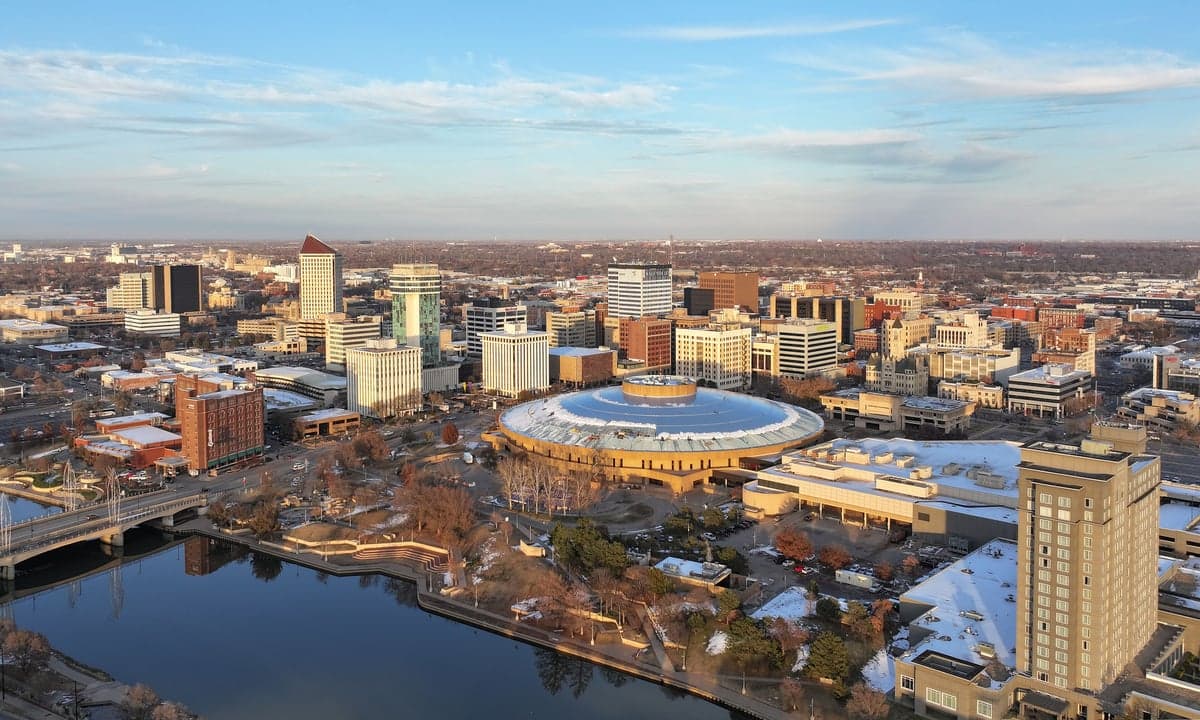
Photo: Wikipedia
Personal Sovereignty in Wichita, KS
Viable for self-reliance. Generally workable, though some barriers may limit total independence.
What does Personal Sovereignty tell us?
Personal Sovereignty measures your capacity for self-reliance and independence with minimal government friction. Higher scores mean fewer barriers between you and the way you want to live... but it assumes you have the space you need and good neighbors.
What does this tell us?
Personal Sovereignty measures your capacity for self-reliance and independence with minimal government friction. Higher scores mean fewer barriers between you and the way you want to live... but it assumes you have the space you need and good neighbors.
State Policy
Energy independence: Self-sufficient (80% of energy produced in-state)
Personal Liberty
Homesteading

Personal Liberty Analysis
Wichita, Kansas offers a notably high degree of personal sovereignty compared to many urban centers in the United States, particularly for those who prioritize minimal government interference in daily life, self-defense rights, and the ability to live according to one’s own values. The city operates within a state framework that consistently ranks among the most liberty-friendly in the nation, with low taxes, strong firearm protections, and a legal environment that generally respects individual decision-making over state mandates. For single individuals and parents who view government overreach as a growing threat to personal freedoms, Wichita presents a practical, grounded alternative to the regulatory-heavy climates of the coasts or even neighboring states like Colorado or Missouri. The trade-offs are real—limited public transit, a slower pace of life, and a less diverse economy—but for those prioritizing autonomy, the calculus often favors the Air Capital.
Tax burden and regulatory posture: How Kansas compares to high-tax states
Kansas’s tax structure is a significant draw for those seeking to keep more of their earnings and avoid the creeping fiscal control seen in states like California, New York, or Illinois. The state income tax is a flat rate of 5.7% as of 2026, with no progressive brackets that penalize higher earners. Property taxes in Sedgwick County average around 1.3% of assessed value, which is moderate nationally but notably lower than in high-tax states like New Jersey (2.5%) or Texas (1.8% with no state income tax). Sales tax in Wichita is 8.5% (state + local), which is higher than the state average but still below many major metros. More importantly, Kansas has no estate tax, no inheritance tax, and no tax on Social Security benefits—a clear signal that the state intends to let residents keep what they earn. On the regulatory front, Kansas is a right-to-work state, meaning union membership cannot be compelled as a condition of employment, and occupational licensing requirements are less burdensome than in many states. For a prepper or survivalist mindset, this means fewer bureaucratic hurdles to starting a side business, running a home-based trade, or simply living without constant paperwork demands from the state.
Self-defense and gun law specifics: What Wichita residents can legally do
Kansas is a constitutional carry state, and Wichita fully reflects that. Since 2015, any law-abiding adult 21 or older can carry a concealed firearm without a permit, and open carry is legal without a license for those 18 and older. The state preempts local gun ordinances, meaning Wichita city officials cannot pass stricter laws than the state—a critical protection against the patchwork of restrictions seen in places like Denver or Seattle. Stand-your-ground laws are in effect, with no duty to retreat in any place where a person has a legal right to be. The Castle Doctrine applies to homes, vehicles, and workplaces. For parents, this means the legal framework supports the right to defend one’s family without fear of prosecution for using force in a justified situation. Kansas also prohibits the seizure of firearms during declared emergencies—a direct response to the overreach seen in other states during civil unrest or health crises. Magazine capacity limits, assault weapon bans, and red flag laws are all absent from Kansas statutes. For anyone concerned about the erosion of Second Amendment rights nationally, Wichita offers a legal environment where self-defense is treated as a fundamental right, not a privilege subject to government discretion.
Self-reliance and homesteading viability: Lot sizes, zoning, and off-grid feasibility
Wichita’s zoning and land-use policies are generally favorable to self-reliance, though the city’s urban core imposes more restrictions than the surrounding county. Inside city limits, standard residential lots range from 6,000 to 10,000 square feet, with some newer subdivisions offering larger parcels up to half an acre. However, keeping chickens, goats, or bees is permitted in most residential zones with minimal permitting, and the city allows front-yard vegetable gardens without restriction. For those seeking true homesteading, the unincorporated areas of Sedgwick County and neighboring Butler County offer 1-to-5-acre parcels at prices often under $10,000 per acre—far cheaper than comparable land in Colorado or the Pacific Northwest. Off-grid living is legally feasible outside city limits: rainwater collection is unrestricted, composting toilets are allowed with proper septic permits, and solar panel installation faces no HOA or city-level bans in unincorporated areas. The county does not enforce building codes on agricultural structures, which can be used for workshops, storage, or even temporary living quarters. For a prepper, this means the ability to establish a semi-autonomous property with food production, water independence, and energy resilience within a 20-minute drive of Wichita’s hospitals and supply chains—a balance of isolation and access that is increasingly rare in the Lower 48.
Personal liberties: Parental rights, medical autonomy, speech, and property
Kansas has been a battleground for parental rights, and the current legal landscape strongly favors family autonomy. The state’s Parental Bill of Rights, enacted in 2023, explicitly affirms that parents have the fundamental right to direct the upbringing, education, and healthcare of their children. This includes the right to opt children out of any school curriculum or activity without penalty, and to access all educational and medical records without bureaucratic obstruction. Medical autonomy is similarly robust: Kansas does not have a state vaccine mandate for children attending public school (only standard childhood immunizations are required, with broad exemption options), and there is no state-level mask or lockdown authority that can override individual choice. During the COVID-19 pandemic, Kansas was one of the few states where the legislature actively curtailed the governor’s emergency powers, a precedent that remains in place. Free speech protections are strong, with no hate speech laws that criminalize political or religious expression, and property rights are reinforced by the state’s strict eminent domain laws, which limit government seizure for private development. For a conservative-leaning individual or parent, Wichita offers a legal environment where the default assumption is that you—not the state—know what is best for your family, your body, and your land.
In the broader context of American personal sovereignty, Wichita ranks as a strong contender for those seeking to escape the regulatory creep of blue states while maintaining access to urban infrastructure. It lacks the extreme libertarian ethos of rural Idaho or the tax-free haven of New Hampshire, but it compensates with a lower cost of living, a central location, and a legal framework that consistently sides with individual rights over collective mandates. For a single person or family evaluating relocation through a survivalist or prepper lens, Wichita is not a bug-out location—it is a viable, long-term base of operations where the government is more of a background presence than a daily adversary. The city’s political culture, while not uniformly conservative, leans center-right in practice, and the state’s constitutional protections provide a buffer against the worst impulses of federal overreach. If your priority is to live with minimal interference, maximum self-defense capability, and the legal room to build a resilient, self-sufficient life, Wichita deserves a serious look.

* Values derived from national, state, county, city and local statistics and may differ in a specific area. Last updated: 2026-04-30T23:46:43.000Z
Narrative content on this page is AI-generated and may contain mistakes. Verify any details that matter before acting on them.
ReloMaps may earn a commission from affiliate links at no extra cost to you.

