Photo: Wikipedia
Demographics of Winchester, VA
Affluence Level in Winchester, VA
A middle-class area roughly in line with national averages across income, home values, education, and employment.
People of Winchester, VA
The people of Winchester, VA today form a compact, historically rooted community of 27,981 residents, characterized by a white majority (62.7%) and a substantial Hispanic population (20.1%) that has reshaped the city’s cultural landscape over the past three decades. With a foreign-born share of 9.1% and a college-educated rate of 31.6%, the city blends working-class resilience with a growing professional class, anchored by local healthcare, manufacturing, and retail sectors. Distinctive identity markers include a strong sense of place tied to the Shenandoah Valley’s agricultural heritage, a visible Latino presence in neighborhoods like the North End and West End, and a steady influx of commuters drawn by lower housing costs relative to Northern Virginia and Washington, D.C.
How the city was settled and grew
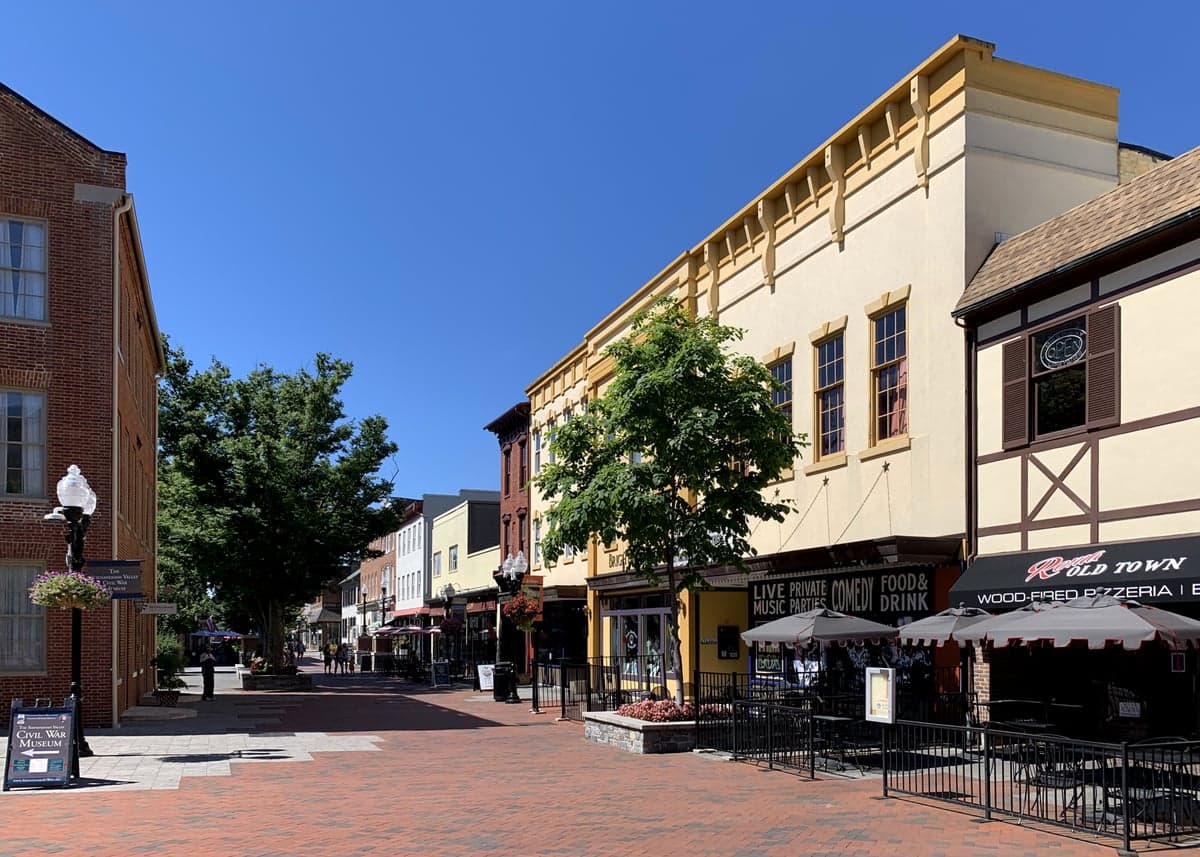
Winchester’s population history begins with its 1744 founding by European settlers, primarily Scots-Irish and German farmers who were granted land in the fertile Shenandoah Valley under Lord Fairfax’s proprietary. The city’s strategic location at the intersection of the Great Wagon Road and the Valley Pike made it a regional trading hub, and by the early 19th century, it had become a center for milling, tanning, and later, apple orchards. The Old Town district, with its grid of brick streets and 18th-century stone buildings, was built by these early settlers and their enslaved African laborers, who constituted roughly 25% of the population by 1800. The post-Civil War era saw a slow influx of freed Black families, who established the North End neighborhood around the city’s historically Black commercial corridor on North Kent Street. The early 20th century brought a wave of Italian and Lebanese immigrants, drawn by railroad and factory jobs, who settled in the West End near the Winchester & Western Railroad yards. By 1950, the population had reached 15,000, overwhelmingly white and native-born, with a small but established Black community concentrated in the North End.
Modern era (post-1965)
The 1965 Hart-Cellar Act had a modest immediate impact on Winchester, but the city’s demographic transformation accelerated sharply after 1990. The primary driver was the expansion of the poultry processing industry in the Shenandoah Valley, which drew a large wave of Mexican and Central American immigrants to fill labor shortages. These newcomers settled predominantly in the West End and the South End, areas with older, affordable housing stock and proximity to industrial employers like Cargill and Tyson Foods. By 2020, the Hispanic share had grown from under 2% in 1990 to 20.1%, making it the city’s largest minority group. The Black population, at 8.8%, has remained relatively stable, with families still concentrated in the North End but also dispersing into newer subdivisions like Appleland and Shawnee Springs. East and Southeast Asian communities (1.7%) and Indian-subcontinent residents (0.7%) are small but growing, often drawn by professional jobs at Valley Health System and the Winchester Medical Center, and tend to settle in the South End and newer developments near Interstate 81. Domestic in-migration from Northern Virginia and the D.C. metro area has also increased since 2010, bringing a wave of white and Asian professionals seeking lower home prices and a slower pace of life, particularly in the South End and the Appleland area.
The future
Winchester’s population is heading toward greater diversity, but not toward rapid homogenization. The Hispanic community is the fastest-growing segment, projected to reach 25-28% of the city’s population by 2040, driven by both immigration and higher birth rates. This growth is likely to deepen the cultural and economic character of the West End and South End, where Latino-owned businesses, churches, and community organizations are already well-established. The white population, while still the majority, is aging and declining slightly in absolute numbers, as younger white families often move to outlying suburbs like Stephens City or Middletown for larger lots and lower taxes. The Black population is expected to remain stable or grow modestly, with some movement from the historic North End into newer subdivisions. East and Southeast Asian and Indian communities are likely to grow slowly, primarily through professional migration, and will remain dispersed rather than forming distinct ethnic enclaves. The city is not tribalizing into rigid enclaves; rather, it is experiencing a gradual, layered diversification where older neighborhoods retain their historic character while newer areas become more mixed. For someone moving in now, Winchester offers a community that is becoming more culturally varied but remains anchored by its small-town feel, affordable housing, and proximity to the D.C. job market.
Winchester is becoming a more diverse, working-to-middle-class city where the historic white majority is slowly giving way to a growing Hispanic plurality, while Black, Asian, and Indian communities add smaller but meaningful layers. For a conservative-leaning newcomer, this means a place where traditional values of community and self-reliance coexist with a visible immigrant presence, particularly in the West End and South End, and where the pace of change is steady but not disruptive. The city’s future is one of gradual demographic evolution, not revolution, making it a stable choice for families and individuals seeking affordability and a rooted sense of place.

* Values derived from national, state, county, city and local statistics and may differ in a specific area. Last updated: 2026-05-01T01:48:50.000Z
Narrative content on this page is AI-generated and may contain mistakes. Verify any details that matter before acting on them.
ReloMaps may earn a commission from affiliate links at no extra cost to you.

