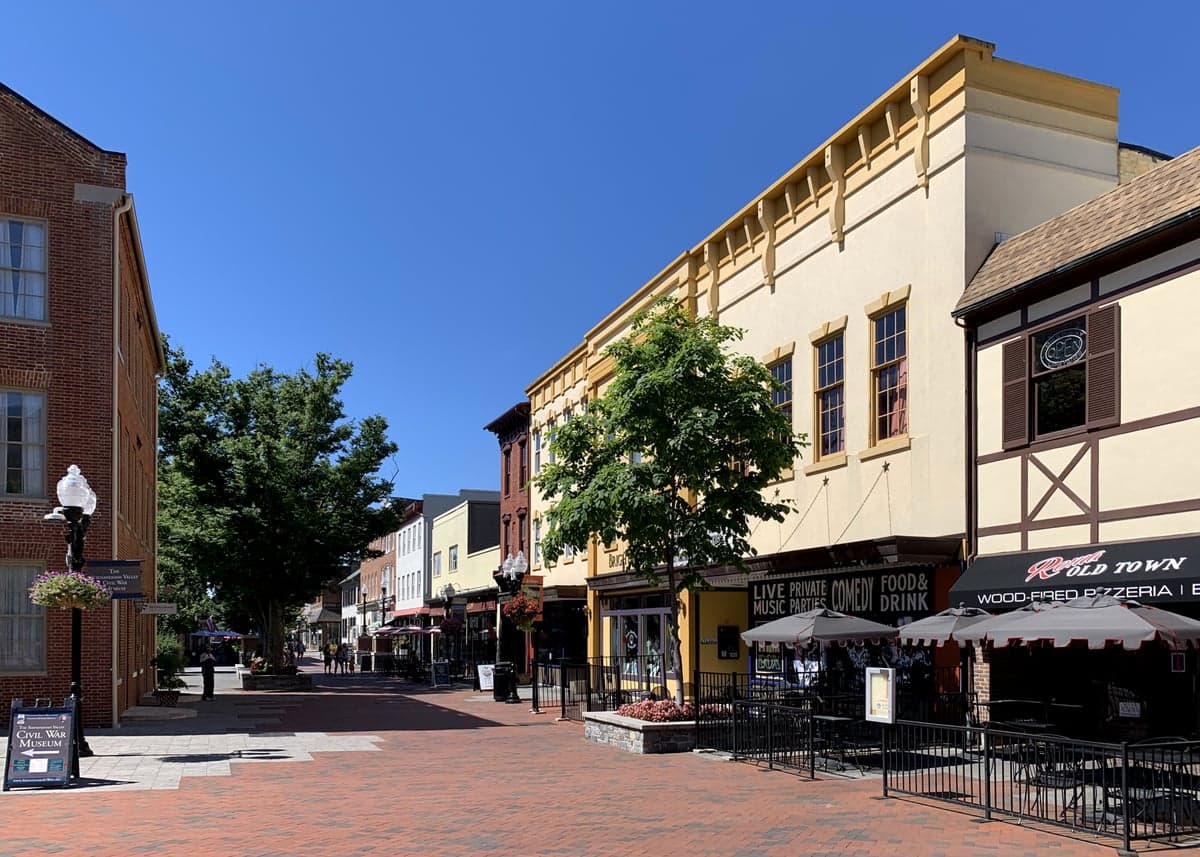
Photo: Wikipedia
Personal Sovereignty in Winchester, VA
Viable for self-reliance. Generally workable, though some barriers may limit total independence.
What does Personal Sovereignty tell us?
Personal Sovereignty measures your capacity for self-reliance and independence with minimal government friction. Higher scores mean fewer barriers between you and the way you want to live... but it assumes you have the space you need and good neighbors.
What does this tell us?
Personal Sovereignty measures your capacity for self-reliance and independence with minimal government friction. Higher scores mean fewer barriers between you and the way you want to live... but it assumes you have the space you need and good neighbors.
State Policy
Energy independence: Importer (20% of energy produced in-state)
Personal Liberty
Homesteading

Personal Liberty Analysis
Winchester, Virginia, offers a notably high degree of personal sovereignty relative to much of the Mid-Atlantic, functioning as a practical buffer zone between the heavy regulatory climates of Northern Virginia and the more permissive environments further south and west. For the individual or family prioritizing autonomy—whether that means minimal government intrusion into daily life, the ability to keep and bear arms without excessive friction, or the freedom to pursue self-reliant living—Winchester and its surrounding Frederick County present a workable, if not perfect, balance. The city itself leans more moderate, but the county and state-level legal framework provide a foundation that respects individual decision-making, particularly when compared to neighboring states like Maryland or the District of Columbia.
Tax burden and regulatory posture in Winchester and Frederick County
Virginia is a right-to-work state with a generally business-friendly regulatory environment, and Winchester reflects that posture without the extreme costs found in the D.C. suburbs. The state income tax is a flat rate of 5.75%, which is moderate, but there is no local income tax in Winchester or Frederick County—a significant advantage over jurisdictions that layer on county-level income levies. Property taxes are reasonable, with Frederick County’s rate hovering around $0.55 per $100 of assessed value, and Winchester’s slightly higher at roughly $0.62. For a survivalist or prepper mindset, the absence of a local income tax means less government claim on your earnings, leaving more capital for land, supplies, and infrastructure. The regulatory posture is also favorable: Virginia has no statewide building code that prohibits off-grid systems outright, though local zoning in Winchester’s city limits is more restrictive. Frederick County, however, allows for agricultural and rural residential zoning that permits accessory structures, workshops, and even small-scale farming without the bureaucratic gauntlet seen in more urbanized areas. The state’s right-to-work laws also mean fewer union-imposed constraints on construction or trade work, which matters if you plan to build or retrofit a property yourself.
Self-defense and gun law specifics in Virginia’s Shenandoah Valley
Virginia is a shall-issue state for concealed carry permits, meaning the sheriff’s office in Frederick County must issue a permit if you meet the basic requirements—no subjective “good cause” hurdle like in Maryland or New York. The process is straightforward: a background check, proof of competency (typically a hunter safety or NRA course), and a fee. Winchester’s local gun culture is strong, with multiple gun shops, indoor ranges, and a thriving community of competitive shooters and hunters. Open carry is legal without a permit for anyone 18 or older who can legally possess a firearm, and the state preempts local governments from enacting their own gun bans—so Winchester City cannot impose its own AWB or magazine restrictions, even if the city council leans left. However, there are recent state-level changes to be aware of: Virginia passed a “red flag” law (Emergency Substantive Risk Order) in 2020, and a one-handgun-per-month limit was reinstated. These are real erosions of sovereignty that a prepper should factor in. Still, compared to Maryland, where a carry permit remains difficult to obtain and magazine capacity is capped at 10 rounds, Winchester offers a far more permissive environment. For the strategic-minded, Frederick County’s sheriff has publicly stated he will not enforce unconstitutional gun laws, which provides an additional layer of practical protection against overreach.
Self-reliance and homesteading viability: lot sizes, zoning, and off-grid feasibility
Winchester’s city limits are dense and restrictive—most residential lots are under a quarter-acre, and the city zoning code requires connection to municipal water and sewer, making true off-grid living impractical within the city. The real opportunity lies in Frederick County, where you can find rural residential lots of 1 to 5 acres for under $50,000, and larger tracts of 10 to 20 acres for serious homesteading. The county’s zoning for Agricultural (A) and Rural Areas (RA) permits livestock, poultry, beekeeping, and even small-scale commercial agriculture without a special use permit. Rainwater collection is legal in Virginia, and there are no state-level restrictions on solar panel installation, though homeowners’ associations in some subdivisions may impose covenants—so always check the deed restrictions before buying. Off-grid power is feasible: net metering is available for grid-tied solar, and standalone systems with battery storage are unregulated at the county level. Wells and septic systems are permitted in rural zones, though the health department requires permits and testing. For the prepper, the key limitation is that Frederick County does require building permits for any structure over 200 square feet, so a large shed or workshop will need approval. But compared to counties in Maryland or Pennsylvania that ban composting toilets or require minimum square footage for dwellings, Winchester’s rural areas are relatively hands-off. The growing season is about 170 days, suitable for corn, beans, squash, and hardy greens, and the local soil is generally fertile limestone-based loam.
Personal liberties: parental rights, medical autonomy, speech, and property
Virginia’s legal framework provides strong protections for parental rights, particularly in education. The state has a robust homeschool statute that requires only a notice of intent and a basic curriculum description—no portfolio reviews or standardized testing mandates for most families. Winchester has several active homeschool co-ops and a supportive community, with the Frederick County Public Schools system offering part-time enrollment for homeschoolers in elective courses. Medical autonomy is more mixed: Virginia did expand Medicaid under the ACA, which some see as government overreach, but the state does not have a vaccine mandate for adults, and religious exemptions for school vaccine requirements are still available (though the process has become more burdensome since 2021). For the survivalist, the presence of the Winchester Medical Center, a 445-bed regional hospital, is a practical asset—it’s one of the few Level II trauma centers in the Valley, and it’s not part of a massive urban healthcare system that might be overwhelmed in a crisis. Free speech is protected under the First Amendment, and Virginia has no state-level hate speech laws that chill political expression. Property rights are strong: Virginia is a “Dillon’s Rule” state, meaning local governments only have powers explicitly granted by the state, which limits the ability of Winchester City to impose radical land-use restrictions. Eminent domain abuse is less common here than in Northern Virginia, and the county has a history of resisting federal overreach on environmental regulations that would restrict private land use.
Overall, Winchester offers a sovereignty profile that is solidly above average for the Eastern Seaboard, but it is not a libertarian utopia. The state-level red flag law and the one-gun-per-month rule are genuine compromises that a prepper must account for, and the city itself is more restrictive than the surrounding county. However, the combination of reasonable taxes, shall-issue carry, viable rural homesteading land within 20 minutes of a regional hospital, and strong parental rights in education makes it one of the better options in Virginia for someone seeking to maximize personal autonomy while still having access to infrastructure. If your priority is absolute freedom from government oversight, you would need to look further west—West Virginia or Tennessee. But if you need to stay within commuting distance of D.C. or want a strategic position in the Shenandoah Valley with good medical and supply-chain access, Winchester is a defensible choice that respects individual sovereignty more than most places in the Mid-Atlantic.

* Values derived from national, state, county, city and local statistics and may differ in a specific area. Last updated: 2026-05-01T01:48:50.000Z
Narrative content on this page is AI-generated and may contain mistakes. Verify any details that matter before acting on them.
ReloMaps may earn a commission from affiliate links at no extra cost to you.

