Photo: Wikipedia
Political ClimatePolitical Climate in Douglas County
Showing district-level results — no local-only data available.
Local Political AnalysisPolitical Analysis of Douglas County
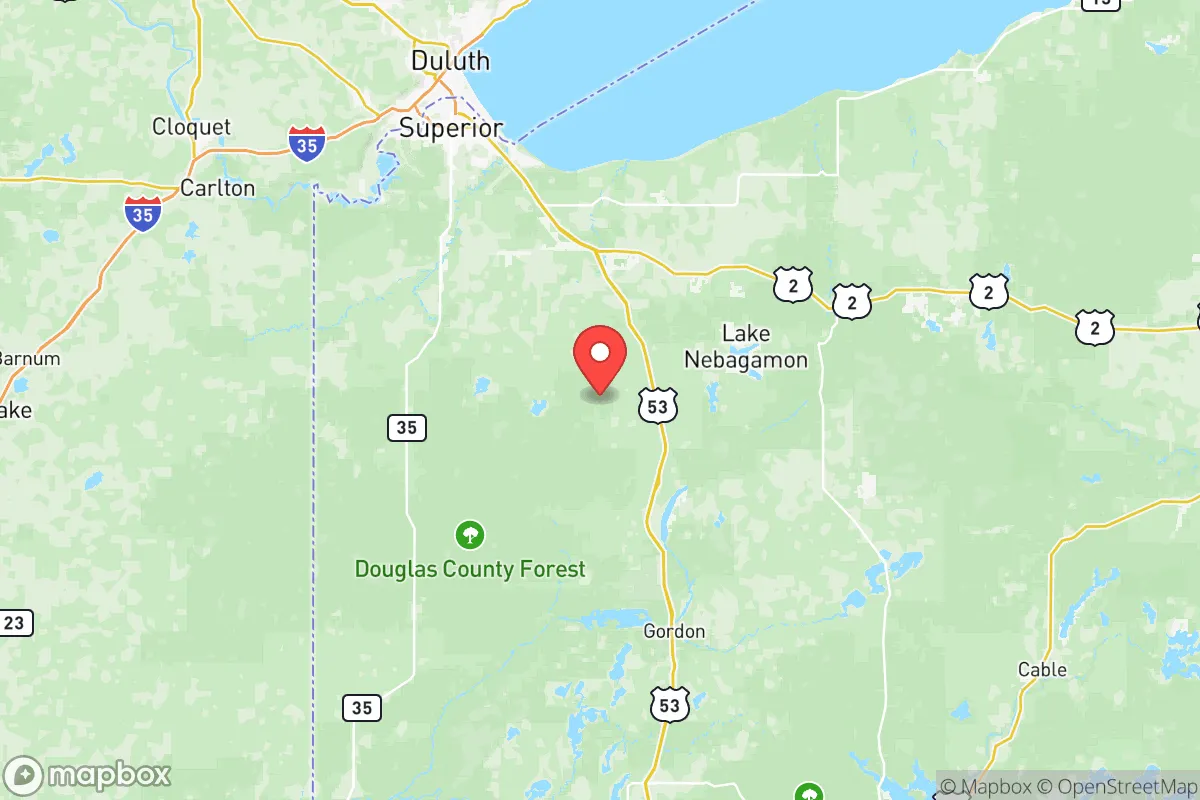
Douglas County has a Cook PVI of R+11, making it one of the more reliably conservative areas in Wisconsin, but that number hides a lot of local nuance. The county seat, Superior, leans blue—it’s a working-class port town with a strong union history—while the rural townships like Maple, Bennett, and Gordon are deep red. The real swing precincts are in the exurban fringe around Lake Nebagamon and Solon Springs, where independent-minded folks have shifted rightward over the past decade. Overall, the county has been trending redder since 2016, but the pace is slower than in some neighboring counties because of Superior’s Democratic anchor.
How it compares
Wisconsin as a whole has a Cook PVI of EVEN, meaning it’s a true battleground state that flips between parties every few cycles. Douglas County’s R+11 puts it about 11 points to the right of the state average, which is a big deal when you consider that Wisconsin’s statewide races are often decided by less than a point. For example, in 2024, Douglas County voted for Trump by about 12 points, while the state overall went for Biden by less than 1 point. That gap is driven by the rural townships—places like Wascott and Brule—where turnout is high and voters are consistently conservative. Meanwhile, Superior’s precincts vote blue by 15-20 points, but they’re outnumbered by the county’s landmass. Compared to the rest of Wisconsin, Douglas County is a reliable conservative stronghold in a state that’s otherwise a toss-up.
What this means for residents
For folks living here, the political climate means local government tends to be hands-off on personal freedoms—something I’ve seen erode in other parts of the state. The county board has resisted mask mandates, vaccine passports, and other overreach that’s become common in Dane or Milwaukee counties. Property taxes are relatively low, and there’s no county-level income tax, which keeps more money in your pocket. But there’s a growing concern: the progressive influence from Superior is creeping into countywide policies, especially around land use and environmental regulations. The push for stricter shoreline zoning on the St. Louis River and Lake Superior is a red flag for property owners who value their rights to develop their land. If the blue vote in Superior continues to grow, we could see more of that kind of government overreach in the next decade.
Culturally, Douglas County is still a place where people mind their own business and neighbors help each other without a government mandate. The hunting and fishing culture runs deep, and the Second Amendment is respected here—you won’t find the kind of gun control debates that dominate Madison. That said, the influx of remote workers from the Twin Cities is starting to shift the vibe in towns like Solon Springs and Lake Nebagamon. These newcomers often bring progressive voting habits, and if they keep coming, the county’s R+11 rating could slip. For now, though, Douglas County remains a solid conservative pocket in a purple state, where personal liberty is still the default—but you’ve got to keep an eye on the ballot box to make sure it stays that way.

State Political ClimatePolitical Climate in Wisconsin
State Political AnalysisPolitical Environment in the State
Wisconsin is a true battleground state, with a Cook PVI of EVEN, meaning it is perfectly split between the two major parties. Over the last 10-20 years, the state has shifted from a reliably blue-leaning state in presidential races (voting for Democrats from 1988 to 2012) to a pure toss-up, flipping for Donald Trump in 2016, Joe Biden in 2020, and then swinging back to Trump in 2024. The dominant coalition is a classic urban-rural split: Milwaukee and Madison drive Democratic margins, while the rest of the state—especially the WOW counties (Waukesha, Ozaukee, Washington) and the rural north and west—anchor the Republican base. The trajectory is a slow, grinding rightward shift in the exurbs and rural areas, offset by explosive Democratic growth in Dane County (Madison) and the Milwaukee suburbs.
Urban vs. rural divide
The political map of Wisconsin is a tale of two worlds. Milwaukee County and Dane County (Madison) are the Democratic strongholds, delivering margins of 60-75% for Democratic candidates. Madison, home to the University of Wisconsin, is a deep-blue progressive hub, while Milwaukee is a diverse, union-heavy city that reliably votes Democratic. The real story is in the suburbs: the WOW counties—Waukesha, Ozaukee, and Washington—are among the most Republican suburban counties in the nation, routinely voting 60-65% Republican. However, the inner-ring Milwaukee suburbs like Shorewood and Whitefish Bay have been trending left. Meanwhile, the rural northwoods (e.g., Vilas, Oneida, and Forest counties) and the western driftless region (e.g., Lafayette and Grant counties) are deeply red, with many precincts voting 70%+ Republican. The swing areas are the exurbs of Green Bay (Brown County) and the Fox Valley (Outagamie, Winnebago counties), which have moved rightward since 2012, flipping from Obama to Trump.
Policy environment
Wisconsin’s policy environment is a mixed bag for conservatives. On the plus side, the state has a flat income tax rate of 4.4% (down from a progressive 7.65% top rate in 2011), thanks to Republican-led reforms. Property taxes are moderate, and the state has a right-to-work law (2015) and is a "shall-issue" state for concealed carry. However, the state has a Democratic governor, Tony Evers, who has vetoed Republican bills on school choice expansion, election integrity, and tax cuts. The state’s education system is dominated by powerful teachers’ unions, and Madison and Milwaukee have imposed mask and vaccine mandates in the past. Election laws are a flashpoint: Wisconsin has no-excuse absentee voting, same-day voter registration, and a bipartisan election commission, but Republicans have pushed for stricter voter ID laws and limits on drop boxes. Healthcare is a mixed bag—the state expanded Medicaid under the Affordable Care Act, but private insurance markets are competitive. The regulatory posture is generally business-friendly outside of Dane and Milwaukee counties, but environmental regulations on farming (especially CAFOs) and mining are contentious.
Trajectory & freedom
Wisconsin is becoming more free in some areas, less in others. On the positive side, the state passed constitutional carry (Act 69) in 2024, eliminating the need for a permit to carry a concealed firearm. This was a major win for Second Amendment advocates. Additionally, the state has a strong parental rights law (Act 20, 2023) that requires school districts to notify parents of any changes to a student’s health or emotional well-being, and it bans instruction on gender identity and sexual orientation in grades K-3. Property rights are generally respected, though the state has a complicated process for eminent domain. On the negative side, the state’s emergency powers during COVID were heavily abused by Governor Evers, who issued multiple statewide mask mandates and business closures without legislative approval. The state Supreme Court, now controlled by a 4-3 liberal majority after the 2023 election, has upheld these mandates and struck down Republican-drawn legislative maps, ordering new maps that are more favorable to Democrats. This has led to a loss of legislative accountability. The state also has a highly centralized education system, with the Department of Public Instruction (led by a liberal superintendent) imposing curriculum mandates that conservatives view as overreach.
Civil unrest & political movements
Wisconsin has a history of intense political activism. The 2011 Act 10 protests against Governor Scott Walker’s collective bargaining reforms drew 100,000 people to the Capitol in Madison, and the state became a national symbol of labor unrest. More recently, the 2020 Kenosha riots after the Jacob Blake shooting saw businesses burned and two people killed, sparking a fierce debate over law and order. The state has a strong grassroots conservative movement, with groups like the Wisconsin Family Action and the Wisconsin Institute for Law & Liberty (WILL) actively litigating against progressive policies. Immigration politics are relatively muted compared to border states, but there is tension over sanctuary city policies in Madison and Milwaukee, which have declared themselves "welcoming cities" and limit cooperation with ICE. Election integrity remains a hot-button issue: the 2020 election saw widespread use of private grant money (from the Center for Tech and Civic Life) to fund election administration in Democratic cities, which Republicans view as illegal. The state has seen multiple recounts and lawsuits, and the 2024 election was again close, with Trump winning by less than 1%. There is a growing secessionist sentiment in rural counties, with some supervisors in Marathon and Clark counties floating the idea of joining a "State of Superior" or merging with the Upper Peninsula, though this is mostly symbolic.
Projection
Over the next 5-10 years, Wisconsin is likely to remain a purple state with a slight rightward tilt. Demographic trends favor Republicans: the state’s rural and exurban areas are growing slowly but are deeply red, while the urban cores of Milwaukee and Madison are losing population to the suburbs. In-migration from Illinois (especially from Cook County) is bringing more conservative-leaning families to the WOW counties and the Fox Valley. However, the liberal Supreme Court majority will continue to strike down Republican laws on abortion, election integrity, and legislative maps, making it harder for conservatives to govern. The state’s aging population (Wisconsin has one of the oldest median ages in the Midwest) means that issues like Social Security, healthcare costs, and property taxes will dominate. The biggest wildcard is the 2026 gubernatorial election: if a Republican wins the governorship, the state could see a wave of tax cuts, school choice expansion, and election reforms. If Evers or another Democrat wins, expect continued gridlock and executive overreach. For a conservative moving in, expect a state where your vote matters but your local government may be at odds with the state capital.
Bottom line for a new resident: Wisconsin offers a high quality of life with low crime in the suburbs, good schools in the WOW counties, and a strong sense of community. But be prepared for political whiplash: you’ll have a Republican legislature that passes conservative laws, a Democratic governor who vetoes them, and a liberal Supreme Court that rewrites the rules. If you value local control and low taxes, stick to the WOW counties or the rural northwoods. If you want a more progressive environment, Madison or Milwaukee are your options. Either way, your vote will count more here than in almost any other state.
* Values derived from national, state, county, city and local statistics and may differ in a specific area. Last updated: 2026-06-06T21:38:18.000Z
Narrative content on this page is AI-generated and may contain mistakes. Verify any details that matter before acting on them.
ReloMaps may earn a commission from affiliate links at no extra cost to you.

