Photo: Wikipedia
Demographics of Wolf Point, MT
Affluence Level in Wolf Point, MT
A below-average socioeconomic profile. Incomes, home values, and educational attainment trail the U.S., with higher poverty and unemployment.
People of Wolf Point, MT
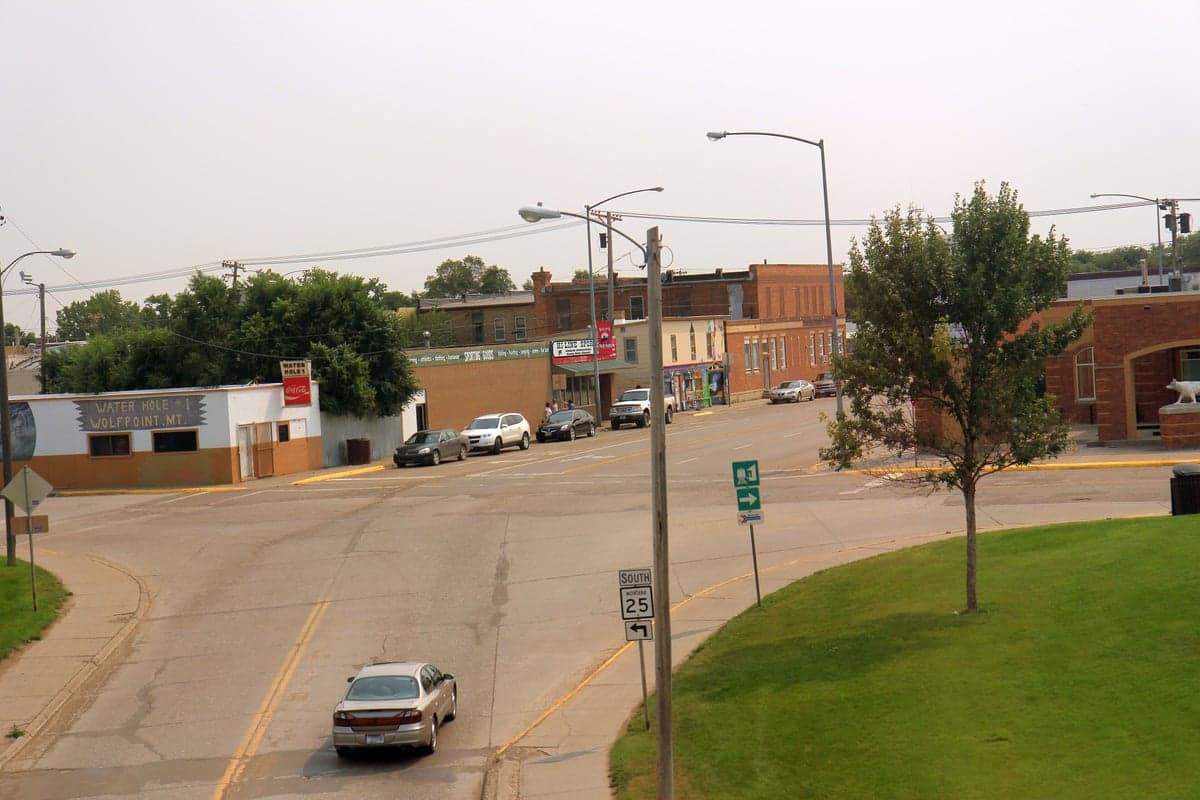
The people of Wolf Point, Montana, today number 2,604, forming a community defined by its majority Native American population and a deep-rooted sense of place along the Missouri River. The city is the seat of Roosevelt County and the largest population center on the Fort Peck Indian Reservation, giving it a distinctive character shaped by tribal governance, ranching, and a sparse, rural economy. With a median age of 33 and a low college attainment rate of 11.7%, the population is young, family-oriented, and closely tied to the land and local institutions.
How the city was settled and grew
Wolf Point’s human history begins with the Assiniboine and Sioux peoples, who used the area as a seasonal camp and trading post long before permanent white settlement. The city itself was founded in 1915 as a railroad town on the Great Northern Railway, which drew a wave of homesteaders—primarily of Northern European stock—seeking cheap land under the Enlarged Homestead Act of 1909. These early settlers, mostly farmers and ranchers, built the original core of the city around the railroad depot in what is now the Historic Downtown Wolf Point district, where grain elevators and brick storefronts still stand. A second wave came during the 1930s and 1940s as the Fort Peck Dam project brought construction workers and their families, many of whom stayed and settled in the North Side neighborhood, a working-class area of modest homes and small businesses. By mid-century, the population was roughly two-thirds white and one-third Native American, with the tribal community concentrated in the West End near the reservation boundary, where housing was more affordable and closer to tribal services.
Modern era (post-1965)
The post-1965 period saw a dramatic demographic shift as the Native American population grew through higher birth rates and a return of tribal members to the reservation, while the white population began a slow decline due to out-migration of young adults seeking jobs elsewhere. By 2020, the city’s racial composition had inverted: 31.4% white and a majority Native American (the remaining share, not listed in the data, is overwhelmingly enrolled tribal members). The South Side neighborhood, once predominantly white, has become more integrated as younger Native families moved into formerly white-owned homes. The East Bench area, a newer subdivision developed in the 1990s, attracted a mix of tribal employees and white professionals working for the Bureau of Indian Affairs and Indian Health Service. The foreign-born population is negligible at 0.6%, and the Hispanic share is a modest 4.6%, mostly concentrated in the River Road corridor, where seasonal agricultural workers have settled. East/Southeast Asian residents make up 2.0%, a small but stable group linked to the local hospital and tribal college faculty.
The future
The population of Wolf Point is heading toward a continued homogenization along tribal lines, with the Native American share likely to grow further as white out-migration persists and tribal enrollment expands. The city is not tribalizing into distinct enclaves—neighborhoods are becoming more mixed—but the cultural and political center of gravity is shifting decisively toward the Fort Peck Tribes. The small Hispanic and Asian communities are plateauing, as they are tied to specific employers (the hospital, the college) that are not expanding. The next 10-20 years will likely see a younger, more Native population, with a growing reliance on tribal government and federal programs as the economic base. The low college attainment rate (11.7%) suggests limited in-migration of educated professionals, reinforcing the city’s role as a regional service hub for the reservation rather than a destination for outside talent.
For someone moving in now, Wolf Point is becoming a place where tribal identity and community cohesion are the dominant social forces, and where the white population is a shrinking minority. The city offers a tight-knit, family-oriented environment with a strong sense of history, but economic opportunities are limited and tied almost entirely to the reservation and public sector. New residents should expect to integrate into a community where Native culture and governance shape daily life, and where the pace of change is slow and locally driven.

* Values derived from national, state, county, city and local statistics and may differ in a specific area. Last updated: 2026-04-30T00:12:08.000Z
Narrative content on this page is AI-generated and may contain mistakes. Verify any details that matter before acting on them.
ReloMaps may earn a commission from affiliate links at no extra cost to you.

