
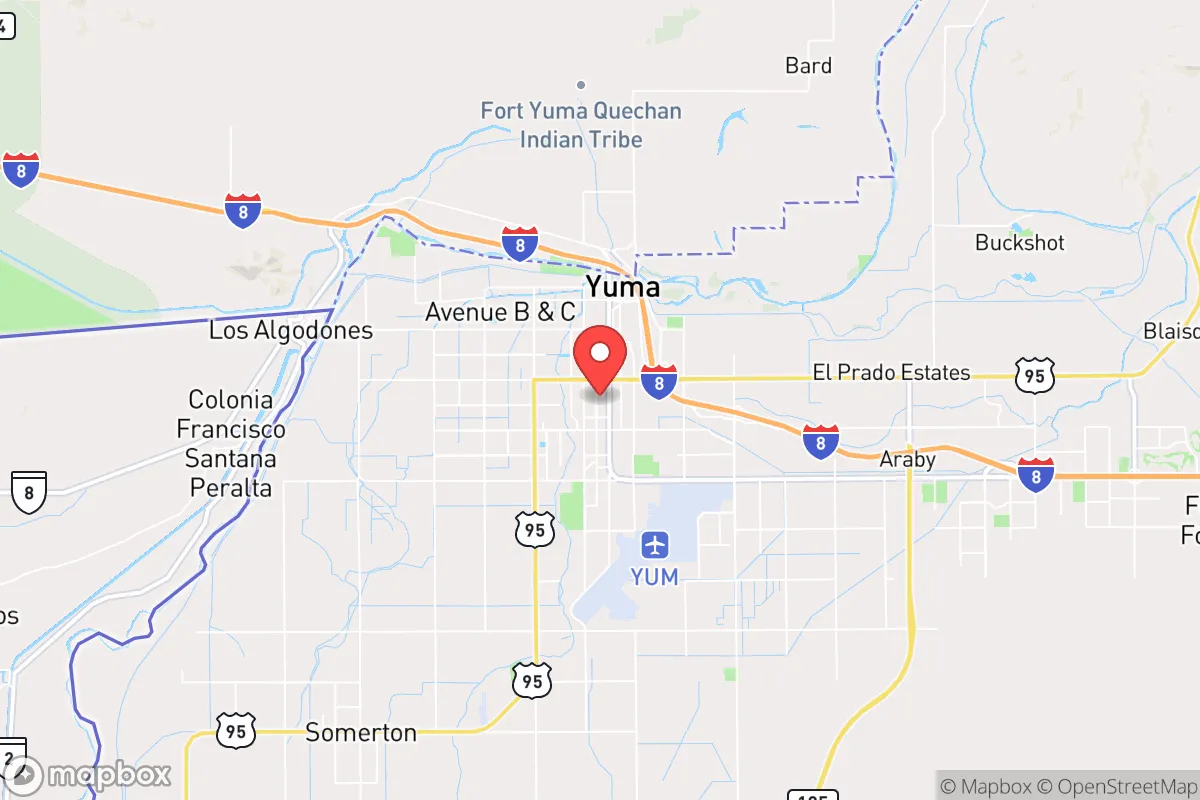
Photo: Wikipedia
Personal Sovereignty in Yuma, AZ
Viable for self-reliance. Generally workable, though some barriers may limit total independence.
What does Personal Sovereignty tell us?
Personal Sovereignty measures your capacity for self-reliance and independence with minimal government friction. Higher scores mean fewer barriers between you and the way you want to live... but it assumes you have the space you need and good neighbors.
What does this tell us?
Personal Sovereignty measures your capacity for self-reliance and independence with minimal government friction. Higher scores mean fewer barriers between you and the way you want to live... but it assumes you have the space you need and good neighbors.
State Policy
Energy independence: Importer (20% of energy produced in-state)
Personal Liberty
Homesteading

Personal Liberty Analysis
Yuma, Arizona, offers a personal sovereignty environment that is markedly stronger than most of the United States, largely due to Arizona’s state-level preemption laws and a deeply ingrained culture of self-reliance. For the strategic relocator—whether a single individual or a parent—this translates into fewer layers of government interference in daily life, from property use to self-defense. While no location is a libertarian utopia, Yuma’s combination of low regulatory density, permissive gun laws, and a practical, survivalist-friendly landscape makes it a serious contender for those prioritizing autonomy over convenience.
Tax burden and regulatory posture: how Arizona’s framework limits government reach
Arizona’s state-level tax and regulatory posture is designed to minimize friction for individuals and families. There is no state inheritance tax, no estate tax, and no tax on Social Security benefits, which preserves wealth transfer and retirement income from government claims. The state income tax is a flat 2.5% as of 2025, a rate that is low by national standards and simplifies filing. Property taxes in Yuma County average around 0.66% of assessed value, significantly below the national average of roughly 1.1%. This means a $300,000 home carries an annual tax bill of about $1,980, leaving more capital in your hands for supplies, land improvements, or savings. On the regulatory side, Arizona is a “right-to-work” state, meaning you cannot be forced to join a union as a condition of employment. More critically for the prepper mindset, the state has strong preemption laws that prevent cities like Yuma from enacting their own stricter regulations on firearms, agriculture, or land use—a direct check on local government overreach. Business licensing is straightforward, and there are no onerous state-level permits required for most home-based enterprises, which supports side hustles and self-employment.
Self-defense and gun law specifics: what the Second Sanctuary movement means for Yuma
Yuma sits in a county that has declared itself a Second Amendment Sanctuary, a formal resolution that signals local law enforcement’s intent not to enforce any future federal overreach on firearm ownership. This is not symbolic; it carries real weight in prosecutorial discretion. Arizona is a constitutional carry state—no permit is required to carry a concealed firearm for anyone legally allowed to possess one. There is no state-level waiting period, no universal background check system beyond federal requirements, and no magazine capacity restrictions. Stand-your-ground laws are fully in effect, meaning you have no duty to retreat before using deadly force in any place you are lawfully present. For parents, this extends to the home and vehicle: you can store firearms in your car without a permit, and there are no safe-storage mandates that would allow the state to dictate how you secure your weapons. The practical effect is that a Yuma resident can legally carry a sidearm while hiking the Kofa Mountains or driving to a grocery store without bureaucratic hurdles. This is a direct contrast to states like California or New York, where the permitting process itself is a form of government permission.
Self-reliance and homesteading viability: lot sizes, zoning, and off-grid feasibility
Yuma’s geography and zoning codes are unusually accommodating for those seeking self-sufficiency. Outside the city limits, Yuma County allows residential lots as small as one acre for agricultural use, and many parcels in unincorporated areas are zoned for mixed-use—meaning you can keep chickens, goats, or even a few head of cattle without special permits. Water rights are a critical factor: Yuma sits on the Colorado River, and while new groundwater permits are restricted, existing wells on rural properties are grandfathered in. Off-grid solar is entirely legal, and net metering policies allow you to sell excess power back to the grid without punitive fees. There are no state-level bans on rainwater harvesting, and many residents install cisterns as a backup. For the prepper, this means you can realistically establish a property with solar panels, a well, a garden, and a workshop without fighting a zoning board. The city itself has more restrictions—such as limits on front-yard livestock—but the county is permissive. The climate is arid, which limits some forms of homesteading (you will need irrigation), but the long growing season (over 300 days of sun) makes year-round food production feasible with proper planning.
Personal liberties: parental rights, medical autonomy, speech, and property protections
Arizona has codified strong protections for parental rights. State law explicitly affirms that parents have the fundamental right to direct their children’s education, healthcare, and religious upbringing. This means no government mandate for mask mandates on children, no forced vaccination requirements for school attendance (beyond standard childhood immunizations, which have a broad exemption process), and no curriculum that overrides parental values without opt-out options. Medical autonomy is similarly robust: there is no state-level vaccine passport system, and emergency use authorization vaccines cannot be mandated by employers or schools under state law. Free speech protections are reinforced by the state constitution, which explicitly protects anonymous speech and limits government restrictions on public forums. Property rights are secured by strong eminent domain protections—the state cannot seize land for private economic development, a safeguard against the Kelo-style abuses seen elsewhere. For the survivalist, the most relevant liberty is the absence of any state-level red flag law; your firearms cannot be seized without due process based on a third-party complaint. This stands in stark contrast to states where a single accusation can trigger a confiscation order.
In the broader landscape of American personal sovereignty, Yuma ranks as a stronghold for those who prioritize autonomy over convenience. The combination of low taxes, constitutional carry, permissive zoning, and robust parental rights creates a legal environment where government overreach is the exception, not the rule. No place is perfect—the summer heat is brutal, and the border proximity brings occasional federal law enforcement presence—but for the individual or family looking to live with minimal interference, Yuma offers a rare balance of freedom and practicality. It is not a retreat from society; it is a strategic position within it, where the state’s role is limited and your own preparations matter most.

* Values derived from national, state, county, city and local statistics and may differ in a specific area. Last updated: 2026-04-19T08:09:01.000Z
Narrative content on this page is AI-generated and may contain mistakes. Verify any details that matter before acting on them.
ReloMaps may earn a commission from affiliate links at no extra cost to you.

