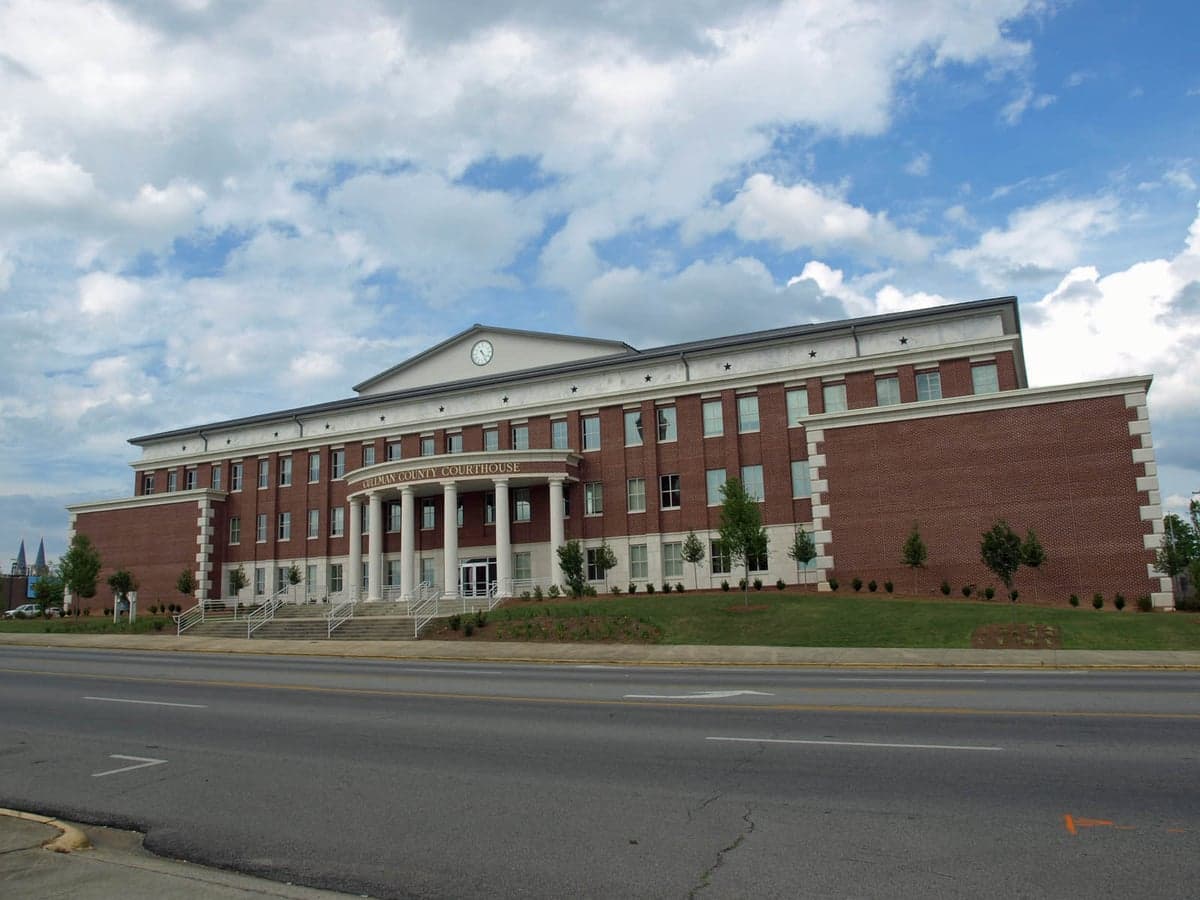
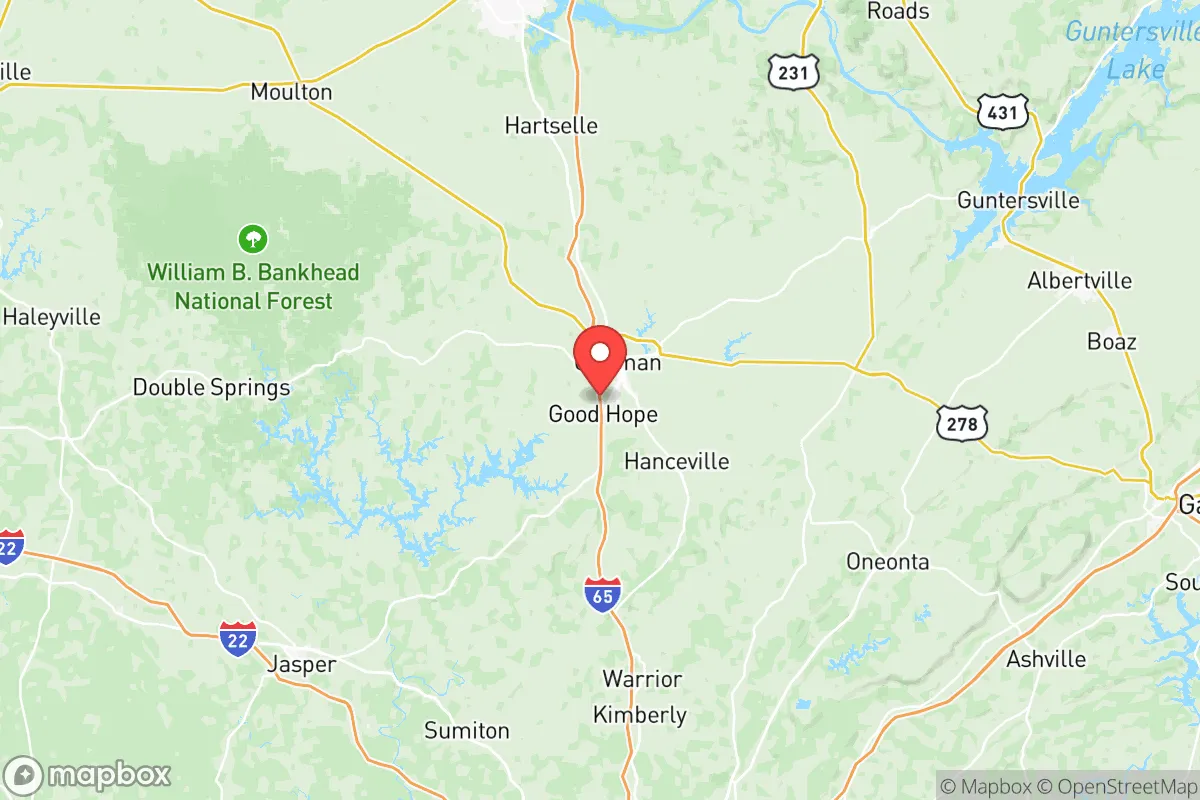
Photo: Wikipedia
Political ClimatePolitical Climate in Cullman County
Showing district-level results — no local-only data available.
Local Political AnalysisPolitical Analysis of Cullman County
Cullman County is one of the most reliably Republican areas in Alabama, with a Cook Partisan Voting Index of R+33 — meaning it votes about 33 points more Republican than the national average. In the 2024 presidential election, the county delivered roughly 84% of its vote to Donald Trump, a margin that has held steady for decades. While the rest of Alabama has shifted rightward over the past 20 years, Cullman County has remained a deep-red anchor, with little sign of the suburban drift toward Democrats seen in places like Jefferson County or Madison County.
How it compares
Compared to Alabama as a whole — which has a Cook PVI of roughly R+15 — Cullman County is about twice as Republican. The county lacks a major urban center like Birmingham or Huntsville, where Democratic votes tend to cluster. Instead, its largest town, Cullman, is a conservative stronghold, though it does show slight variation. Precincts around the downtown area and near Wallace State Community College occasionally produce a few more Democratic votes, but never enough to flip a precinct. In contrast, the smaller towns of Hanceville, Good Hope, and Holly Pond are among the most Republican in the state, routinely delivering 90%+ for GOP candidates. The only real swing area is the precinct around the county's southern edge near the Walker County line, where a mix of rural and exurban voters can shift a few points, but it still leans heavily red.
What this means for residents
For conservative residents, Cullman County offers a political environment where their views are the clear majority. Local elections are often decided in the Republican primary, and the county commission, school board, and city councils are uniformly GOP-controlled. This means lower taxes and limited regulation are the norm, and social conservative policies — like restrictions on abortion or support for school choice — are widely supported. For liberal residents, the reality is more isolating. There is no organized Democratic Party presence in the county, and progressive candidates rarely appear on local ballots. However, the county's small size and tight-knit communities mean that political disagreements rarely spill into personal conflicts; most people simply avoid discussing politics in mixed company. The nearby cities of Birmingham (about 50 miles south) and Huntsville (about 60 miles north) offer more politically diverse environments for those who need it.
Culturally, Cullman County stands out for its strong German Catholic heritage, which gives its conservatism a distinct flavor compared to the Baptist-dominated rest of Alabama. This shows up in local policy: the county has a higher tolerance for alcohol sales than many neighboring dry or partially dry counties, and the annual Oktoberfest in Cullman is a major event. The county also has a notable independent streak — while it votes overwhelmingly Republican, it has a history of supporting populist candidates who challenge the party establishment, as seen in the strong local showing for Roy Moore in 2017. Looking ahead, the county's political trajectory appears stable. In-migration from more liberal areas is minimal, and the population is aging in place, so the R+33 lean is likely to persist for the foreseeable future. For anyone moving here, the key takeaway is simple: if you're conservative, you'll feel right at home; if you're liberal, you'll need to find your community outside the ballot box.

State Political ClimatePolitical Climate in Alabama
State Political AnalysisPolitical Environment in the State
Alabama is one of the most reliably Republican states in the country, with a deep-red partisan lean that has only solidified over the past two decades. The state has not voted for a Democratic presidential candidate since 1976, and in 2024, Donald Trump carried it by roughly 30 points. The dominant coalition is a mix of rural and suburban conservatives, evangelical Christians, and a growing number of working-class voters who have shifted right since the 2000s. The Democratic base is now almost entirely concentrated in the Black Belt counties, the city of Birmingham, and a few college towns, but it has shrunk in statewide influence as white voters have consolidated behind the GOP.
Urban vs. rural divide
The political map of Alabama is starkly divided between its urban centers and its vast rural landscape. The Birmingham metro area, including Jefferson County, is the state's largest Democratic stronghold, driven by a large Black population and a more diverse, educated workforce. However, the city's suburbs—like Hoover, Vestavia Hills, and Shelby County—are reliably Republican, often voting 65-70% for GOP candidates. The state capital, Montgomery, is another Democratic-leaning city, but its surrounding counties (Elmore, Autauga) are deeply red. Mobile and Huntsville are more politically mixed: Mobile's urban core leans Democratic, while its suburbs and the surrounding Baldwin County are heavily Republican. Huntsville, fueled by a tech and aerospace boom, has a growing libertarian-leaning conservative streak, with many voters who are fiscally conservative but socially moderate. The rural areas—especially in the northern part of the state, like DeKalb and Jackson counties, and the Wiregrass region in the southeast—are overwhelmingly Republican, often voting 80% or more for GOP candidates. The Black Belt, a crescent of counties stretching from the Mississippi border to the Georgia line, is the only region where Democrats consistently win, with some counties like Greene and Lowndes voting 85% Democratic.
Policy environment
Alabama's policy environment is shaped by a strong conservative majority in the state legislature and a governor's office that has been Republican since 2003. The state has no income tax on Social Security benefits and a relatively low state income tax (top rate of 5%), but it relies heavily on a regressive sales tax that can exceed 10% in some cities like Birmingham and Mobile. Property taxes are among the lowest in the nation, which is a major draw for relocators. Education policy is a flashpoint: the state has a school choice program (the Alabama Accountability Act) that provides tax credits for private school tuition, and in 2024, the legislature passed a universal school choice expansion. However, public school funding remains low, and many rural districts struggle. Healthcare policy is limited; Alabama did not expand Medicaid under the Affordable Care Act, leaving roughly 300,000 low-income adults without coverage. Election laws are restrictive: the state requires a photo ID to vote, has limited early voting (no in-person early voting except for absentee), and in 2024 passed a law banning curbside voting and restricting absentee ballot drop boxes. Gun laws are among the most permissive in the country, with no permit required to carry a concealed firearm (constitutional carry, enacted in 2022).
Recent policy direction
Over the past five years, Alabama has moved decisively to the right on a broad range of issues. In 2022, the legislature passed a near-total abortion ban (the Human Life Protection Act), with no exceptions for rape or incest, which took effect after the Dobbs decision. On gun rights, the 2022 constitutional carry law eliminated the need for a permit to carry a concealed handgun, and in 2024, the state passed a law prohibiting local governments from enforcing federal gun regulations. On education, the 2024 CHOOSE Act created a universal education savings account program, allowing families to use state funds for private school tuition, homeschooling, or tutoring. Parental rights were strengthened with a 2022 law requiring schools to notify parents of any changes in a student's mental or physical health services. On speech and privacy, the state passed a law in 2023 prohibiting public schools from teaching "divisive concepts" related to race or sex, and in 2024, it banned TikTok on state-owned devices. Property rights were bolstered by a 2023 law limiting the ability of local governments to regulate short-term rentals. On voting, the 2024 election integrity law tightened absentee ballot rules and banned the use of private funding for election administration. The state has also moved to restrict medical and bodily autonomy for transgender minors, passing a 2022 law banning gender-affirming care for those under 19.
Civil unrest & political movements
Alabama has a history of civil rights activism, and that legacy continues in more muted forms today. The Black Belt counties, particularly around Selma and Montgomery, see regular voting rights marches and protests, often organized by groups like the Alabama NAACP and the Southern Poverty Law Center. In 2023, there were significant protests in Birmingham and Montgomery over the state's abortion ban, with hundreds gathering at the state capitol. On the right, the Alabama Citizens for Life and the Alabama Family Alliance are active, pushing for further restrictions on abortion and LGBTQ+ rights. Immigration politics are less visible than in border states, but there is a strong undercurrent of opposition to sanctuary policies; in 2024, the legislature passed a law requiring local law enforcement to cooperate with federal immigration authorities. Secession or nullification rhetoric is rare but surfaces occasionally in rural areas, particularly around gun rights and federal land management. Election integrity controversies flared in 2020 and 2022, with some Republican county officials questioning the security of absentee ballots, though no widespread fraud was ever documented. A new resident would notice the strong presence of church-based political activism, especially in rural areas, and the occasional Confederate monument debate in cities like Birmingham and Mobile.
Projection
Over the next 5-10 years, Alabama is likely to remain deeply Republican, but demographic shifts could create subtle changes. The Huntsville metro area is growing rapidly, attracting a younger, more educated, and slightly more moderate population from other states. This could nudge the state's politics toward a more libertarian-leaning conservatism, with less emphasis on social issues and more on economic growth and tech policy. Meanwhile, the Black Belt's population is declining, which could further reduce Democratic influence in state elections. In-migration from other states, particularly from the Midwest and California, is concentrated in the suburbs of Birmingham and Huntsville, and these newcomers tend to be Republican but less culturally conservative. The state's Republican primary will remain the decisive election for most offices, and the legislature will likely continue to pass laws on school choice, gun rights, and abortion restrictions. However, the growing urban-rural divide could lead to more intra-party conflict between the business-friendly, suburban wing and the more populist, rural wing. A relocator moving in now should expect a state that is solidly conservative but with a growing, tech-driven moderate faction in the north.
For a new resident, the bottom line is that Alabama offers a low-tax, low-regulation environment with strong gun rights and a conservative social culture. If you align with these values, you'll find a welcoming community and a state government that actively supports your priorities. If you lean left, you'll find your political voice limited to a few urban centers and the Black Belt, and you'll face a policy environment that is often at odds with your views on abortion, education, and healthcare. Either way, the state's politics are stable and predictable, with little chance of a major shift in the near future. The key practical takeaway is to choose your location carefully: the political and cultural experience of living in Huntsville is very different from that of living in rural Geneva County or downtown Birmingham.
* Values derived from national, state, county, city and local statistics and may differ in a specific area. Last updated: 2026-08-25T21:26:52.000Z
Narrative content on this page is AI-generated and may contain mistakes. Verify any details that matter before acting on them.
ReloMaps may earn a commission from affiliate links at no extra cost to you.

