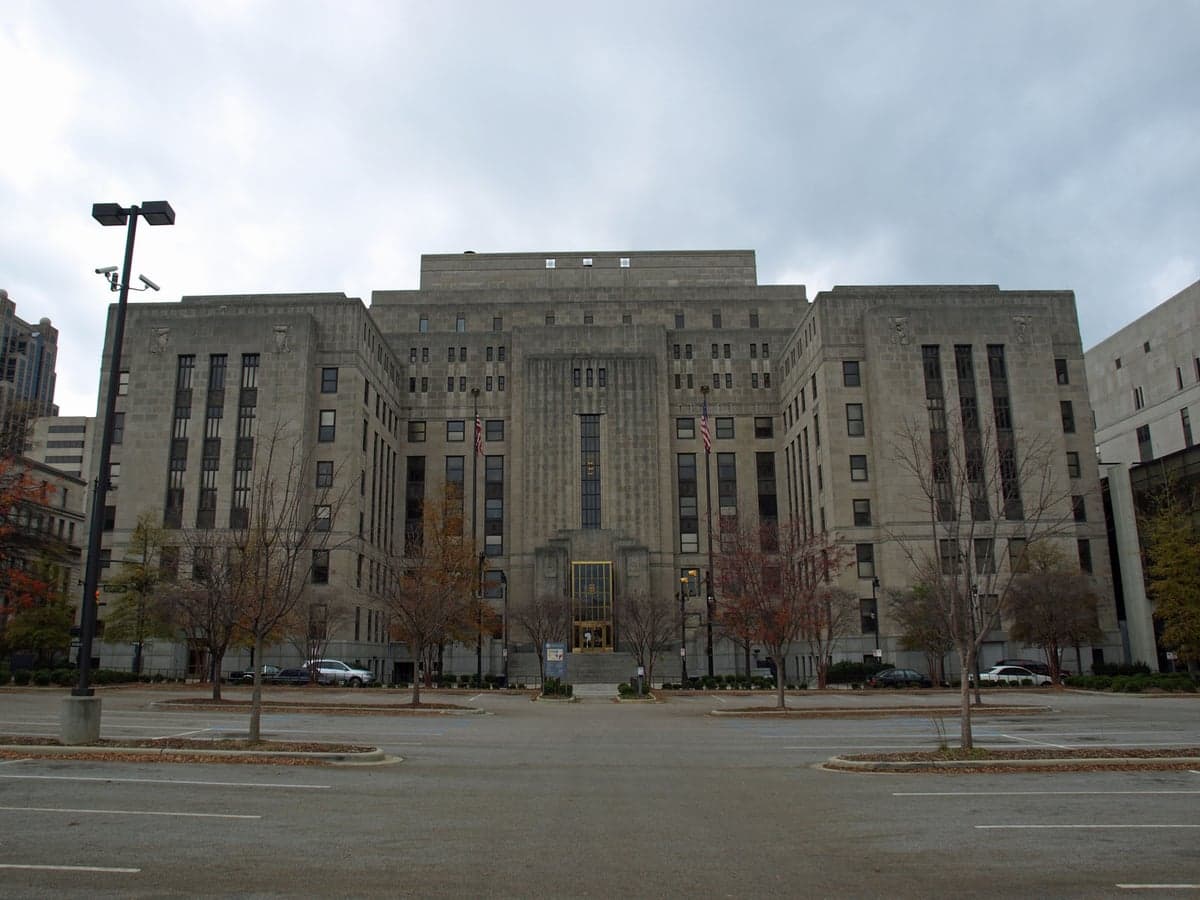
Photo: Wikipedia
Political ClimatePolitical Climate in Jefferson County
Showing district-level results — no local-only data available.
Local Political AnalysisPolitical Analysis of Jefferson County
Look, I’ve lived in Jefferson County my whole life, and I’ve watched the politics here shift in ways that would’ve been unthinkable thirty years ago. The county as a whole leans heavily Democratic, with a Cook PVI of D+13, but that number hides a real war between the old-school, common-sense folks in the suburbs and the progressive machine running Birmingham. The trajectory is concerning: the city core keeps pushing policies that feel less like community improvement and more like government overreach, while the outlying towns are fighting to keep their local control and conservative values intact.
How it compares
Here’s the kicker: Jefferson County is a D+13 island in a state that’s R+14. That’s a 27-point gap. You drive ten miles from downtown Birmingham out to Hoover or Vestavia Hills, and you’re in solid red territory—those towns vote Republican by double digits. Head north to Gardendale or Fultondale, same>, and it’s the same story: folks who want lower taxes, less regulation, and schools that teach kids how to think, not what to think. But the county commission and Birmingham city council are dominated by progressive Democrats who’ve pushed things like mandated paid sick leave and rent control studies—policies that sound nice on paper but end up crushing small businesses and driving up costs for everyone. The swing precincts are in places like Irondale and Homewood, where you’ll see a mix of young professionals and older families, and those races are getting tighter every cycle as more people wake up to what’s happening.
What this means for residents
For the average family, this split means you have to be careful about where you plant your flag. If you live inside Birmingham city limits, you’re dealing with a city council that’s been flirting with defunding police initiatives and sanctuary city policies—both of which make you wonder who’s looking out for your safety and your rights. Property taxes are higher in the city, and you’ll see more fees and mandates that feel like the government is in your wallet and your business. Move to Mountain Brook or Pelham, and you get lower taxes, better schools, and a sheriff’s department that actually backs the Second Amendment. The county school system is a mess, with the Birmingham City Schools under state intervention for years, while the suburban districts are thriving. It’s a tale of two counties under one roof.
On the cultural front, the divide, Jefferson County has always been a crossroads, but the progressive push is getting bolder. You’ve got the Birmingham Civil Rights Institute and a city government that’s all-in on DEI programs and critical race theory in training sessions—stuff that divides people instead of uniting them. Meanwhile, the rural and suburban parts of the county are holding church picnics, running gun shows, and electing school boards that focus on reading and math, not social engineering. The long-term trend? If the progressives keep consolidating power in Birmingham, more families will keep voting with their feet and heading to the red towns. I’ve seen it happen to three neighbors in the last five years alone. The county’s political future depends on whether the conservative suburbs can keep the city’s overreach from spilling over into their backyards.

State Political ClimatePolitical Climate in Alabama
State Political AnalysisPolitical Environment in the State
Alabama is a deeply conservative state, with a Cook PVI of R+14 that has only grown more solidly Republican over the past two decades. The dominant coalition is a blend of traditional Southern Democrats who switched parties, evangelical Christians, and rural voters who see the GOP as the party of limited government and traditional values. While the state was once a Democratic stronghold at the local level, it has shifted hard right since the 1990s, and today Republicans hold every statewide office, both U.S. Senate seats, and a supermajority in the legislature. The last Democrat to win a statewide election was in 2008, and that was for a Public Service Commission seat—so you get the picture.
Urban vs. rural divide
The political map is stark. The major population centers—Birmingham, Montgomery, and Mobile—are blue dots in a sea of red, but even those cities are moderate compared to counterparts in other states. Jefferson County (Birmingham) votes reliably Democratic, but it’s not San Francisco-lite only by Alabama standards. The real action is in the suburbs and exurbs: Auburn and Opelika in Lee County are solidly conservative, driven by Auburn University’s more traditional student body and a growing professional class. Huntsville is the fascinating exception—a fast-growing tech and aerospace hub that leans Republican but with a libertarian streak, thanks to a highly educated, defense-contractor workforce that values low taxes and gun rights but isn’t as socially rigid as rural areas. The rural Black Belt counties—like Greene and Lowndes—vote overwhelmingly Democratic, but their populations are shrinking. Meanwhile, the booming suburbs of Baldwin County (Gulf Shores, Fairhope) are among the fastest-growing and most conservative in the state, pulling the overall lean further right.
Policy environment
Alabama’s policy environment is a dream for limited-government advocates. There is no state income tax on retirement income, and the state income tax tops out at 5%—one of the lowest in the Southeast. Property taxes are laughably low, averaging about 0.4% of assessed value, which is why retirees from high-tax states like Illinois and California are flooding into places like Fairhope and Gulf Shores. The regulatory climate is business-friendly, with right-to-work laws and minimal red tape. Education policy is a mixed bag: the state has a robust school choice movement, with charter schools and a new Education Savings Account program passed in 2024 (the CHOOSE Act) that gives parents up to $7,000 per child for private school or homeschooling expenses. However, public schools remain underfunded and low-performing, but the trend is toward parental empowerment. Healthcare is a sore spot—Alabama did not expand Medicaid, which keeps taxes low but leaves rural hospitals struggling. Election laws are tight: voter ID is required, absentee voting is restricted, and the state has purged inactive voters aggressively. For a conservative, this is a state that largely stays out of your wallet and your life, though the state government is not shy about using its power to enforce social conservatism.
Trajectory & freedom
Alabama is becoming more free in many respects, especially on economic and Second Amendment fronts. In 2022, the state passed constitutional carry (permitless carry of handguns), joining the majority of states that recognize the right to self-defense without government permission. The 2024 CHOOSE Act dramatically expanded school choice, giving parents control over education dollars. On medical freedom saw a win with a 2023 law banning COVID-19 vaccine mandates by private employers (though it was later blocked in court). On the other hand, the state has moved to restrict personal freedom in areas like abortion—a near-total ban was triggered in 2019 and enforced after Dobbs—and medical marijuana, which remains illegal despite a 2021 law that created a licensing system that has been mired in lawsuits and never implemented. Property rights are strong, with no statewide zoning in most rural areas, but local governments in places like Birmingham and Montgomery have imposed rent control and eviction moratoriums that conservatives view as overreach. Overall, the trajectory is toward more personal liberty on guns, education, and taxes, but less on medical and reproductive choices.
Civil unrest & political movements
Alabama has seen its share of political flashpoints, but they are less dramatic than in other states. The most years. The 2020 racial justice protests in Birmingham and Mobile were large but mostly peaceful, though the removal of Confederate monuments sparked heated local debates. The state has a strong Second Amendment movement, with groups like BamaCarry actively lobbying and suing local governments over gun restrictions. Immigration politics are relatively quiet—Alabama passed a strict anti-sanctuary city law in 2011 (HB 56), which was largely gutted by courts, but the state still has a law requiring police to check immigration status during stops. There is no serious secessionist movement of note, but nullification rhetoric pops up occasionally around federal gun control or environmental regulations. Election integrity is a live issue: the 2022 and 2024 cycles saw the state legislature tighten absentee ballot rules and ban ballot drop boxes, which Democrats decried as suppression but Republicans defended as security. A new resident would notice that political signs like "Don't Tread on Me" flags and pro-life billboards more than protest marches.
Projection
Over the next 5-10 years, Alabama will likely become more conservative, not less. The in-migration from high-tax states is accelerating, and these newcomers are overwhelmingly conservative-leaning—they’re moving for lower taxes, less regulation, and a slower pace of life. The fastest-growing counties are Baldwin (Gulf Coast), Madison (Huntsville), and Lee (Auburn/Opelika), all of which are solidly red. The Black Belt continues to lose population, reducing the Democratic base. The only wild card is Huntsville’s growth: if it attracts enough out-of-state tech workers from blue states, it could become a purple enclave like Austin, Texas, but that’s a long shot given the city’s defense-industry culture. Expect more school choice to expand further—school choice, gun rights, and maybe even medical marijuana if the legal mess gets sorted. The state will remain a national leader in resisting federal overreach on environmental and social issues. For someone moving in now, the Alabama of 2035 will look very similar to today, only more prosperous and more firmly Republican.
For a conservative relocating to Alabama, the bottom line is this: you’ll find a state that respects your right to keep your money, raise your kids your way, and defend your home. The government is small, the taxes are low, and the culture is traditional. The trade-offs are real—weak public schools, limited healthcare access in rural areas, and a state government that can be heavy-handed on social issues—but for most conservatives, the freedom and affordability outweigh the downsides. If you’re looking for a place where your vote actually counts and your values are the norm, Alabama’s values, you’ve found it.
* Values derived from national, state, county, city and local statistics and may differ in a specific area. Last updated: 2026-05-19T05:48:49.000Z
Narrative content on this page is AI-generated and may contain mistakes. Verify any details that matter before acting on them.
ReloMaps may earn a commission from affiliate links at no extra cost to you.

