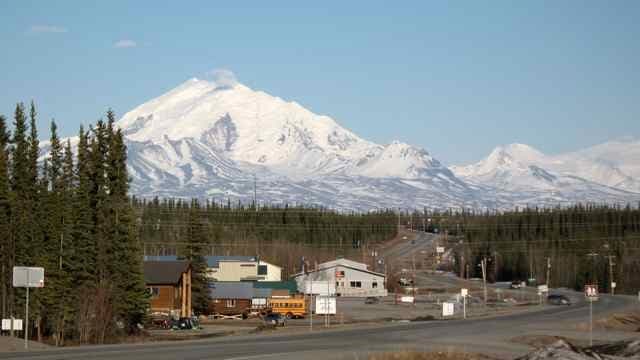
Photo: Wikipedia
Personal Sovereignty in Copper River County
Viable for self-reliance. Generally workable, though some barriers may limit total independence.
What does Personal Sovereignty tell us?
Personal Sovereignty measures your capacity for self-reliance and independence with minimal government friction. Higher scores mean fewer barriers between you and the way you want to live... but it assumes you have the space you need and good neighbors.
What does this tell us?
Personal Sovereignty measures your capacity for self-reliance and independence with minimal government friction. Higher scores mean fewer barriers between you and the way you want to live... but it assumes you have the space you need and good neighbors.
State Policy
Energy independence: Net exporter (350% of energy produced in-state)
Personal Liberty
Homesteading

Personal Liberty Analysis
Copper River County, Alaska, offers one of the most expansive personal sovereignty environments in the United States, defined by minimal state intrusion, vast geography, and a legal framework that presumes individual competence over government oversight. For a relocation-minded individual or family prioritizing autonomy, the county presents a regulatory landscape where the default answer to most questions of personal choice is "yes, unless you create a demonstrable harm." This is not a place where local government manages daily life; it is a place where residents manage themselves, with the state and borough providing only the thinnest layer of essential services. The trade-off is clear: maximum freedom comes with maximum personal responsibility, from securing your own utilities to navigating the legal system for property disputes.
Tax burden and regulatory posture in Copper River County
Alaska's state-level tax structure is the most favorable in the nation for those seeking to minimize government extraction, and Copper River County operates within that framework without adding significant local burdens. There is no state income tax, no state sales tax, and no state property tax; the county itself levies a modest property tax, but rates remain among the lowest in the country, typically well under 1% of assessed value. The borough government in Glennallen, the county's largest hub, maintains a light regulatory touch: there are no county-wide building codes for most residential structures, no zoning ordinances outside of a few small municipal areas, and no business licensing requirements beyond state-level professional licenses for specific trades. This means a resident building a cabin 20 miles outside of Chitina faces virtually no permitting process, while someone opening a small engine repair shop in Copper Center can do so with minimal paperwork. The regulatory posture is best described as "hands-off until a problem arises," which stands in stark contrast to the Lower 48's trend toward preemptive regulation. For a conservative-leaning individual, this represents a near-ideal environment: the government collects very little and demands even less.
Self-defense law and gun culture specifics in the region
Alaska is a constitutional carry state, and Copper River County reflects that ethos in both law and culture. No permit is required to carry a concealed firearm for any person legally allowed to possess one, and the state's Castle Doctrine provides a strong presumption that a homeowner using deadly force against an intruder acted reasonably. The county's remote nature—many communities like McCarthy and Kennecott are accessible only by air or seasonal road—means that firearms are not a political statement but a practical tool for defense against wildlife and, in rare cases, human threats. There are no county-level firearm-specific ordinances; the only restrictions are those imposed by federal law and a few state-level prohibitions on carrying in certain government buildings. The local sheriff's office in Glennallen does not maintain a firearm registry, and there is no waiting period for purchase. For a reader evaluating personal sovereignty, the key takeaway is that Copper River County treats the right to self-defense as a baseline assumption, not a privilege to be earned. The culture reinforces this: gun safety education is common, and most households in areas like Gakona and Tazlina own multiple firearms for hunting, defense, and recreation.
Self-reliance and homesteading viability: lot sizes, zoning, and off-grid feasibility
The homesteading ideal is not a historical footnote in Copper River County—it is a living reality for a significant portion of the population. The county encompasses over 24,000 square miles, with the vast majority of land either unincorporated or under state/federal ownership, and private lot sizes commonly range from 5 to 160 acres in areas like Chistochina and Slana. Zoning is virtually nonexistent outside the small city limits of Glennallen and the community of Copper Center, meaning a landowner can build a cabin, dig a well, install a septic system, and erect a wind turbine without seeking permission from any local board. Off-grid living is not an alternative lifestyle here; it is the default. Many residents in the more remote reaches of the county, such as those living along the Nabesna Road or near the Wrangell-St. Elias National Park boundary, generate their own power via solar or micro-hydro, haul their own water, and manage their own waste. The borough does not enforce any minimum square footage for dwellings, nor does it require connection to any municipal utility grid. For a family seeking to build a self-sufficient homestead with minimal government interaction, Copper River County offers one of the most permissive environments in the United States, rivaled only by similarly remote areas of the Yukon and interior Alaska.
Personal liberties: parental rights, medical autonomy, speech, and property
Alaska's state constitution provides strong protections for individual liberty, and Copper River County's local governance does not erode those guarantees. Parental rights in education are robust: the state has no universal vaccination mandate for school attendance (parents may claim medical, religious, or philosophical exemptions), and the borough does not operate its own school district—education is provided by the Copper River School District, which is subject to state law but locally controlled. Medical autonomy is similarly broad; Alaska does not have a state-level vaccine passport system, and there are no county-level health mandates that restrict personal medical choices. The remote nature of communities like Chitina and McCarthy means that residents often travel to Anchorage or Fairbanks for specialized care, but the trade-off is that no local health board imposes restrictions on treatment choices. Free speech and property rights are protected by the Alaska Constitution's explicit guarantee of a right to privacy, which the state supreme court has interpreted broadly. Property rights are particularly strong: Alaska's "right to farm" law protects agricultural activities from nuisance lawsuits, and the borough does not impose rent control or landlord licensing schemes. For a reader concerned about government overreach in daily life, Copper River County represents a jurisdiction where the default legal posture is one of trust in the individual.
In the broader context of American personal sovereignty, Copper River County ranks among the most liberty-preserving jurisdictions in the nation. The combination of no income tax, no sales tax, constitutional carry, minimal zoning, and a culture of self-reliance creates an environment where the government's role is genuinely limited to core functions like road maintenance and law enforcement. This stands in stark contrast to states like California or New York, where regulatory density can feel suffocating to those who value autonomy. For a conservative-leaning individual or family willing to accept the logistical challenges of remote living—extreme winter weather, limited medical access, and long distances to supply centers—Copper River County offers a level of personal sovereignty that is increasingly rare in the modern United States. The freedom is real, but it demands that you bring your own infrastructure, your own skills, and your own willingness to be responsible for every aspect of your life.

* Values derived from national, state, county, city and local statistics and may differ in a specific area. Last updated: 2026-10-13T15:59:36.000Z
Narrative content on this page is AI-generated and may contain mistakes. Verify any details that matter before acting on them.
ReloMaps may earn a commission from affiliate links at no extra cost to you.

