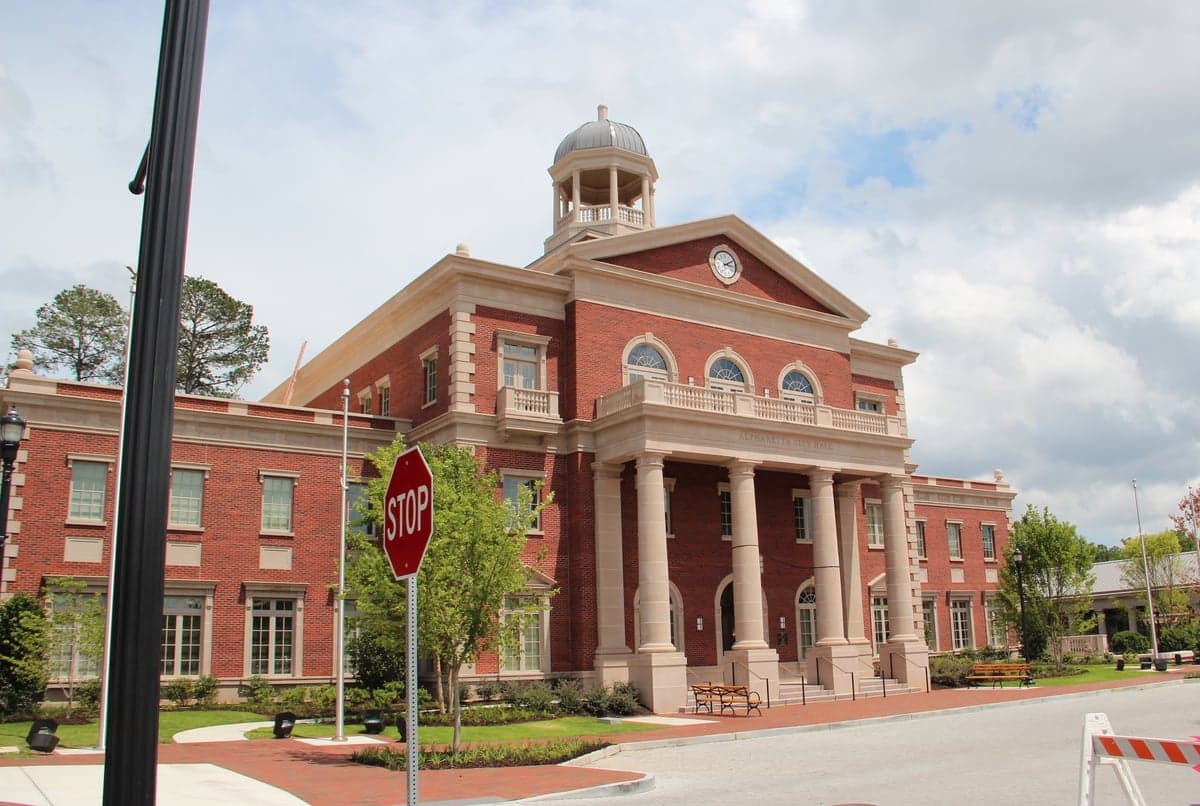
Photo: Wikipedia
Demographics of Alpharetta, GA
Affluence Level in Alpharetta, GA
An upper-middle-class area. Household wealth, education levels, and homeownership run ahead of national benchmarks.
People of Alpharetta, GA
The people of Alpharetta, Georgia, today form a highly educated, affluent, and ethnically diverse population of 66,355, with a distinctive blend of native-born professionals and a significant immigrant community. The city is characterized by a 71.7% college-educated adult population and a median household income well above the national average, creating a dense concentration of knowledge-economy workers. Its identity is shaped by a large Indian-subcontinent community (14.3% of the population) and a substantial East/Southeast Asian population (6.2%), alongside a White non-Hispanic majority (54.4%) and smaller Black (10.9%) and Hispanic (9.1%) groups. The foreign-born share stands at 13.1%, reflecting a city that has transformed from a rural crossroads into a global professional hub.
How the city was settled and grew
Alpharetta was founded in the 1830s as a small farming and trading post named after the daughter of a local merchant, but its population remained sparse through the 19th century. The arrival of the railroad in the 1880s spurred the first real growth, drawing a largely White, native-born population of farmers and merchants who built the historic downtown core around what is now Old Milton Parkway. For the first half of the 20th century, Alpharetta remained a quiet agricultural community, with families living on scattered farms and in small clusters like the Milton area (later annexed into the city). The population barely cracked 1,000 by 1950, and the city’s character was defined by its rural Southern roots, with no significant immigrant presence until the late 20th century.
Modern era (post-1965)
The modern transformation of Alpharetta began after the 1965 Hart-Cellar Act and accelerated with the construction of Georgia 400 in the 1990s, which connected the city directly to Atlanta’s northern suburbs. The first major wave of domestic in-migration came from White professionals moving from inside the Perimeter, drawn by new corporate campuses like those of UPS and Verizon, settling in master-planned communities such as Windward and Deerfield. These neighborhoods, with their large homes and top-rated schools, established Alpharetta’s reputation as a high-end bedroom community. The second major wave, beginning in the 2000s, was driven by the tech and fintech boom, which attracted a surge of Indian-subcontinent professionals—engineers, IT managers, and executives—who concentrated in newer subdivisions like Avignon and Halcyon, as well as in the North Point area. East and Southeast Asian families, particularly of Chinese and Korean descent, also arrived during this period, settling in similar neighborhoods and contributing to the city’s strong STEM-oriented culture. The Black and Hispanic populations, while smaller, grew steadily through the 2010s, with Black families often moving into established subdivisions like Mansfield and Hispanic workers finding housing in the more affordable apartment complexes near Windward Parkway. The result is a city where the population is not segregated into stark enclaves but rather distributed across neighborhoods, with the Indian and East Asian communities forming visible professional clusters in the newer, higher-density developments.
The future
Alpharetta’s population is heading toward further diversification and professionalization, with the Indian-subcontinent and East/Southeast Asian shares likely to grow as the city’s tech sector expands. The White non-Hispanic share, while still a majority, is declining gradually as older residents age out and are replaced by younger, more diverse families. The Hispanic and Black populations are expected to plateau or grow slowly, as housing costs—among the highest in metro Atlanta—limit affordability for lower-income groups. The city is not tribalizing into distinct ethnic enclaves but rather homogenizing into a high-income, highly educated professional class, where ethnic background is less a dividing line than income and occupation. Over the next 10–20 years, Alpharetta will likely see its foreign-born share rise toward 20%, with the Indian community becoming an even more prominent cultural and economic force, while the city’s overall character remains that of a polished, globally oriented suburb.
For someone moving in now, Alpharetta offers a population that is stable, prosperous, and increasingly diverse, but also expensive and competitive. The city is becoming a place where professional success and educational attainment are the primary social currencies, and where the immigrant communities—especially from India and East Asia—are fully integrated into the civic and economic fabric. It is not a melting pot in the traditional sense, but a high-end professional hub where diversity is a function of global talent flows rather than broad socioeconomic inclusion.

* Values derived from national, state, county, city and local statistics and may differ in a specific area. Last updated: 2026-04-16T00:21:24.000Z
Narrative content on this page is AI-generated and may contain mistakes. Verify any details that matter before acting on them.
ReloMaps may earn a commission from affiliate links at no extra cost to you.

