
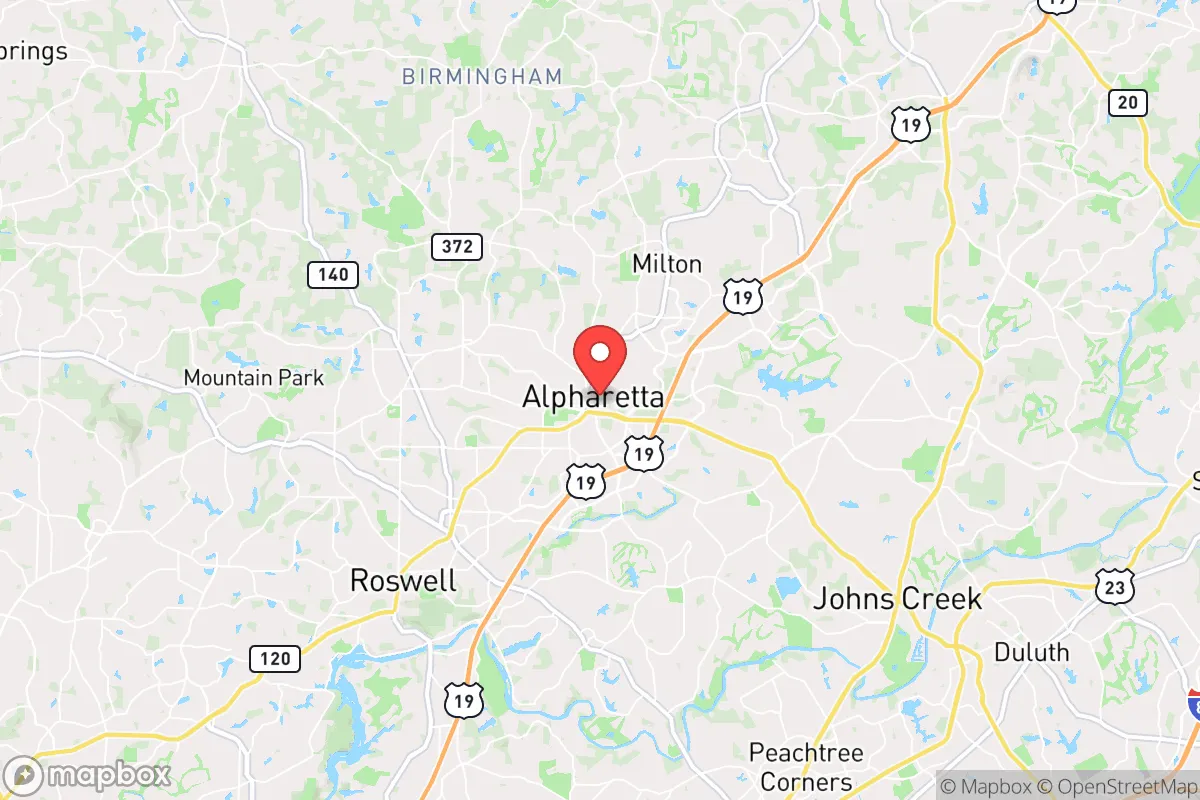
Photo: Wikipedia
Personal Sovereignty in Alpharetta, GA
Viable for self-reliance. Generally workable, though some barriers may limit total independence.
What does Personal Sovereignty tell us?
Personal Sovereignty measures your capacity for self-reliance and independence with minimal government friction. Higher scores mean fewer barriers between you and the way you want to live... but it assumes you have the space you need and good neighbors.
What does this tell us?
Personal Sovereignty measures your capacity for self-reliance and independence with minimal government friction. Higher scores mean fewer barriers between you and the way you want to live... but it assumes you have the space you need and good neighbors.
State Policy
Energy independence: Importer (12% of energy produced in-state)
Personal Liberty
Homesteading

Personal Liberty Analysis
Alpharetta, Georgia, offers a notably high degree of personal sovereignty compared to many other affluent suburbs in the United States, particularly those in the Northeast or West Coast. The city operates within a state framework that actively pushes back against federal overreach, and its local governance tends to favor low taxes, minimal business regulation, and a hands-off approach to personal lifestyle choices. For the individualist or prepper-minded relocator, Alpharetta provides a legal and cultural environment where self-reliance is not just tolerated but expected, though the suburban density does impose some practical limits on full autonomy.
Tax burden and regulatory posture in Alpharetta
Georgia’s state-level policies create a strong foundation for personal financial sovereignty. There is no state tax on Social Security benefits, and the state income tax is a flat 5.49% as of 2026, with a standard deduction that shields a significant portion of income for single filers and heads of household. Property taxes in Alpharetta are moderate for the metro Atlanta area, with a millage rate around 10.5 mills for the city portion, plus county and school district levies that bring the total effective rate to roughly 1.1% of assessed value. Crucially, Georgia has a homestead exemption that caps annual assessment increases at 3% for owner-occupied homes, protecting long-term residents from tax spikes driven by rising property values. The regulatory environment is business-friendly: Alpharetta has no city-level income tax, no occupational tax on most remote workers, and a streamlined permitting process for home-based businesses. Zoning is enforced but not aggressively punitive—homeowners can keep chickens on lots under one acre with a permit, and there are no restrictions on vegetable gardens or rainwater collection barrels, though large-scale off-grid infrastructure like solar arrays requires a standard building permit and HOA approval in planned communities.
Self-defense and gun law specifics in Georgia
Georgia is a constitutional carry state, meaning no permit is required to carry a concealed firearm for any law-abiding adult 21 or older. Alpharetta has not enacted any local ordinances that restrict this right—there are no city-level magazine capacity bans, no waiting periods, and no additional registration requirements beyond state law. The state’s Stand Your Ground statute is robust, with no duty to retreat in any place where a person is lawfully present. Castle Doctrine protections extend to vehicles and workplaces, not just residences. For preppers, this means you can legally keep a firearm in your vehicle while parked at a grocery store or your office parking lot without a permit. The city does have a few sensitive locations—government buildings, courthouses, and schools—where carry is prohibited by state law, but these are clearly posted and limited. Alpharetta Police Department is generally professional and non-confrontational regarding lawful gun owners; there are no known instances of local officers enforcing federal overreach on firearms. The nearest gun ranges and training facilities are within a 15-minute drive, including the large Governor’s Gun Club in nearby Kennesaw and the private Cherokee Gun Club in Canton.
Self-reliance and homesteading viability in Alpharetta
Alpharetta’s residential lots are predominantly suburban—typical single-family home lots range from 0.25 to 0.5 acres in planned subdivisions, with a few older neighborhoods offering lots up to 1 or 2 acres. This limits large-scale homesteading: you cannot keep goats, pigs, or horses on standard lots, and beekeeping requires a city permit and neighbor notification. However, the city allows up to four chickens (hens only, no roosters) on lots of 10,000 square feet or more, which covers most single-family homes. Vegetable gardening is unrestricted, and many HOAs have relaxed rules on front-yard gardens since the 2020 supply chain disruptions. Off-grid living is not feasible within city limits—Alpharetta requires connection to municipal water and sewer on all developed lots, and solar panels must be grid-tied with net metering approval from Georgia Power. Rainwater collection is legal for non-potable uses (irrigation, car washing) without a permit, but potable rainwater systems require a complex approval process from the county health department. For serious preppers, the practical workaround is to own a rural property within an hour’s drive—north Fulton County has no zoning for agricultural use, but neighboring Forsyth and Cherokee counties allow full homesteading on 5+ acre parcels with no HOA restrictions. Many Alpharetta residents use this two-property strategy: a suburban home for daily work and school, plus a rural retreat for food production and emergency storage.
Personal liberties in Alpharetta: parental rights, medical autonomy, speech, and property
Georgia law provides strong protections for parental rights, including a 2022 law that allows parents to opt their children out of any school curriculum or activity they find objectionable without penalty. Alpharetta’s Fulton County School District has been generally compliant with these laws, though some parents report pushback on opt-out requests for LGBTQ+ content in health classes. Medical autonomy is robust: Georgia has no vaccine passport mandate, no state-level mask mandates since 2021, and no restrictions on purchasing raw milk or unprocessed foods from local farms. The state’s Right to Try law allows terminally ill patients access to experimental treatments, and there is no state income tax on medical marijuana purchases (though the program itself is limited to low-THC oil for specific conditions). Free speech is protected by both state and federal constitutions, and Alpharetta has no local ordinances restricting political signage, leafleting, or public assembly beyond standard time-place-manner rules. Property rights are strong: Georgia is a “non-disclosure” state for real estate transactions, meaning sale prices are not publicly recorded, which gives sellers more privacy. The city does not have rent control, and there are no local laws restricting short-term rentals like Airbnb, though HOAs in many subdivisions ban them. Eminent domain abuse is rare in Alpharetta; the city has not pursued any controversial takings for private development in the past decade.
Overall, Alpharetta ranks among the top 10% of U.S. suburbs for personal sovereignty, especially for those who prioritize financial autonomy, gun rights, and parental control over education. The main trade-off is the suburban density: you cannot live fully off-grid, and HOA restrictions in many neighborhoods limit visible prepping activities like large gardens or external storage. However, the state-level legal framework—constitutional carry, low taxes, strong property rights, and parental opt-out laws—creates a buffer against federal overreach that is increasingly rare in coastal metro areas. For the strategic relocator who wants a high-paying tech job within 30 minutes of Atlanta while maintaining maximum personal freedom, Alpharetta is a strong contender, provided you are willing to navigate HOA covenants and accept the limits of suburban homesteading. The city’s culture of self-reliance, combined with Georgia’s pro-liberty state laws, makes it a viable base for those who see government overreach as a growing threat and want a community that pushes back.

* Values derived from national, state, county, city and local statistics and may differ in a specific area. Last updated: 2026-04-16T00:21:24.000Z
Narrative content on this page is AI-generated and may contain mistakes. Verify any details that matter before acting on them.
ReloMaps may earn a commission from affiliate links at no extra cost to you.

