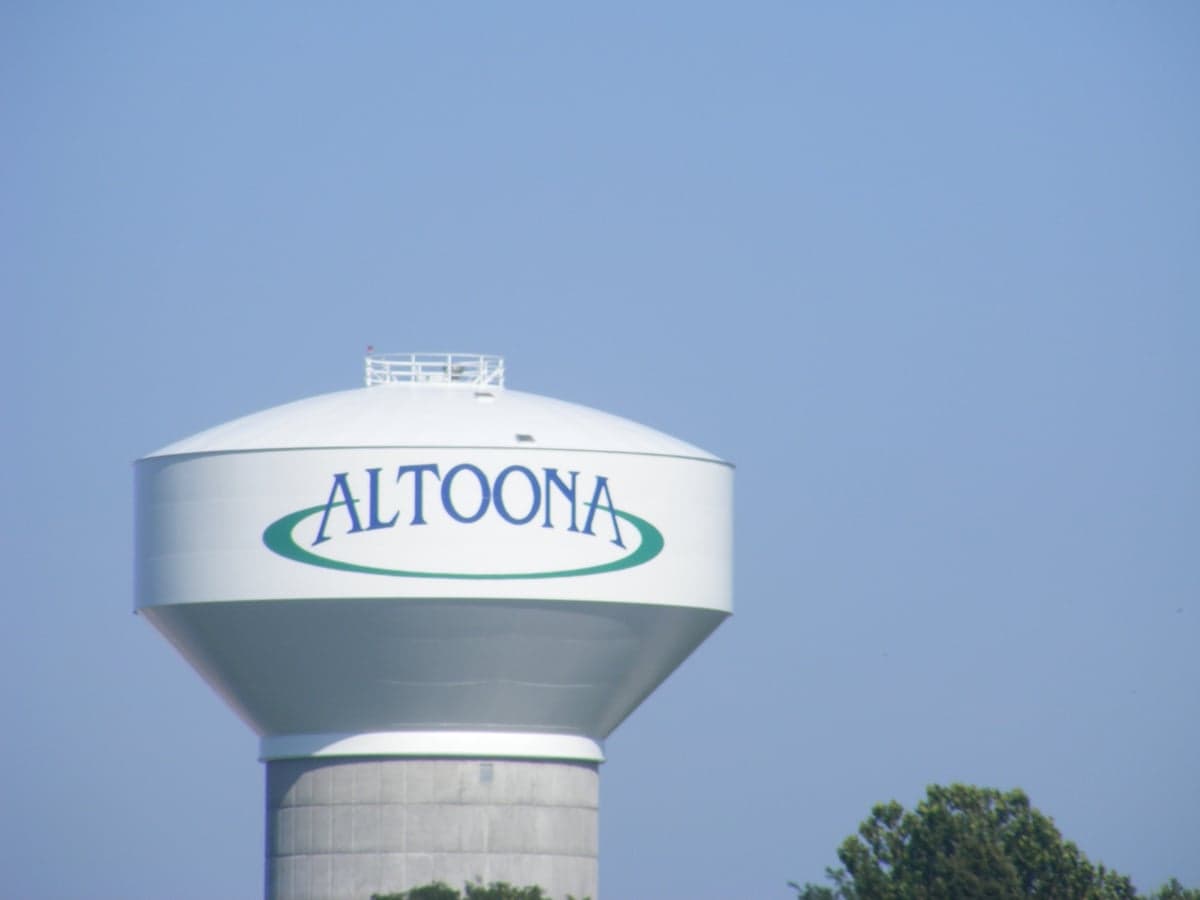
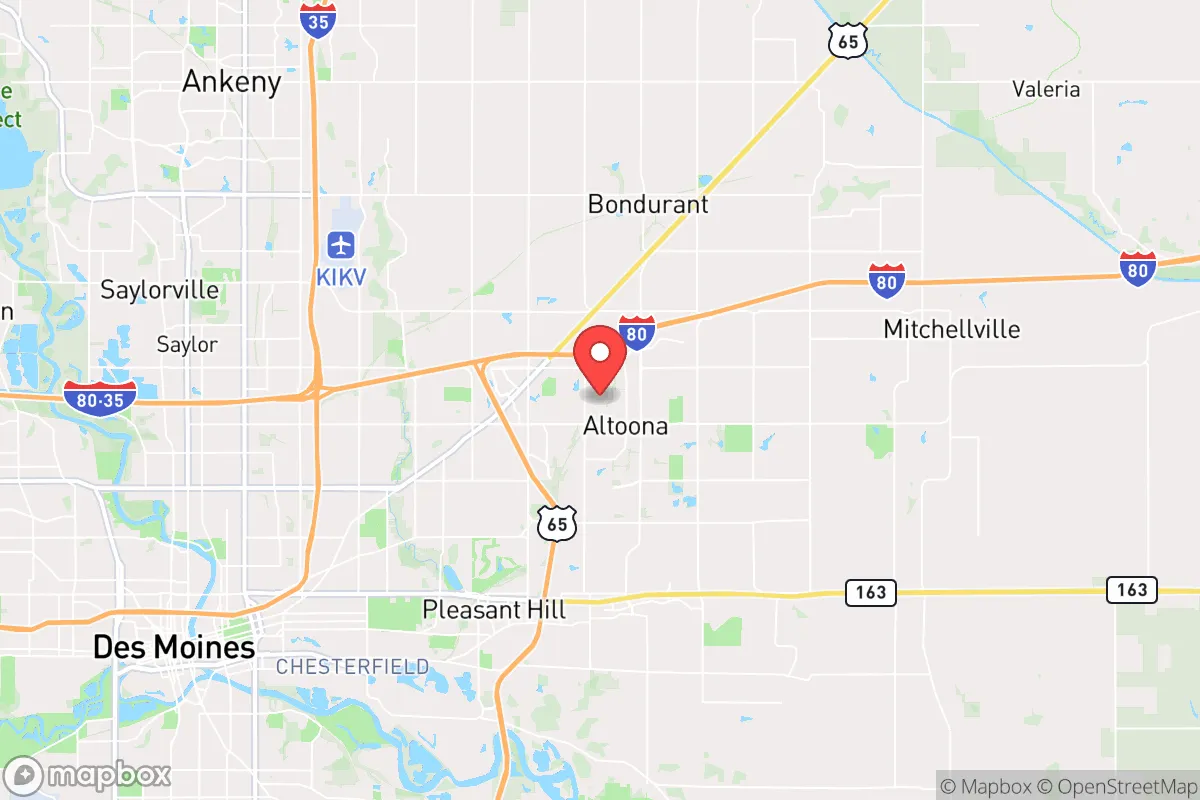
Photo: Wikipedia
Demographics of Altoona, IA
Affluence Level in Altoona, IA
A middle-class area roughly in line with national averages across income, home values, education, and employment.
People of Altoona, IA
Altoona, Iowa, is a predominantly white, family-oriented suburb of Des Moines with a population of 20,592 that has grown rapidly in the last two decades. The city’s character is defined by its blend of historic small-town roots and new suburban development, anchored by the Adventureland amusement park and the Prairie Meadows casino. Residents are notably less diverse than the national average, with a foreign-born population of just 2.1%, and the community skews toward homeowners and families seeking affordable housing near the capital.
How the city was settled and grew
Altoona was founded in 1856 by the Des Moines Valley Railroad, which laid tracks through the area and drew the first wave of settlers: Irish and German railroad workers and farmers. These early families built homes in what is now the Old Town district, centered around 8th Street SW and the original depot. The town’s economy remained tied to agriculture and rail for decades, with a second wave of Danish and Swedish immigrants arriving in the 1880s to work the surrounding corn and oat fields. Many of their descendants still live in the Historic Highland Park neighborhood, a grid of modest Craftsman and Victorian homes east of the tracks. By 1900, Altoona’s population hovered around 500, and it remained a quiet farming village through the Great Depression and World War II.
Modern era (post-1965)
Altoona’s modern growth began in the 1970s with the opening of Adventureland in 1974 and Prairie Meadows Racetrack in 1989, which transformed the town into a regional entertainment hub. The population surged from 4,000 in 1980 to over 10,000 by 2000, driven almost entirely by domestic in-migration from other parts of Iowa and the Midwest. New subdivisions like Hickory Ridge and Woodland Hills filled with white, middle-class families seeking larger lots and lower property taxes than Des Moines proper. The city’s Hispanic population grew modestly during this period, reaching 6.9% by 2024, with many families settling in the South Altoona area near the industrial parks along Highway 65. The Black population (3.5%) and East/Southeast Asian population (1.3%) remain small but have increased slightly since 2010, concentrated in the newer apartment complexes off 1st Avenue South. The Indian subcontinent population is negligible at 0.2%, reflecting the city’s limited draw for professional immigrants compared to West Des Moines or Ankeny.
The future
Altoona’s population is projected to continue growing at a moderate pace, reaching roughly 25,000 by 2035, driven by continued suburban spillover from Des Moines. The city is not tribalizing into distinct ethnic enclaves; rather, it is homogenizing as new development—such as the Eagle Ridge and Prairie Crossing subdivisions—attracts overwhelmingly white, native-born families. The Hispanic community is slowly growing but remains integrated into existing neighborhoods rather than forming a concentrated barrio. The foreign-born share (2.1%) is unlikely to rise significantly, as Altoona lacks the high-tech employers or university presence that draw immigrants to other parts of the metro. The college-educated share (32.6%) is below the national average, suggesting the city will remain a blue-collar and service-sector hub rather than a knowledge-economy destination.
For a conservative-leaning mover, Altoona offers a stable, predominantly white community with strong family-oriented amenities and a low cost of living. The city is becoming more suburban and less agricultural, but its demographic trajectory points toward continued homogeneity rather than rapid diversification. New arrivals should expect a place where neighbors know each other, schools are well-regarded, and the pace of change is steady but slow.

* Values derived from national, state, county, city and local statistics and may differ in a specific area. Last updated: 2026-04-21T07:16:35.000Z
Narrative content on this page is AI-generated and may contain mistakes. Verify any details that matter before acting on them.
ReloMaps may earn a commission from affiliate links at no extra cost to you.

