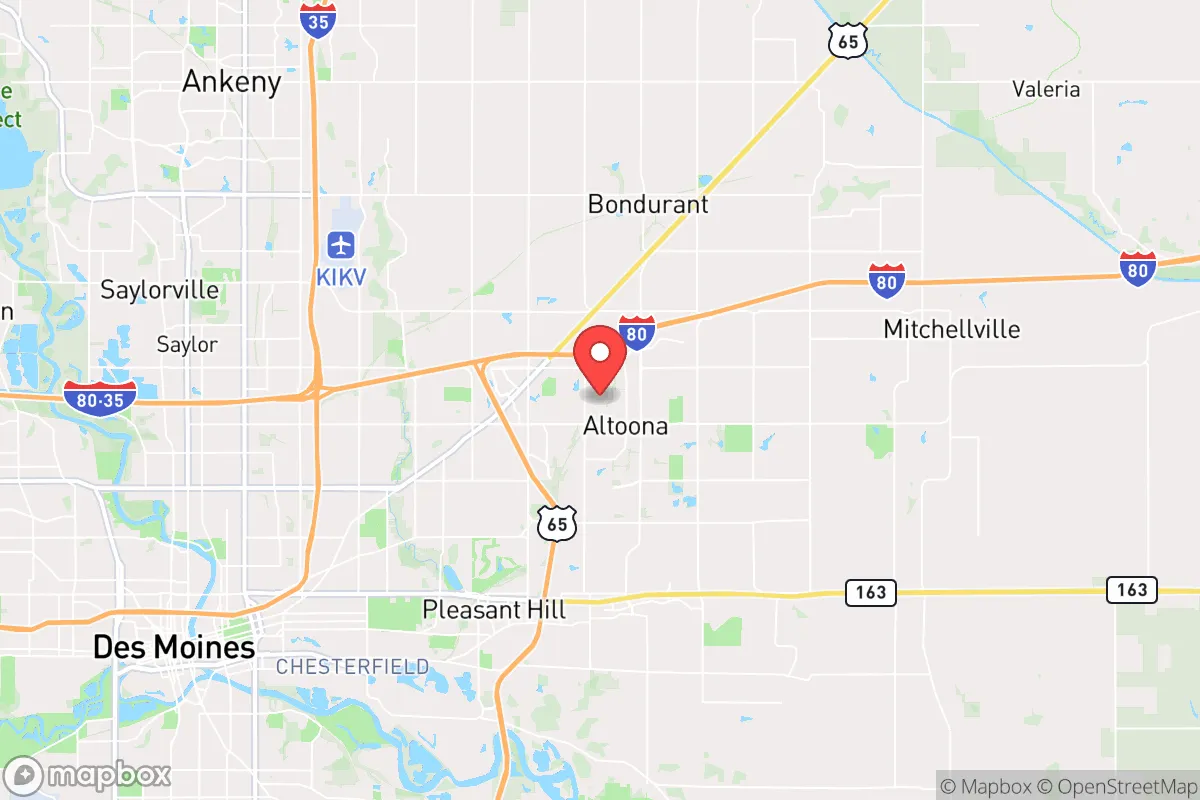
Photo: Wikipedia
Personal Sovereignty in Altoona, IA
Viable for self-reliance. Generally workable, though some barriers may limit total independence.
What does Personal Sovereignty tell us?
Personal Sovereignty measures your capacity for self-reliance and independence with minimal government friction. Higher scores mean fewer barriers between you and the way you want to live... but it assumes you have the space you need and good neighbors.
What does this tell us?
Personal Sovereignty measures your capacity for self-reliance and independence with minimal government friction. Higher scores mean fewer barriers between you and the way you want to live... but it assumes you have the space you need and good neighbors.
State Policy
Energy independence: Importer (50% of energy produced in-state)
Personal Liberty
Homesteading

Personal Liberty Analysis
Altoona, Iowa, offers a notably high degree of personal sovereignty relative to many other Midwestern communities, particularly for those who prioritize minimal government interference in daily life. The city’s political culture, rooted in central Iowa’s conservative leanings, generally supports individual autonomy over collective mandates, though it operates within the broader framework of state-level preemption laws that can both protect and limit local control. For the survivalist or prepper mindset, Altoona represents a strategic balance: close enough to Des Moines for economic opportunity, yet far enough to avoid the densest regulatory overreach, with a legal environment that largely respects the right to keep and bear arms, make personal health decisions, and manage one’s property without excessive bureaucratic friction.
Tax burden and regulatory posture: How Iowa’s flat tax and zoning affect your autonomy
Iowa’s move to a flat 3.8% individual income tax rate, fully phased in by 2026, directly enhances personal sovereignty by leaving more money in your pocket to allocate as you see fit—whether for supplies, land, or self-reliance projects. The state’s regulatory posture is generally business-friendly, with a right-to-work law and limited occupational licensing burdens compared to coastal states. At the local level, Altoona’s city council has historically favored development over heavy-handed zoning, though it’s not a free-for-all. Residential lots in newer subdivisions typically range from one-quarter to one-half acre, which is adequate for a substantial garden and small livestock like chickens, but not for full-scale homesteading. The city’s zoning code does restrict certain agricultural uses within city limits, so if you’re planning a serious off-grid operation, you’ll want to look at unincorporated Polk County or adjacent rural townships where property taxes are lower (around 1.2% of assessed value versus Altoona’s roughly 1.5%) and land-use restrictions are minimal. Property taxes in Altoona are moderate for the metro area, but the lack of a state inheritance tax and the absence of a local income tax are clear wins for those seeking to build generational wealth without the state taking a cut.
Self-defense and gun law specifics: What Iowa’s permitless carry means for your safety
Iowa became a permitless carry state in 2021, meaning any law-abiding adult 21 or older can carry a concealed firearm without a license, background check, or training requirement. This is a foundational pillar of personal sovereignty for the prepper community, as it removes a bureaucratic barrier to self-defense. The state also has strong castle doctrine and Stand Your Ground laws, with no duty to retreat in any place you are lawfully present. Altoona itself has a relatively low violent crime rate—about 1.5 incidents per 1,000 residents annually, well below the national average—but the proximity to Des Moines (15 minutes west) means that situational awareness remains critical. The Polk County Sheriff’s Office and Altoona Police Department are generally supportive of Second Amendment rights, and there are no local ordinances that further restrict firearms beyond state law. However, be aware that Iowa law prohibits carrying in certain locations like schools, courthouses, and private property with posted signage, so knowing the boundaries of your rights is essential. For those building a defensive stockpile, there are no state-level magazine capacity bans or firearm registration requirements, and the state preempts all local gun laws, meaning Altoona cannot enact its own restrictions—a significant protection against future city council overreach.
Self-reliance and homesteading viability: Lot sizes, zoning, and off-grid feasibility in Altoona
True off-grid living within Altoona city limits is challenging due to standard utility hookup requirements and zoning that prohibits permanent alternative energy systems as primary power sources without special permits. Most residential lots are 6,000 to 10,000 square feet, which limits large-scale food production, though many homeowners successfully raise backyard chickens (allowed with a permit and setback rules) and maintain substantial vegetable gardens. Rainwater collection is not restricted by state law, but Altoona’s municipal code requires connection to city water and sewer, so full water independence is not feasible within town. For serious homesteading, the better play is to look at rural Polk County or neighboring Jasper County, where 5- to 20-acre parcels are available within a 20-minute drive of Altoona. In those areas, you can install solar panels, dig a well, and use composting toilets without municipal interference. The state’s right-to-farm laws protect agricultural operations from nuisance lawsuits, which is a strong plus for those raising livestock or running a small farm. The local soil is fertile, with a growing season of about 160 days, making it viable for staple crops like corn, beans, and squash. If your goal is maximum self-reliance, Altoona itself is a compromise—good for a suburban base with a garden, but not for a full retreat.
Personal liberties: Parental rights, medical autonomy, speech, and property protections
Iowa has been a battleground for parental rights, with recent legislation (HF 68 in 2023) requiring schools to notify parents of any student requests for changes to gender identity or pronouns, and giving parents the right to review instructional materials. This aligns with a conservative view of family sovereignty, where the state defers to parents on education and health decisions. Medical autonomy is more mixed: Iowa does not have a state-level vaccine mandate for adults, but certain healthcare workers and schoolchildren faced requirements during the COVID-19 pandemic that have since been rolled back. The state does not restrict the purchase of over-the-counter antibiotics or emergency medications for personal stockpiles, though a prescription is still needed for most. Free speech protections are strong, with no hate speech laws that chill political expression, and the state’s open carry of firearms is itself a form of political speech. Property rights are well-guarded by Iowa’s eminent domain laws, which require just compensation and a public purpose, though the 2005 Kelo decision still allows for economic development takings—a point of concern for those with valuable land near Des Moines’ expanding suburbs. The state’s homestead exemption protects up to $30,000 of home equity from creditors, which is modest but provides a basic shield against financial overreach.
Overall, Altoona offers a solid sovereignty profile for the conservative-leaning individual or family, particularly when compared to states like California, New York, or Illinois, where tax burdens, gun control, and regulatory overreach are far more intrusive. The city’s main trade-off is between convenience and full autonomy: you get low taxes, strong gun rights, and parental control in schools, but you sacrifice the ability to live completely off-grid or avoid municipal utility mandates. For the prepper who wants a suburban base with good infrastructure and access to a major metro’s job market, while maintaining the legal freedom to defend themselves, raise some food, and keep the government out of family decisions, Altoona is a strong contender. The real sovereignty play, however, lies in the surrounding rural areas, where you can combine Altoona’s legal protections with the land and space to truly live by your own rules.

* Values derived from national, state, county, city and local statistics and may differ in a specific area. Last updated: 2026-04-21T07:16:35.000Z
Narrative content on this page is AI-generated and may contain mistakes. Verify any details that matter before acting on them.
ReloMaps may earn a commission from affiliate links at no extra cost to you.

