Photo: Wikipedia
Political ClimatePolitical Climate in Altoona, IA
District shown is the primary district for this city’s centroid. Cities may span multiple districts.
Local Political AnalysisPolitical Analysis of Altoona, IA
Altoona, Iowa, has long been a solidly conservative community, and while the Cook PVI of R+2 might suggest a purple tint, the day-to-day reality on the ground feels much redder than that number implies. For decades, this was a place where folks minded their own business, kept their lawns mowed, and didn't expect the government to poke its nose into their lives. The political trajectory here is a slow, cautious drift—not a hard left turn, but a subtle shift that has some of us who’ve been around a while keeping a closer eye on local school board meetings and city council votes than we ever used to.
How it compares
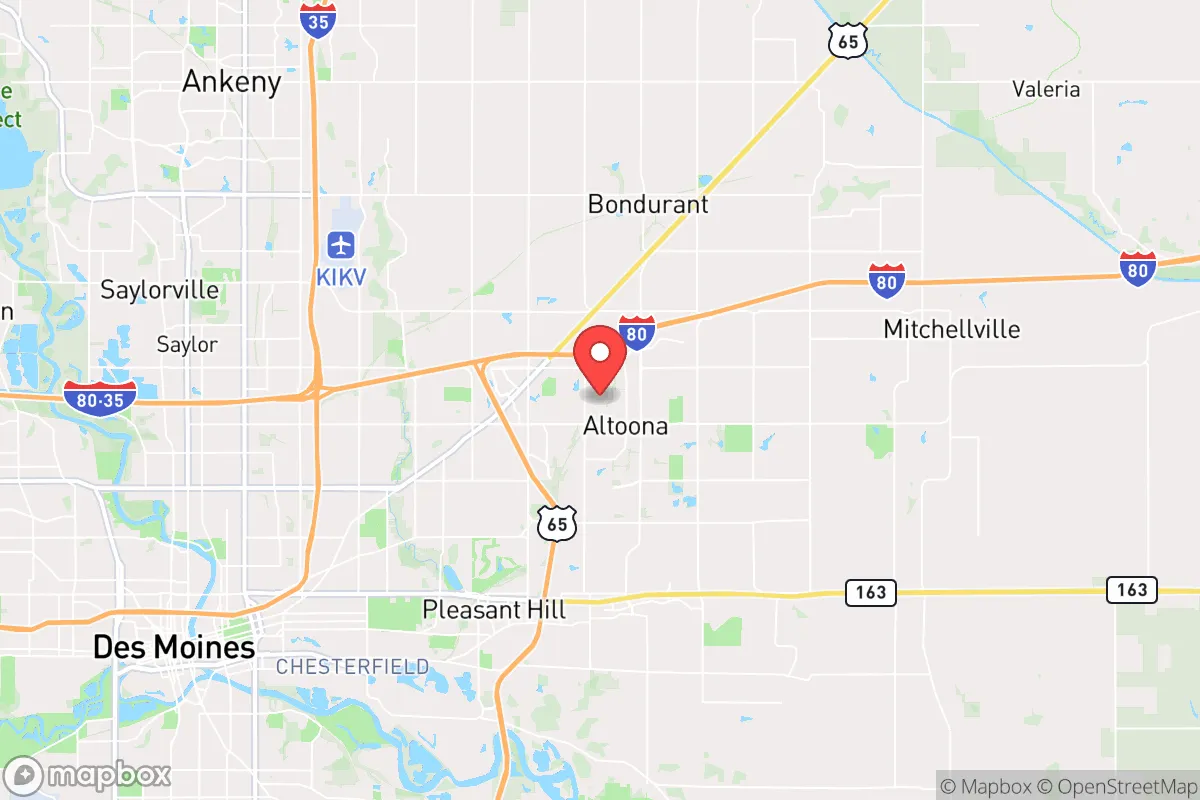
To really get the feel of Altoona’s politics, you have to look at the neighbors. Head west into Des Moines proper, and you’re in a different world—a place where progressive policies on housing, policing, and taxes have taken hold in ways that make a lot of Altoona folks shake their heads. Drive east to Newton or south to Indianola, and you find communities that still vote like Altoona used to: reliably conservative, with a healthy skepticism of government overreach. The contrast is sharpest with the Des Moines school district, where ideological battles over curriculum and parental rights have been front-page news. In Altoona, the Southeast Polk school board has largely held the line, but the pressure is there, and it’s something we watch closely. The R+2 rating feels like a warning—it means the margin for error is thin, and a few thousand new arrivals from blue states could tip the balance in a way that changes the character of the place.
What this means for residents
For the average family living here, the political climate translates directly into how much freedom you actually have in your daily life. Right now, Altoona still feels like a place where you can raise your kids without the government second-guessing every decision you make. Property taxes are reasonable compared to what you’d pay in the metro core, and there’s a general attitude of “live and let live” as long as you’re not hurting anyone. But the creeping influence of state-level progressive ideas—like expanded zoning controls or mandates that override local preferences—is a real concern. If you value the right to decide what’s best for your own family, your own business, and your own property, Altoona is still a good bet, but it’s not a sure thing anymore. The long-term trend depends heavily on who moves in and whether the city council stays focused on keeping government small and responsive, rather than expanding its reach.
Culturally, Altoona still holds onto a few distinctions that set it apart from the more progressive enclaves nearby. The strong presence of the local police and fire departments is respected, not resented, and there’s a general understanding that public safety isn’t something to be defunded or reimagined. The annual Prairie Meadows events and the community’s support for local veterans’ groups reflect a traditional, patriotic bent that hasn’t faded. That said, the biggest policy fight on the horizon is likely to be around housing density and development—whether the city will let builders put up high-density apartments that could change the neighborhood feel, or keep things more single-family and owner-occupied. For now, the conservative voice is still the loudest in the room, but it’s not the only one anymore. If you’re looking for a place where your rights and your wallet are still respected, Altoona is worth a look—just keep your ear to the ground.

State Political ClimatePolitical Climate in Iowa
State Political AnalysisPolitical Environment in the State
Iowa has been a reliably Republican state in presidential elections since 2016, but its political identity is more nuanced than a simple red-state label suggests. The state’s overall partisan lean is roughly +8 to +10 points Republican in statewide races, but that masks a dramatic 20-year shift: as recently as 2012, Iowa was a true swing state (Obama won it by 5 points). The 2024 presidential race saw Donald Trump carry the state by 13 points, cementing a rightward trajectory driven by rural depopulation, suburban realignment, and the collapse of the old Democratic coalition in the eastern industrial counties. For a conservative relocating here, the bottom line is that Iowa is now solidly red at the state level, but local politics vary widely—and the state’s policy environment has become a national model for conservative governance.
Urban vs. rural divide
The political map of Iowa breaks into three distinct zones. The Des Moines metro (Polk, Dallas, and Warren counties) is the state’s blue anchor: Polk County voted for Biden in 2020 by 18 points, and Des Moines itself is a reliably Democratic city with a growing progressive activist class. However, the surrounding suburbs tell a different story. Ankeny and Waukee in Dallas County have flipped from purple to red over the past decade; Dallas County went from a 2-point Obama win in 2012 to a 12-point Trump win in 2024. The second zone is the eastern industrial corridor—Davenport, Bettendorf, and the Quad Cities region. These Mississippi River towns were once the backbone of the state’s Democratic machine (union-heavy, Catholic, blue-collar), but they’ve shifted hard right since 2016. Scott County, home to Davenport, voted for Trump in 2024 after supporting Obama twice. The third zone is the vast rural expanse: counties like Sioux, Lyon, and Plymouth in northwest Iowa routinely vote 75-80% Republican, while the southern tier (Appanoose, Wayne, Decatur) is deeply red but also shrinking. The only remaining Democratic strongholds outside Des Moines are Johnson County (Iowa City, home to the University of Iowa) and Story County (Ames, home to Iowa State). These two college towns vote 65-70% Democratic but are increasingly isolated islands in a sea of red.
Policy environment
Iowa’s policy environment is aggressively conservative and has been shaped by a Republican trifecta (governor, House, Senate) since 2017. The state’s income tax was flattened to a single rate of 3.9% in 2023, down from a top rate of 8.98% a decade ago, and the corporate tax rate is being phased down to 5.5%. There is no inheritance tax, and property taxes are capped at 2% annual growth for residential properties. On education, Governor Kim Reynolds signed a universal school choice bill in 2023 (HF 68) that allows any family to use state funds for private or homeschool expenses—a major win for parental rights. The state also passed a law in 2022 banning transgender athletes from girls’ sports (HF 2416) and a 2023 law restricting gender transition procedures for minors (SF 538). Healthcare policy is mixed: Iowa expanded Medicaid under the Affordable Care Act in 2014, but the state has since received a federal waiver to impose work requirements on able-bodied adults. Election integrity is a priority: Iowa has strict voter ID laws (SF 413, 2021), limits early voting to 20 days, and requires polls to close at 8 p.m. sharp. The state also passed a 2021 law making it a felony for election officials to send unsolicited absentee ballot applications. For a conservative, this is a state that has systematically rolled back the progressive agenda of the 2010s.
Trajectory & freedom
Iowa is unequivocally becoming more free by conservative metrics. The 2021 permitless carry law (SF 507) allows any law-abiding adult to carry a concealed firearm without a permit, and the state preempts all local gun ordinances—so no city-level bans on assault weapons or magazine capacity. On medical freedom, Iowa passed a 2022 law prohibiting COVID-19 vaccine mandates by private employers (HF 889) and a 2023 law banning mask mandates in schools (HF 847). Property rights were strengthened by a 2022 law limiting the use of eminent domain for carbon pipeline projects (SF 541), though the controversial Summit Carbon Solutions pipeline is still moving forward under regulatory pressure. Parental rights were expanded by the 2023 “Parents’ Bill of Rights” (HF 595), which requires schools to notify parents of any curriculum involving sexuality or gender identity and allows parents to opt their children out. The only area where freedom has contracted is on abortion: Iowa passed a six-week abortion ban in 2023 (HF 732), which was temporarily blocked by courts but reinstated by the Iowa Supreme Court in 2024. For a conservative, this is a state where the legislature is actively dismantling government overreach in education, healthcare, and personal defense.
Civil unrest & political movements
Iowa has seen relatively little civil unrest compared to coastal states, but there have been flashpoints. The 2020 Black Lives Matter protests in Des Moines and Iowa City were large but mostly peaceful, though there were property damage incidents in the East Village neighborhood of Des Moines. The most organized activist movements are on the right: the Iowa Firearms Coalition is a powerful lobbying force, and the state’s chapter of Moms for Liberty has been active in school board races in West Des Moines, Ankeny, and Cedar Rapids. Immigration politics are less heated than in border states, but there was a 2023 controversy when Governor Reynolds deployed the Iowa National Guard to the Texas border as part of a multi-state operation. There is no sanctuary city movement in Iowa; in fact, a 2024 law (HF 260) requires local law enforcement to cooperate with ICE detainer requests. Election integrity remains a live issue: the 2020 election in Iowa was not seriously contested, but the 2021 audit law (SF 413) was driven by grassroots concerns about mail-in voting. The most visible political flashpoint for a new resident would likely be the ongoing fight over carbon pipelines—landowners in Humboldt, Pocahontas, and Calhoun counties have organized fierce resistance to eminent domain for CO2 pipelines, creating a rare left-right coalition of property rights activists and environmentalists.
Projection
Over the next 5-10 years, Iowa will likely become more Republican and more conservative. The key demographic driver is that the state’s population is aging and rural counties are shrinking, while the Des Moines metro is growing modestly. However, the growth in the Des Moines suburbs (Ankeny, Waukee, Norwalk) is overwhelmingly conservative-leaning—these are families moving from blue states for lower taxes and school choice. The college towns (Iowa City, Ames) will remain blue, but their political influence is diluted by the fact that they are not growing as fast as the red suburbs. The wild card is the potential for a Democratic resurgence in the eastern industrial corridor if the national party re-embraces economic populism, but that seems unlikely in the near term. The state’s policy trajectory is set: expect further income tax cuts (possibly to a flat 3.5% by 2028), continued expansion of school choice, and additional restrictions on transgender rights and abortion. A new resident moving in now should expect to find a state that is stable, predictable, and increasingly aligned with conservative values—but also one where the urban-rural cultural divide is real and visible in everyday life.
For a conservative relocating to Iowa, the practical takeaway is that this is a state where your values are reflected in state law, your taxes are low and falling, and your children’s education is protected from progressive curriculum mandates. The trade-off is that you’ll be living in a state with harsh winters, a shrinking rural population, and a cultural scene that is heavily centered on Des Moines and the college towns. If you’re looking for a place where government overreach is actively being rolled back and where your personal freedoms—from gun rights to school choice to medical autonomy—are expanding, Iowa is one of the best bets in the Midwest. Just be prepared for the cold and the cornfields.
* Values derived from national, state, county, city and local statistics and may differ in a specific area. Last updated: 2026-04-21T07:16:35.000Z
Narrative content on this page is AI-generated and may contain mistakes. Verify any details that matter before acting on them.
ReloMaps may earn a commission from affiliate links at no extra cost to you.

