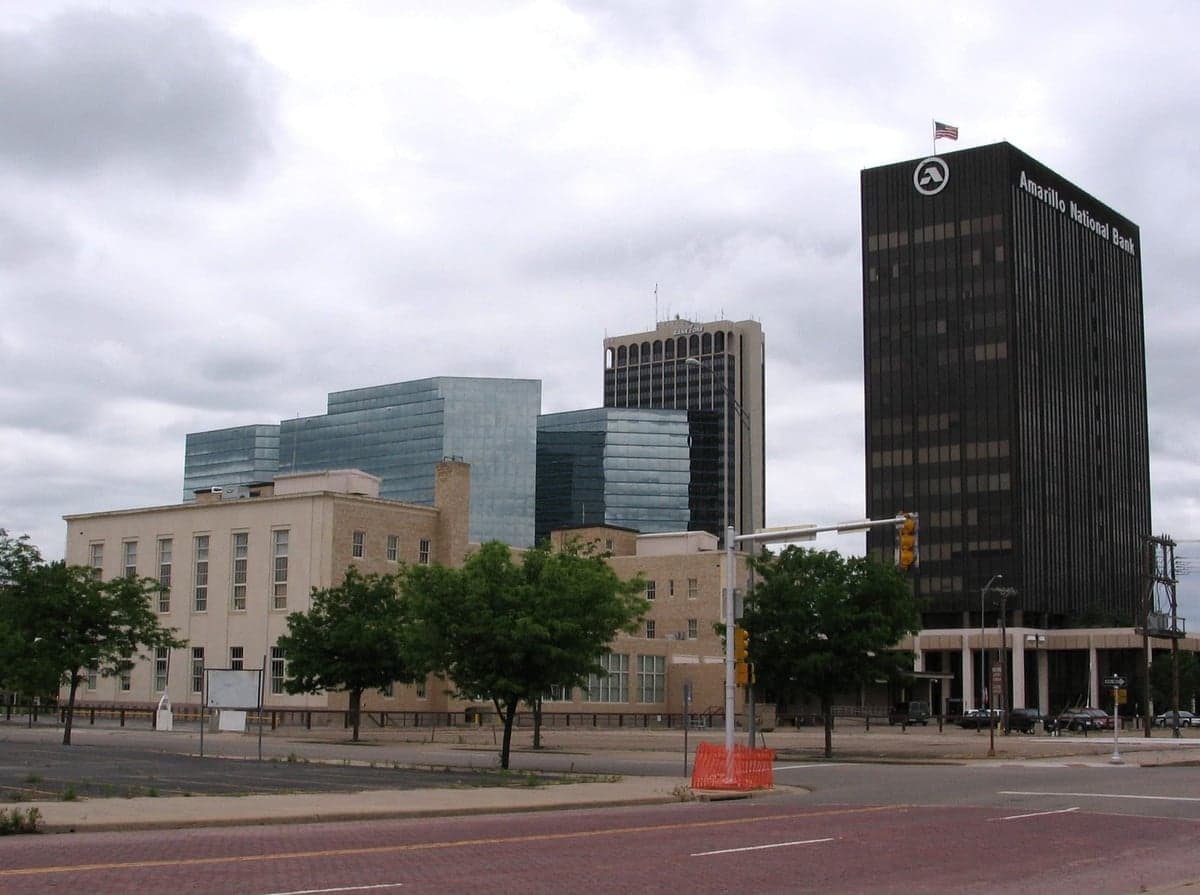
Photo: Wikipedia
Demographics of Amarillo, TX
Affluence Level in Amarillo, TX
A middle-class area roughly in line with national averages across income, home values, education, and employment.
People of Amarillo, TX
The people of Amarillo, Texas today form a community of roughly 200,945 residents characterized by a strong Western identity, a significant Hispanic presence, and a notably lower foreign-born share than the national average. The city’s population is 52.0% White, 33.7% Hispanic, 7.0% Black, 3.7% East/Southeast Asian, and 0.3% Indian (subcontinent), with only 6.3% foreign-born and 25.1% holding a college degree. This demographic profile reflects a city that grew through distinct waves of migration tied to railroads, agriculture, and the energy industry, rather than through large-scale international immigration. The result is a population that is more ethnically diverse than much of the Texas Panhandle, yet remains culturally rooted in ranching and conservative values.
How the city was settled and grew
Amarillo was founded in 1887 as a railroad town on the Fort Worth and Denver City Railway, which drew the first wave of settlers: Anglo-American cattle ranchers and merchants from the South and Midwest. The original townsite, centered around what is now the San Jacinto neighborhood, was built by these early ranchers and railroad workers, who established the city as a shipping hub for cattle and later for wheat and cotton. By the early 1900s, the discovery of natural gas and oil in the Panhandle triggered a second wave, bringing white laborers from Oklahoma and Kansas into areas like Bivins and Plemons, where company housing and modest bungalows sprang up. A smaller but notable wave of Black settlers arrived during the Great Migration, settling primarily in the North Heights neighborhood, which became the historic center of Amarillo’s Black community, anchored by churches and the Carver School. Hispanic migration began in earnest during the 1910s and 1920s, as Mexican laborers were recruited for railroad maintenance and agricultural work, forming the Barrio (now part of the San Jacinto area) and later spreading into Eastridge. By 1950, Amarillo’s population was roughly 90% White, with small but established Black and Hispanic enclaves.
Modern era (post-1965)
The post-1965 period brought significant demographic change, driven less by the Hart-Cellar Act and more by domestic migration tied to the energy boom of the 1970s and 1980s. The oil and gas industry drew white and Hispanic workers from across the Southwest into newer subdivisions like Sleepy Hollow and Puckett, where ranch-style homes and cul-de-sacs replaced older grid neighborhoods. Hispanic growth accelerated steadily, rising from roughly 12% of the population in 1980 to 33.7% today, with families moving into Eastridge and San Jacinto as older Anglo residents suburbanized westward toward West Hills and Bishop Hills. The Black population, which peaked at around 10% in the 1990s, has since declined to 7.0%, with many families leaving North Heights for more integrated areas or other cities. East/Southeast Asian communities, primarily Vietnamese and Filipino, arrived in small numbers after the Vietnam War, settling in Puckett and near the medical district, but remain a modest 3.7% share. The Indian (subcontinent) population is negligible at 0.3%, concentrated among professionals in healthcare and engineering. The foreign-born share of 6.3% is well below the Texas average of 17%, reflecting limited recent international immigration.
The future
Amarillo’s population is heading toward greater Hispanic plurality, with projections suggesting the Hispanic share could reach 40-45% by 2040, driven by higher birth rates and continued domestic migration from South Texas and New Mexico. The White share is declining gradually, while the Black and East/Southeast Asian shares are expected to remain stable or grow slightly. The city is not tribalizing into distinct enclaves; rather, neighborhoods like Eastridge and San Jacinto are becoming more mixed as younger Hispanic families move into areas once predominantly White. The foreign-born share is likely to remain low, as Amarillo lacks the economic pull for large-scale international immigration. The college-educated share of 25.1% is below the national average of 34%, but the presence of Texas Tech University Health Sciences Center and Pantex is slowly attracting more skilled workers. The city is becoming more ethnically diverse but culturally conservative, with a growing bilingual population and a stable, family-oriented character.
For someone moving to Amarillo now, the city offers a population that is increasingly Hispanic, still majority White, and deeply rooted in ranching and energy industries. The community is not experiencing rapid demographic upheaval but a gradual shift toward a more diverse, younger, and family-focused identity. New residents will find a place where neighborhoods are relatively integrated, the cost of living is low, and the social fabric remains shaped by church, school, and work rather than by ethnic division.

* Values derived from national, state, county, city and local statistics and may differ in a specific area. Last updated: 2026-04-19T07:24:17.000Z
Narrative content on this page is AI-generated and may contain mistakes. Verify any details that matter before acting on them.
ReloMaps may earn a commission from affiliate links at no extra cost to you.

