Photo: Wikipedia
Demographics of American Fork, UT
Affluence Level in American Fork, UT
An upper-middle-class area. Household wealth, education levels, and homeownership run ahead of national benchmarks.
People of American Fork, UT
The people of American Fork, Utah, today number 35,312 and form one of the most demographically homogeneous midsize cities in the Wasatch Front. The population is 82.6% white, 9.8% Hispanic, 1.1% East and Southeast Asian, 0.3% Black, 0.3% Indian (subcontinent), and 2.6% foreign-born. With 42.0% of adults holding a college degree, the city is a predominantly white, highly educated, and strongly LDS (Church of Jesus Christ of Latter-day Saints) community that blends suburban family life with a growing tech-sector workforce.
How the city was settled and grew
American Fork was settled in 1850 by Mormon pioneers dispatched by Brigham Young to farm the fertile Utah Valley floor. The original settlers—almost entirely converts from England, Scandinavia, and the eastern United States—built homes along what is now Main Street and the historic Old Town district, centered near 100 East and 100 North. These families drained wetlands, dug irrigation canals, and planted wheat and alfalfa, establishing a tight-knit agrarian society. By the 1870s, the arrival of the Utah Southern Railroad spurred a second wave of LDS settlers from other Utah settlements, who filled out the North Park and East Bench neighborhoods with modest brick homes and small farms. The city remained overwhelmingly white and LDS through the early 1900s, with a population that barely topped 5,000 by 1950.
Modern era (post-1965)
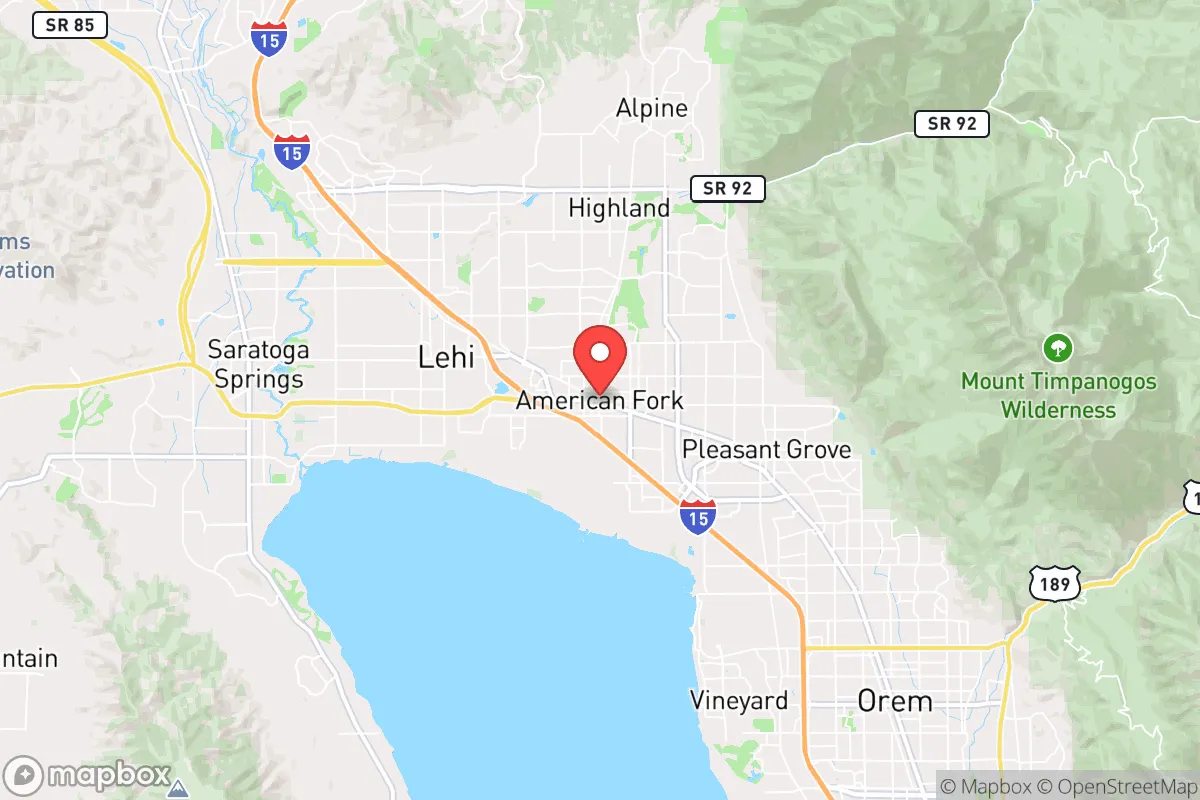
After the 1965 Hart-Cellar Act, American Fork saw negligible immigration from outside the United States—its foreign-born share today is just 2.6%, far below the national average. Instead, the city’s modern growth has been driven by domestic in-migration: white LDS families from other parts of Utah and the Intermountain West, drawn by affordable housing and proximity to Silicon Slopes tech jobs. The Harvest Hills subdivision, developed in the 1990s and 2000s, absorbed many of these newcomers with large single-family homes on cul-de-sacs. The Ponderosa neighborhood, near the freeway, became a landing zone for younger families priced out of Lehi and Alpine. Hispanic residents, who now make up 9.8% of the population, began arriving in the 1990s for construction and service work; they are concentrated in the West Side area, west of I-15, where older, more affordable housing stock exists. East and Southeast Asian residents (1.1%) and Indian-subcontinent residents (0.3%) are thinly scattered, with no distinct ethnic enclave, and are largely professionals in tech or healthcare who live in newer subdivisions like Lakeview near the Utah Lake shoreline. The Black population (0.3%) remains minimal, mostly military families connected to nearby Camp Williams.
The future
American Fork is likely to remain a predominantly white, LDS-majority city for the next 10–20 years, but with gradual diversification. The Hispanic share is growing steadily—projected to reach 12–14% by 2035—driven by second-generation families aging into homeownership and new arrivals in construction and hospitality. These families are expected to expand the West Side footprint and may begin moving into Harvest Hills and East Bench as housing prices rise. The East and Southeast Asian and Indian-subcontinent populations will grow slowly, tracking the expansion of tech employment in Lehi and Vineyard, but will likely remain below 3% combined. The city is not tribalizing into distinct ethnic enclaves; rather, it is homogenizing around a white LDS core while absorbing a modest Hispanic minority into existing neighborhoods. The foreign-born share will rise only slightly, as most growth comes from domestic migration and natural increase.
For someone moving in now, American Fork offers a stable, family-oriented community with strong schools and low crime, but little racial or cultural diversity. The city is becoming slightly more Hispanic and slightly more secular, but its identity as a white, LDS, suburban enclave will persist. New residents should expect a place where neighborly familiarity and church-based social networks dominate, and where newcomers who are not LDS or white may find integration slower but not hostile.

* Values derived from national, state, county, city and local statistics and may differ in a specific area. Last updated: 2026-05-03T20:38:01.000Z
Narrative content on this page is AI-generated and may contain mistakes. Verify any details that matter before acting on them.
ReloMaps may earn a commission from affiliate links at no extra cost to you.

