
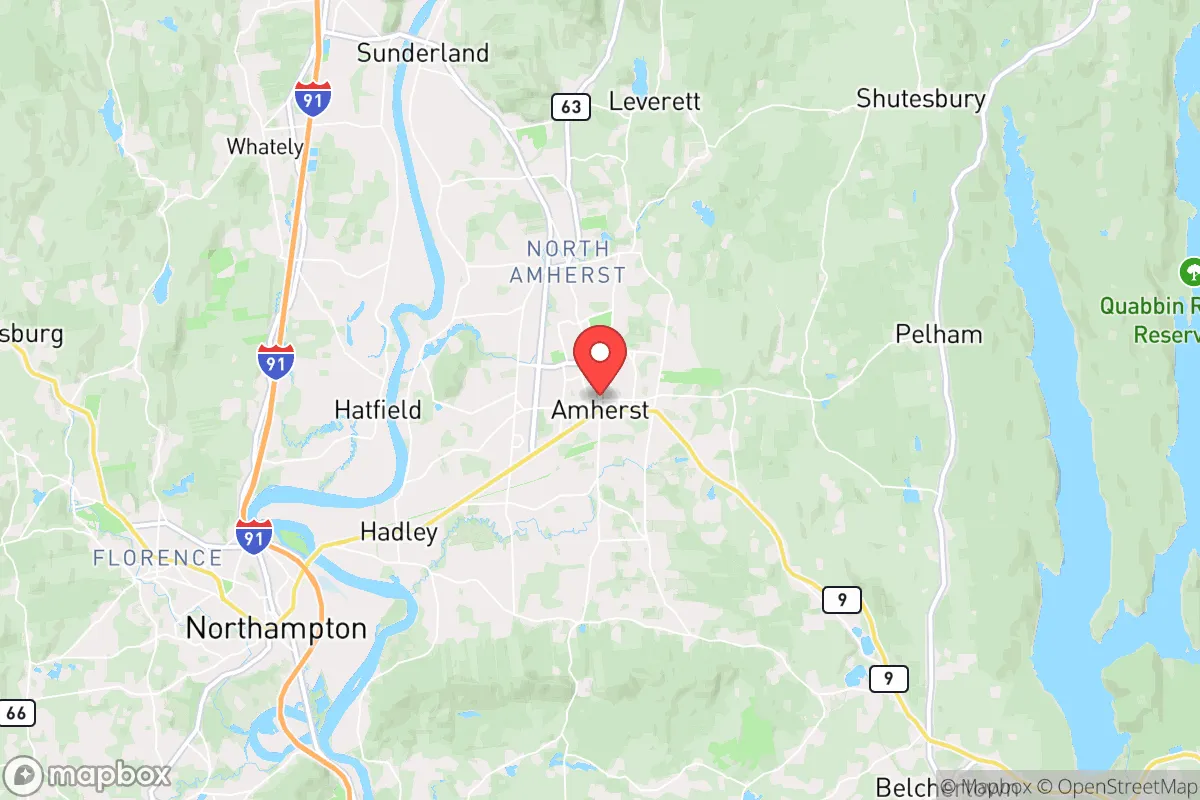
Photo by Evan McNamara on Unsplash
Demographics of Amherst Town, MA
Historical data isn't available for Amherst Town, MA. Trends shown are for Hampshire County, MA.
Affluence Level in Amherst Town, MA
A below-average socioeconomic profile. Incomes, home values, and educational attainment trail the U.S., with higher poverty and unemployment.
People of Amherst Town, MA
Amherst Town, Massachusetts, is a dense, highly educated college town of 35,472 residents, shaped by three centuries of academic and agricultural settlement. Its population is notably young and transient, with a median age of 22.8, driven by the presence of Amherst College, Hampshire College, and the University of Massachusetts Amherst. The town’s character is defined by a 73.8% college-educated rate, a 9.3% foreign-born share, and a racial composition that is 65.9% white, 9.9% East/Southeast Asian, 8.9% Hispanic, 4.5% Black, and 3.9% Indian (subcontinent).
How the city was settled and grew
Amherst’s original population was English Puritan farmers who arrived in the 1730s, drawn by fertile Connecticut River valley land granted by the Massachusetts General Court. The town was incorporated in 1759, and its early economy centered on agriculture, milling, and small-scale manufacturing along the Mill River. The historic Amherst Center neighborhood, clustered around the Common, became the civic and commercial hub, built by Yankee families who dominated local governance and the Congregational church. A second wave arrived after the founding of Amherst College in 1821, bringing faculty, students, and support staff who settled in the College Hill area, just east of the center. The arrival of the railroad in 1853 spurred a modest Irish and French-Canadian immigration, with laborers and domestic workers settling in the North Amherst village, near the mill complexes and the later site of the Massachusetts Agricultural College (now UMass Amherst), founded in 1863. These groups remained largely working-class, distinct from the Yankee academic elite, and their descendants still form a small but stable portion of the town’s older families.
Modern era (post-1965)
The 1965 Hart-Cellar Act and the expansion of UMass Amherst after the 1960s transformed Amherst’s population. The university’s growth drew a wave of domestic in-migration from across the U.S., particularly faculty and graduate students, who settled in the Puffton Village and East Amherst neighborhoods, areas of mid-century ranch homes and garden apartments built to accommodate the influx. The foreign-born share rose from under 5% in 1970 to 9.3% today, driven primarily by academic and professional migration. East/Southeast Asian communities—largely Chinese, Korean, and Vietnamese—concentrated in the South Amherst area near UMass, often in graduate student housing and rental complexes. Indian (subcontinent) residents, a separate group at 3.9%, arrived later, from the 1990s onward, many as tech and engineering professionals tied to the university’s research labs and the nearby Five College consortium; they are dispersed across Amherst Center and East Amherst, with no single ethnic enclave. Hispanic residents (8.9%) include a mix of Puerto Rican, Dominican, and Central American families, many working in service and maintenance roles at the colleges, and are most concentrated in the North Amherst and Mill District neighborhoods, where older, more affordable housing stock exists. Black residents (4.5%) are a smaller, long-established community, with roots in the post-war period and newer arrivals among faculty and staff; they are scattered across the town, with no dominant neighborhood.
The future
Amherst’s population is projected to remain stable or grow slowly, constrained by strict zoning and limited developable land. The town is not homogenizing but is tribalizing into distinct enclaves based on income and tenure: the student-heavy rental zones (South Amherst, Puffton Village) are increasingly East/Southeast Asian and international, while the owner-occupied single-family neighborhoods (East Amherst, College Hill) remain predominantly white and older. The Indian (subcontinent) community is growing modestly, driven by academic hires, but is assimilating into professional-class neighborhoods rather than forming a separate enclave. Hispanic and Black populations are plateauing, as housing costs push lower-income families to cheaper towns like Hadley and Sunderland. The foreign-born share is unlikely to rise significantly above 10-12%, as the university’s international student enrollment faces federal policy headwinds. Over the next 10-20 years, Amherst will likely become more bifurcated: a wealthy, white, older homeowner class in the hills, and a younger, more diverse, transient renter class in the flats near campus.
For a conservative-leaning individual or parent considering a move, Amherst is becoming a place of increasing demographic and economic stratification, where the academic and professional class dominates civic life and housing policy. The town’s high taxes, strict zoning, and progressive political culture mean that newcomers who are not tied to the colleges may find limited community and high costs. The population is stable but not growing in diversity beyond the university orbit, and the long-term trend is toward a more exclusive, college-serving town rather than a broad-based community.

* Values derived from national, state, county, city and local statistics and may differ in a specific area. Last updated: 2026-04-19T07:41:37.000Z
Narrative content on this page is AI-generated and may contain mistakes. Verify any details that matter before acting on them.
ReloMaps may earn a commission from affiliate links at no extra cost to you.

