
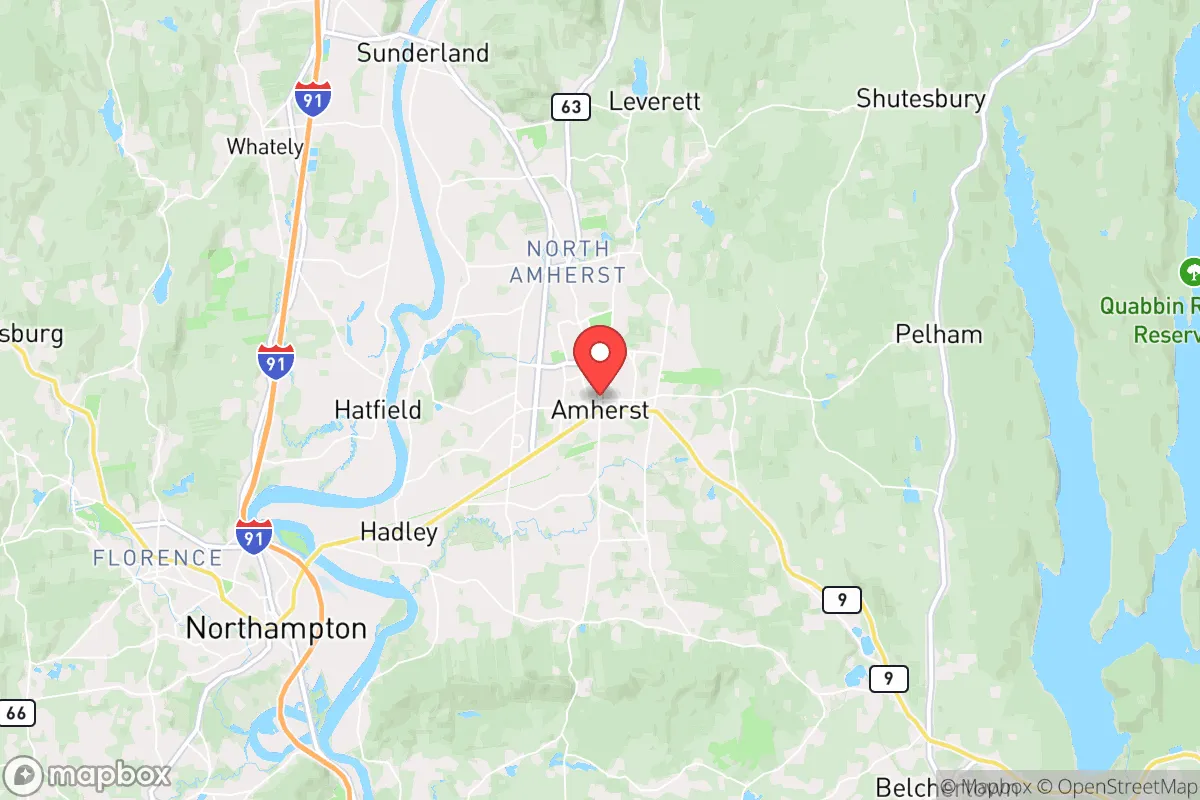
Photo by Evan McNamara on Unsplash
Personal Sovereignty in Amherst Town, MA
Moderate friction. Expect trade-offs in some aspect of personal liberty and independence.
What does Personal Sovereignty tell us?
Personal Sovereignty measures your capacity for self-reliance and independence with minimal government friction. Higher scores mean fewer barriers between you and the way you want to live... but it assumes you have the space you need and good neighbors.
What does this tell us?
Personal Sovereignty measures your capacity for self-reliance and independence with minimal government friction. Higher scores mean fewer barriers between you and the way you want to live... but it assumes you have the space you need and good neighbors.
State Policy
Energy independence: Importer (5% of energy produced in-state)
Personal Liberty
Homesteading

Personal Liberty Analysis
For the liberty-minded individual or family evaluating Amherst Town, Massachusetts, the personal sovereignty environment is best described as heavily constrained by state-level authority, with local governance adding another layer of regulatory friction. While the town itself offers a picturesque New England setting and proximity to academic institutions, the practical reality for those prioritizing self-reliance, minimal government interference, and the right to keep and bear arms is one of significant limitation. The Commonwealth of Massachusetts consistently ranks among the most restrictive states in the nation for personal freedoms, and Amherst, as a progressive college town, largely embraces and amplifies these policies rather than resisting them. For a survivalist or prepper mindset, this is not a jurisdiction that respects the individual as the primary unit of sovereignty; it is a place where the state assumes a dominant role in nearly every aspect of daily life.
Tax burden and regulatory posture for residents and property owners
Massachusetts imposes a heavy tax burden that directly erodes personal financial sovereignty. The state income tax is a flat 5.0% on all earned income, with no standard deduction for many filers, meaning the state takes a cut from the first dollar earned. Property taxes in Amherst are notably high, with a fiscal 2024 rate of approximately $20.84 per $1,000 of assessed value, placing the town well above the national average. For a home valued at $400,000, that translates to over $8,300 annually in property tax alone. The state also levies a 6.25% sales tax on most goods, and there is no local option to reduce it. From a regulatory standpoint, Amherst operates under the state's stringent building codes, environmental restrictions, and zoning bylaws. The town's zoning is dense and restrictive, particularly in the village centers, with large-lot requirements in rural areas that limit subdivision and development. The state's Chapter 40B law allows developers to bypass local zoning for affordable housing projects, which can override neighborhood character and property rights. For someone seeking to minimize tax exposure or build freely on their land, this is a hostile environment.
Self-defense rights and gun law specifics in Amherst and Massachusetts
For the prepper or survivalist, the right to keep and bear arms is non-negotiable, and Massachusetts is one of the worst states in the country for this fundamental liberty. The state requires a License to Carry (LTC) for any handgun, and the issuing authority—the Amherst Police Department—has significant discretion. While "shall issue" in theory, the reality is that the town's licensing officer can impose restrictions, such as limiting the license to "target and hunting" only, which effectively bans concealed carry for self-defense. The state's 2014 "safe storage" law mandates that all firearms be locked in a secure container or equipped with a trigger lock when not in use, even inside the home, creating potential liability for a defender who needs immediate access. Magazine capacity is capped at 10 rounds, and the state's assault weapons ban, one of the oldest in the nation, prohibits a wide range of commonly owned rifles. There is no state preemption for firearm laws, meaning Amherst could theoretically pass its own additional restrictions, though state law already covers most ground. For a family that believes in the right to defend their home without government permission, this legal framework is a direct infringement on personal sovereignty.
Self-reliance and homesteading viability: lot sizes, zoning, and off-grid feasibility
Amherst's rural character offers some theoretical potential for self-reliance, but the regulatory reality imposes severe limits. Minimum lot sizes in the town's Agricultural-Residential zoning districts are 2 acres, which is modest for serious homesteading but workable for a large garden, small orchard, and a few chickens. However, the town's zoning bylaws strictly regulate accessory dwelling units, home occupations, and the keeping of livestock. Chickens are allowed on lots of 20,000 square feet or more, but goats, sheep, and other larger animals require a special permit and a minimum of 2 acres. Off-grid living is effectively illegal: the state building code requires connection to the electrical grid for new construction, and the town enforces strict septic system regulations that make composting toilets or alternative waste systems nearly impossible to permit. Rainwater harvesting is legal but limited to non-potable uses, and any well must meet state Department of Environmental Protection standards. For someone seeking to disconnect from municipal utilities or live a truly self-sufficient lifestyle, Amherst's regulatory apparatus is a significant obstacle. The town's Right to Farm bylaw offers some protection for agricultural operations, but it does not override state environmental or health codes.
Personal liberties: parental rights, medical autonomy, speech, and property
Massachusetts has a well-documented record of asserting state authority over parental rights, particularly in education and medical decisions. The state's 2019 "Healthy Youth Act" mandates comprehensive sex education in public schools, and parents cannot opt their children out of specific lessons—only the entire curriculum. The state also requires all children to be vaccinated against a list of diseases for school attendance, with medical exemptions only; religious and philosophical exemptions were eliminated in 2021. During the COVID-19 pandemic, Massachusetts had some of the most aggressive mandates in the nation, including a statewide school mask mandate that lasted into 2022. Medical autonomy for adults is also limited: the state has a strict Prescription Monitoring Program that tracks all controlled substance prescriptions, and the Massachusetts Health Care Reform Act mandates that all residents carry health insurance or face a tax penalty. Free speech is generally protected, but the state's anti-SLAPP law and hate crime statutes can be used to chill political expression, particularly on controversial topics. Property rights are further constrained by the state's Chapter 61A program, which gives tax breaks to landowners who keep land in agricultural use, but also imposes a penalty if the land is sold for development—effectively a state-enforced land-use restriction. For the individual who believes in the primacy of parental authority and medical choice, this is a jurisdiction that consistently sides with the state over the family.
In the broader landscape of personal sovereignty, Amherst Town, Massachusetts, ranks among the most restrictive environments in the United States for the liberty-minded individual. The combination of high taxes, stringent gun control, aggressive public health mandates, and limited homesteading freedom creates a system where the individual is subordinate to the state at nearly every turn. For a survivalist or prepper seeking a location where they can build a self-reliant life with minimal government interference, this area is a poor fit. Neighboring states like New Hampshire or Vermont offer far greater latitude in gun laws, tax burden, and regulatory freedom. If you value the right to defend your home, raise your children according to your values, and live off the land without bureaucratic permission, look elsewhere. Amherst is a beautiful town, but its beauty is purchased at the cost of your personal sovereignty.

* Values derived from national, state, county, city and local statistics and may differ in a specific area. Last updated: 2026-04-19T07:41:37.000Z
Narrative content on this page is AI-generated and may contain mistakes. Verify any details that matter before acting on them.
ReloMaps may earn a commission from affiliate links at no extra cost to you.

