 Popular
Photo: Wikipedia
Demographics of Anchorage, AK
Affluence Level in Anchorage, AK
A middle-class area roughly in line with national averages across income, home values, education, and employment.
People of Anchorage, AK
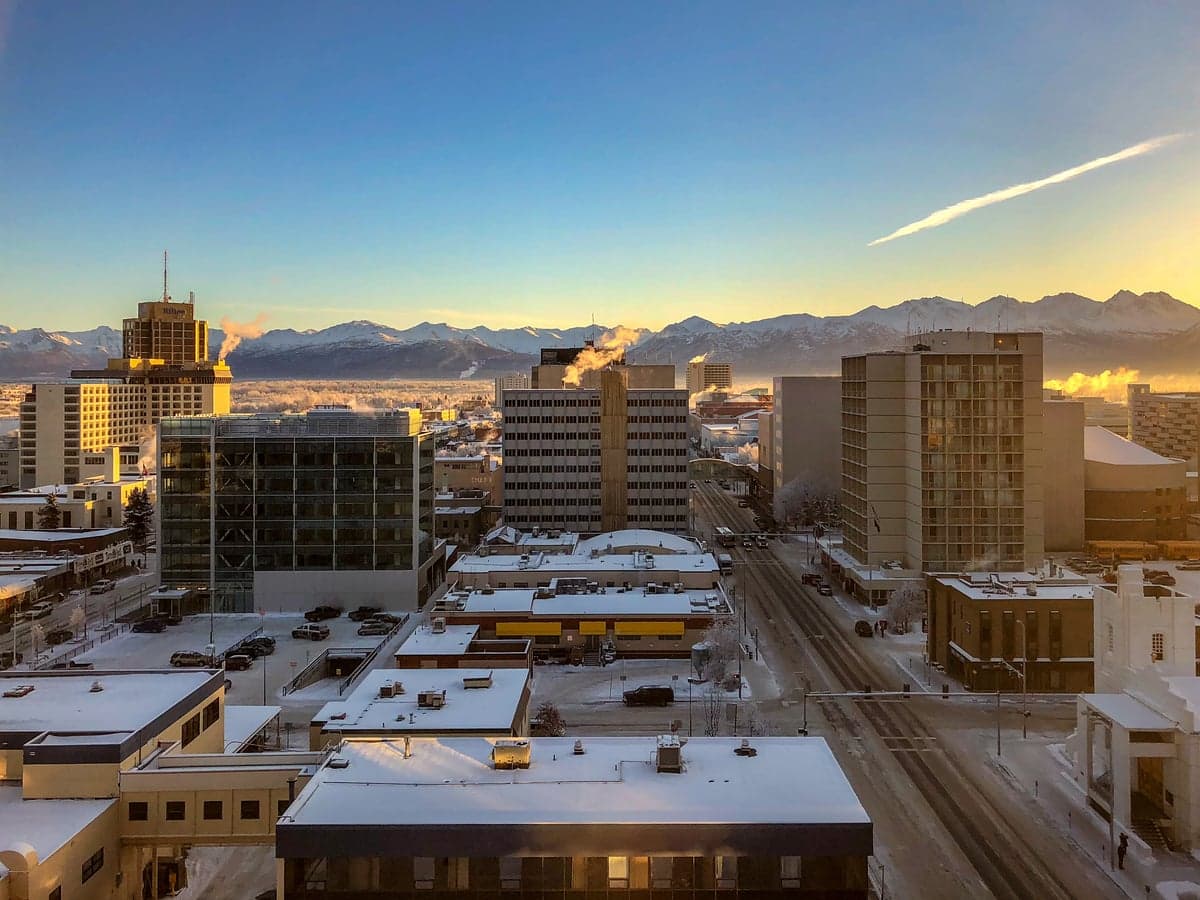
The people of Anchorage, Alaska, today form a population of 289,069 that is notably younger and more racially diverse than the rest of the state, yet still majority white at 55.1%. The city’s identity is shaped by a transient, opportunity-driven workforce—drawn by military bases, oil wealth, and resource extraction—rather than deep generational roots. With a foreign-born population of just 3.8%, Anchorage remains less immigrant-heavy than the national average, but its Asian (9.3%) and Hispanic (9.3%) communities are the fastest-growing segments, concentrated in specific neighborhoods. The city’s character is pragmatic, outdoors-oriented, and politically mixed, with a libertarian streak that appeals to conservative-leaning individuals seeking economic opportunity without the congestion of the Lower 48.
How the city was settled and grew
Anchorage was founded in 1915 as a railroad construction camp for the Alaska Engineering Commission, which built the Alaska Railroad from Seward to Fairbanks. The original population was overwhelmingly male, transient, and white—railroad workers, prospectors, and laborers from the contiguous United States, many of Scandinavian and Irish descent. The city’s first permanent neighborhoods, such as Government Hill (built for railroad and military families) and Downtown Anchorage, were laid out in a grid pattern by the federal government. World War II brought a massive military buildup: Elmendorf Air Force Base (now Joint Base Elmendorf-Richardson) and Fort Richardson drew thousands of service members and civilian contractors, many of whom stayed after the war. The 1950s and 1960s saw the arrival of Alaska Native families from rural villages, who settled in Mountain View and Fairview, neighborhoods that became hubs for Indigenous and mixed-race communities. The 1964 Good Friday Earthquake destroyed much of Downtown and spurred relocation to higher ground, accelerating suburban growth in Spenard and Turnagain.
Modern era (post-1965)
The 1968 discovery of oil at Prudhoe Bay and the 1977 completion of the Trans-Alaska Pipeline transformed Anchorage into a boomtown. Tens of thousands of workers—predominantly white men from the Lower 48—flooded in for high-wage construction and oilfield jobs, settling in suburban subdivisions like Eagle River and Chugiak to the north. The 1980s oil bust caused a sharp population decline, but the city rebounded in the 1990s with diversification into healthcare, logistics, and tourism. Post-1965 immigration reforms had a modest effect compared to other U.S. cities: the Asian population grew primarily through Filipino and Korean immigrants who clustered in Mountain View and Midtown, often working in healthcare, hospitality, and small retail. The Hispanic population, largely Mexican and Puerto Rican, expanded in Fairview and Russian Jack Park, drawn by construction and service jobs. The Black population (5.1%) is heavily tied to the military and has remained stable, concentrated near the bases in Elmendorf and Fort Richardson housing areas. The Indian subcontinent population (0.4%) is tiny and dispersed, working primarily in tech and healthcare. Notably, Anchorage has one of the highest per-capita Alaska Native populations of any U.S. city, with many living in Mountain View and Fairview, though urban Indigenous communities face housing instability and higher poverty rates.
The future
Anchorage’s population is slowly homogenizing in terms of race, but tribalizing by income and geography. The white population share has declined from roughly 70% in 1990 to 55.1% today, driven by out-migration of younger white families to the Matanuska-Susitna Borough (the “Valley”) and the growth of minority groups. The Asian and Hispanic communities are growing steadily through natural increase and secondary migration from other U.S. cities, but the foreign-born share (3.8%) remains low, limiting the pace of diversification. The Alaska Native population is plateauing, with younger generations moving to the Lower 48 for education and jobs. Over the next 10–20 years, Anchorage will likely become more ethnically mixed but also more economically stratified: Eagle River and South Anchorage will remain predominantly white and affluent, while Mountain View and Fairview will become denser, more diverse, and lower-income. The city’s population growth is projected to be flat or slightly negative, as high housing costs and limited job diversity push families to the Valley or out of state.
For a conservative-leaning mover today, Anchorage offers a rare combination of economic opportunity (especially in trades, logistics, and healthcare) and a low-tax, low-regulation environment, but the social fabric is thin and transient. The city is becoming more diverse and urban, but the most stable, family-oriented communities are in the northern suburbs and the Valley, where conservative values and outdoor lifestyles dominate. If you value a place where your neighbors are likely to be fellow transplants rather than multi-generational locals, and where the economy rewards practical skills over credentials, Anchorage remains a viable choice—but expect a population that is aging, slowly shrinking, and increasingly divided by income rather than ethnicity.

* Values derived from national, state, county, city and local statistics and may differ in a specific area. Last updated: 2026-04-19T19:14:18.000Z
Narrative content on this page is AI-generated and may contain mistakes. Verify any details that matter before acting on them.
ReloMaps may earn a commission from affiliate links at no extra cost to you.

