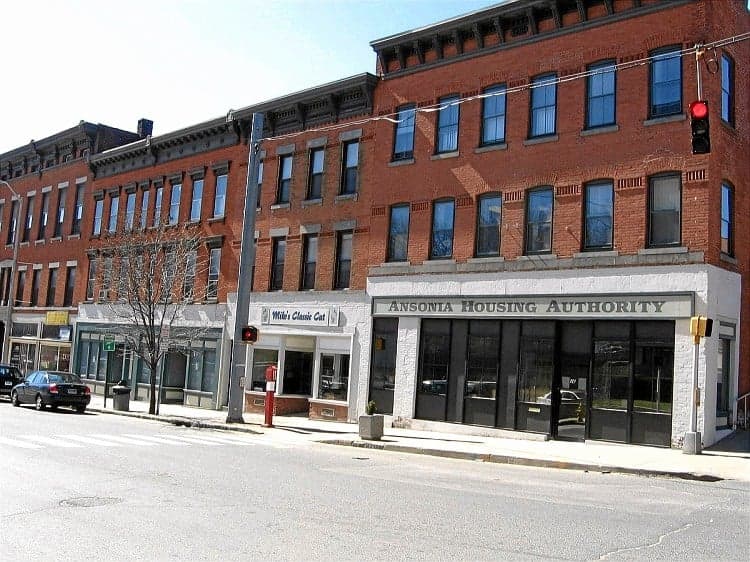
Photo: Wikipedia
Demographics of Ansonia, CT
Affluence Level in Ansonia, CT
A middle-class area roughly in line with national averages across income, home values, education, and employment.
People of Ansonia, CT
The people of Ansonia, Connecticut today form a dense, working-class city of 18,951 residents, marked by a distinctive blend of older European-descended families and a rapidly growing Hispanic and Black population. With a foreign-born share of 8.0%, the city is less immigrant-heavy than neighboring Bridgeport or Waterbury, but its racial and ethnic composition has shifted dramatically in recent decades: White residents now make up 50.6% of the population, while Hispanic residents account for 25.1%, Black residents 16.5%, East/Southeast Asian residents 2.0%, and Indian-subcontinent residents 1.0%. The city retains a strong sense of neighborhood identity, with distinct enclaves shaped by successive waves of settlement, and a college-educated rate of 22.7% that reflects its blue-collar roots.
How the city was settled and grew
Ansonia was originally part of Derby, settled in the 1650s by English colonists drawn to the fertile Naugatuck River valley. The city’s true founding came in the 1840s, when industrialist Anson G. Phelps established the Ansonia Brass Company and laid out a planned mill village along the river. The first major wave of workers were Irish immigrants, who built St. Mary’s Church and settled in the Hilltop neighborhood, the oldest residential area above the mills. By the 1880s, German and Italian immigrants arrived to work in the brass and copper mills, forming tight-knit communities in Pine Street and Division Street corridors, where Italian social clubs and German Lutheran churches still stand. A smaller wave of Polish and Lithuanian families followed in the early 1900s, concentrating in the West Side near the Ansonia Copper & Brass plant. These groups dominated the city’s population through the mid-20th century, when Ansonia peaked at over 19,000 residents in 1950, nearly all White and overwhelmingly Catholic.
Modern era (post-1965)
The 1965 Hart-Cellar Act and the decline of manufacturing reshaped Ansonia’s population. As brass mills closed through the 1970s and 1980s, many White families left for suburbs like Seymour and Oxford, opening housing stock in older neighborhoods. The first new arrivals were Black families from the South and from Bridgeport, who settled in the North Main Street area and the East Side near the Derby line. By 1990, the Black share had risen to roughly 10%. A larger shift began in the 2000s, when Hispanic immigrants—primarily Puerto Ricans and Dominicans, with smaller numbers from Mexico and Central America—moved into the Maple Street and Franklin Street corridors, drawn by low rents and proximity to service jobs in the Naugatuck Valley. Today, Hispanic residents are the fastest-growing group, concentrated in the central and southern parts of the city, while the White population has aged and declined to just over half. The East/Southeast Asian community (2.0%) is small but visible, with a cluster of Vietnamese and Chinese families in the Pulaski Heights area, and the Indian-subcontinent population (1.0%) is scattered but growing, with a few families in the newer developments near the Ansonia Nature Center.
The future
Ansonia’s population is trending toward a majority-minority composition, likely within the next decade. The Hispanic share is projected to rise to 30-35% by 2035, driven by both immigration and higher birth rates, while the White share will continue to decline as older residents pass away or move out. The Black population is stable, with modest growth from domestic migration. The East/Southeast Asian and Indian communities remain small but are slowly expanding, attracted by the city’s lower housing costs relative to Fairfield County. The city is not tribalizing into rigid enclaves—neighborhoods like Hilltop and the West Side are becoming more mixed—but distinct ethnic clusters persist, particularly among Hispanic families in the central corridor. The college-educated share is rising slowly, as some young professionals are priced out of New Haven and seek affordable homes in Ansonia’s historic district.
For someone moving in now, Ansonia is a city in transition: still working-class and affordable, but becoming more diverse and slightly more educated. The old European ethnic identity is fading, replaced by a Hispanic-majority future that is already visible in the storefronts on Main Street and the bilingual signs at City Hall. The city offers a dense, walkable urban experience with a strong sense of place, but newcomers should expect ongoing demographic change and a tax base that is still recovering from the loss of industry.

* Values derived from national, state, county, city and local statistics and may differ in a specific area. Last updated: 2026-04-30T13:09:23.000Z
Narrative content on this page is AI-generated and may contain mistakes. Verify any details that matter before acting on them.
ReloMaps may earn a commission from affiliate links at no extra cost to you.

