 Popular
Photo: Wikipedia
Demographics of Apex, NC
Affluence Level in Apex, NC
An upper-middle-class area. Household wealth, education levels, and homeownership run ahead of national benchmarks.
People of Apex, NC
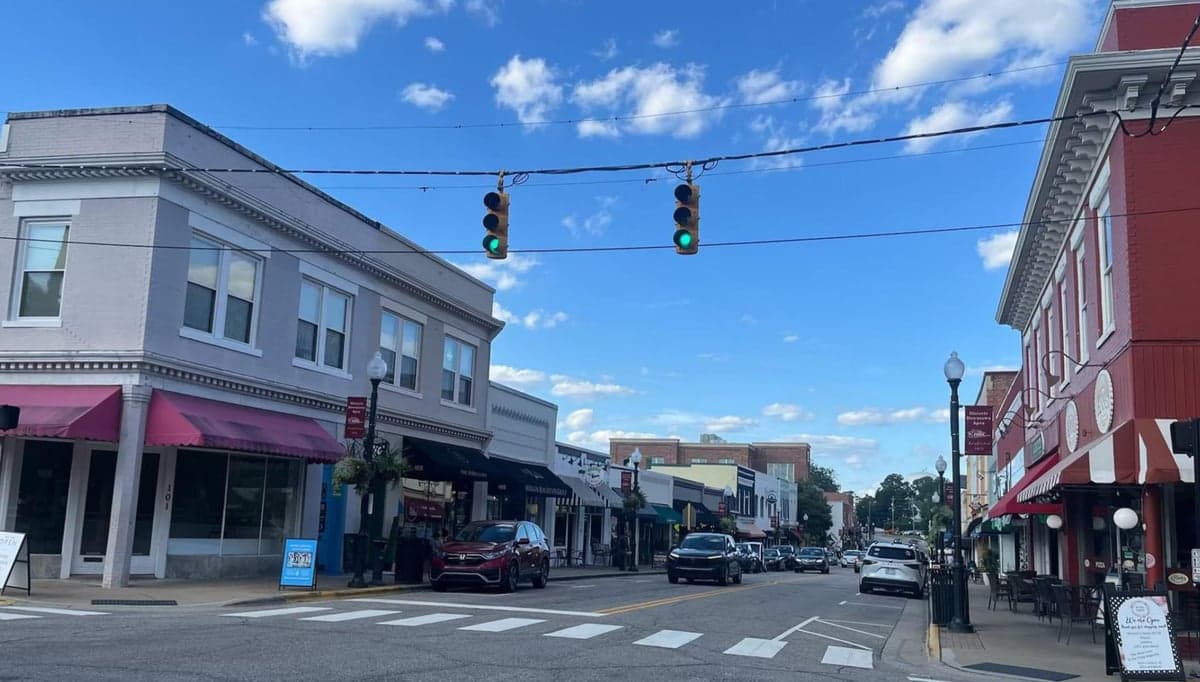
The people of Apex, North Carolina today form a rapidly growing, highly educated, and increasingly diverse suburban population of 67,765. The city is characterized by a majority-white (63.3%) base that has been joined by a significant Indian-subcontinent community (12.5%), alongside smaller Black (8.1%), Hispanic (7.1%), and East/Southeast Asian (4.0%) populations. With 66.6% of adults holding a college degree, Apex has a distinctly professional, family-oriented character, often ranking among the safest and most desirable suburbs in the Raleigh-Durham-Chapel Hill metro area. The city’s identity is one of planned growth and community stability, attracting newcomers seeking top-rated schools and a high quality of life.
How the city was settled and grew
Apex was founded in 1873 as a railroad town, its name derived from being the highest point on the Chatham Railroad line between Richmond and Jacksonville. The original population was overwhelmingly white, drawn by the rail depot and the surrounding agricultural economy of tobacco and cotton. The historic downtown, centered around Salem Street, was built by these early settlers and remains the city’s commercial and social heart. A small Black community also formed during this period, largely residing in the Peach Road area, where a historic Rosenwald school served the segregated population. Through the early and mid-20th century, Apex remained a small, rural crossroads town, with growth limited to a few hundred residents. The population did not exceed 1,000 until the 1960s, as the city’s proximity to Raleigh and Research Triangle Park (RTP) began to attract its first wave of suburban commuters.
Modern era (post-1965)
The post-1965 era, driven by the Hart-Cellar Act and the explosive growth of RTP, transformed Apex from a sleepy village into a booming suburb. The first major wave of domestic in-migration came from other parts of North Carolina and the U.S. Northeast, drawn by jobs in technology, pharmaceuticals, and academia. These newcomers, predominantly white, settled in new subdivisions like Haddon Hall and Beaver Creek, which were developed in the 1980s and 1990s. The 1990s and 2000s saw a second, more diverse wave: highly skilled immigrants, particularly from the Indian subcontinent, arrived to fill engineering and IT roles at companies like Cisco, SAS, and Lenovo. This community concentrated in newer, master-planned neighborhoods such as West Lake and Shepherd’s Vineyard, drawn by large homes and proximity to top-rated schools like Apex High School. The Black population grew more slowly, with many families settling in the Olive Chapel area, while Hispanic residents, often employed in construction and service industries, established a presence in older parts of town and along the U.S. 1 corridor. The East/Southeast Asian community, though smaller, is visible in neighborhoods like Abbington, reflecting the broader tech-driven migration.
The future
The population of Apex is heading toward greater diversity, but with clear patterns of ethnic clustering rather than full integration. The Indian-subcontinent community is the fastest-growing segment, projected to increase its share as RTP continues to attract STEM talent from South Asia. This group is likely to remain concentrated in newer, higher-end subdivisions, reinforcing a pattern of ethnic enclaves based on income and school district boundaries. The white population, while still the majority, is aging and declining in relative share as younger, more diverse families move in. The Hispanic and Black populations are growing slowly but steadily, often settling in more affordable areas like the Peach Road corridor and older neighborhoods near downtown. The city is not homogenizing; rather, it is tribalizing into distinct enclaves defined by ethnicity, income, and housing stock. Over the next 10-20 years, Apex will likely become a majority-minority city, with the Indian-subcontinent community emerging as the largest single minority group, while East/Southeast Asian and Hispanic communities maintain smaller but stable shares.
For someone moving in now, Apex is becoming a highly stratified but stable suburb where neighborhood choice largely determines social and cultural experience. The city offers excellent schools and low crime, but the demographic landscape is one of parallel communities rather than a melting pot. New residents should expect to find strong ethnic networks, particularly among Indian and white families, and a housing market that reinforces these divisions. Apex is a place of opportunity and safety, but its future is one of managed diversity within a framework of suburban affluence.

* Values derived from national, state, county, city and local statistics and may differ in a specific area. Last updated: 2026-10-10T16:26:26.000Z
Narrative content on this page is AI-generated and may contain mistakes. Verify any details that matter before acting on them.
ReloMaps may earn a commission from affiliate links at no extra cost to you.

