
Photo: Wikipedia
Demographics of Arden, DE
Affluence Level in Arden, DE
An upper-middle-class area. Household wealth, education levels, and homeownership run ahead of national benchmarks.
People of Arden, DE
Arden, Delaware, is a tiny, tightly-knit village of roughly 600 residents that remains overwhelmingly white (88.7%) and native-born, with a foreign-born population of 0.0%. Its character is defined by a unique single-tax, land-trust model and a strong arts-and-crafts heritage, creating a community that is both insular and ideologically distinct from the surrounding suburban sprawl. The population is highly educated (33.3% college-educated) and notably homogenous, with no Black or Asian residents and a small Hispanic minority of 8.8%. This is a place where demographic change has been minimal, and the population's identity is rooted in a specific, intentional founding vision rather than waves of migration.
How the city was settled and grew
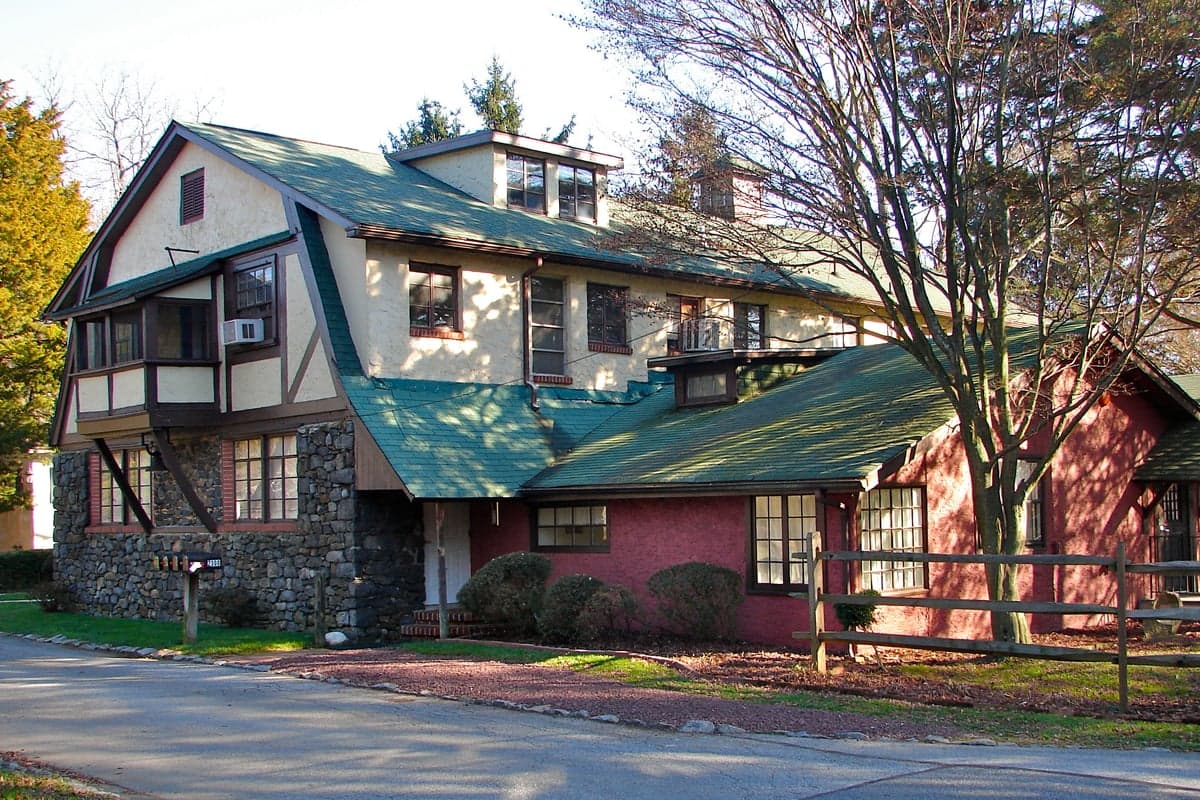
Arden was not settled organically but was founded in 1900 as a planned single-tax community by sculptor Frank Stephens and architect Will Price, followers of Henry George's economic philosophy. The original population was drawn from a narrow pool: progressive-minded artists, writers, craftspeople, and intellectuals from the Northeast, particularly the Philadelphia and New York areas. They built the village around a central village green, with homes designed in the Arts and Crafts style. The earliest settlers clustered in the original village core around the Arden Gild Hall and the Arden Club, establishing a tradition of summer theater, pageants, and communal land ownership. A second, slightly later wave of like-minded families settled in Ardentown (founded 1922) and Ardencroft (founded 1950), each an adjacent but distinct village operating under the same single-tax leasehold system. These neighborhoods remain the geographic and social heart of the community today, with many homes still owned by descendants of the original families.
Modern era (post-1965)
After the 1965 Immigration and Nationality Act, Arden experienced virtually none of the demographic diversification seen in nearby Wilmington or Newark. The village's unique land-trust model—where residents lease the land but own their homes—creates a high barrier to entry and limited housing turnover, effectively filtering for buyers who are both financially able and ideologically aligned with the community's cooperative ethos. The 0.0% foreign-born figure and 0.0% Black and Asian populations reflect this insularity. The small Hispanic population (8.8%) is a very recent and modest addition, concentrated in a handful of rental properties within Ardencroft, the most economically diverse of the three villages. The overwhelming majority of residents are white, native-born, and college-educated, with many working in education, the arts, or professional fields in Wilmington or Philadelphia. The population has remained remarkably stable at around 600 for decades, with growth constrained by the finite number of leasehold lots and the community's deliberate resistance to large-scale development.
The future
The population of Arden is likely to remain small, white, and highly educated for the foreseeable future. The single-tax model and limited housing stock create a natural ceiling on growth and demographic change. The community is not homogenizing further—it is already extremely homogenous—but it is also not tribalizing into distinct enclaves; the three villages (Arden, Ardentown, Ardencroft) function as a single social and economic unit. The small Hispanic population in Ardencroft may grow slightly if rental properties turn over, but the high cost of leasehold ownership will likely prevent significant in-migration of any new group. The biggest demographic trend is aging: many original families are now in their 70s and 80s, and younger families are often priced out, leading to a slow, gradual turnover to new white, professional buyers who value the community's historic character and cooperative governance. The next 10-20 years will likely see a continuation of this pattern: a stable, aging, and overwhelmingly white population, with no major influx of immigrants or racial minorities.
For a conservative-leaning individual or family considering a move to Arden, the bottom line is clear: this is a place that has deliberately preserved its founding character and demographic composition for over a century. It offers a tight-knit, ideologically cohesive community with strong civic engagement and a unique land-ownership structure, but it is not a place of demographic change or diversity. The population is stable, educated, and insular, and that is unlikely to shift in any meaningful way in the coming decades.

* Values derived from national, state, county, city and local statistics and may differ in a specific area. Last updated: 2026-04-29T21:02:29.000Z
Narrative content on this page is AI-generated and may contain mistakes. Verify any details that matter before acting on them.
ReloMaps may earn a commission from affiliate links at no extra cost to you.

