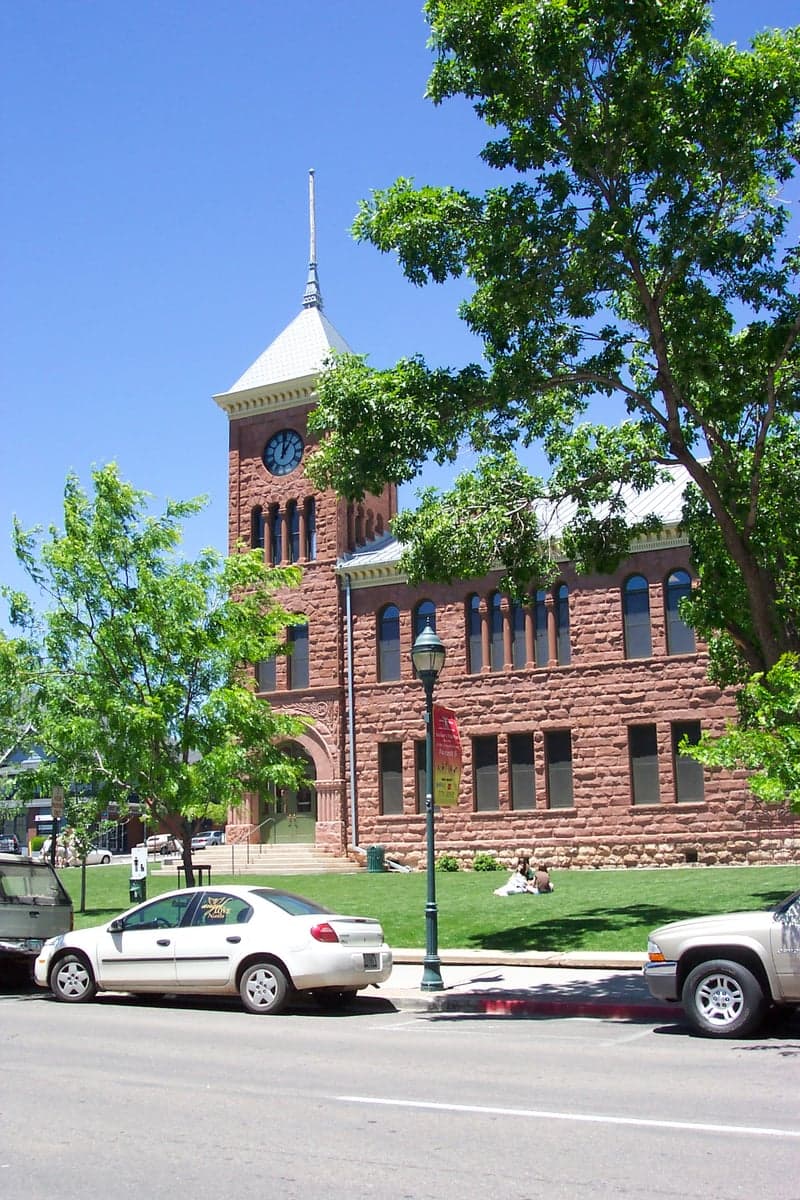
Photo: Wikipedia
Personal Sovereignty in Coconino County
Viable for self-reliance. Generally workable, though some barriers may limit total independence.
What does Personal Sovereignty tell us?
Personal Sovereignty measures your capacity for self-reliance and independence with minimal government friction. Higher scores mean fewer barriers between you and the way you want to live... but it assumes you have the space you need and good neighbors.
What does this tell us?
Personal Sovereignty measures your capacity for self-reliance and independence with minimal government friction. Higher scores mean fewer barriers between you and the way you want to live... but it assumes you have the space you need and good neighbors.
State Policy
Energy independence: Importer (20% of energy produced in-state)
Personal Liberty
Homesteading

Personal Liberty Analysis
Coconino County, Arizona, presents a complex landscape for personal sovereignty, where vast, sparsely populated high desert and pine forests coexist with a significant government and university presence in Flagstaff. For those prioritizing autonomy from perceived government overreach, the county offers a mixed bag: the potential for genuine self-reliance in its remote stretches is counterbalanced by a regulatory environment that, while generally lighter than coastal states, still carries the weight of state-level mandates and local ordinances that can chafe. The key to unlocking personal freedom here lies not in the county seat, but in choosing the right patch of land—and understanding that Arizona’s constitutional framework provides a stronger shield for individual rights than many other parts of the country, even if the day-to-day application requires vigilance.
Tax burden and regulatory posture in Coconino County
Arizona’s overall tax climate is a net positive for sovereignty-minded individuals, with no state tax on Social Security benefits and a flat income tax rate that dropped to 2.5% in 2024. Coconino County, however, levies a sales tax rate of 8.35% in Flagstaff (combining state, county, and city portions), which is notably higher than in unincorporated areas like Williams or Tusayan, where the rate can be closer to 7.8%. Property taxes are moderate, with an effective rate around 0.6% of assessed value, but the county’s assessor has been aggressive in reappraisals, leading to higher bills for those who bought before the recent price surge. The regulatory posture is bifurcated: the state preempts many local gun and land-use laws, but Flagstaff’s city council has a reputation for pushing progressive ordinances, including a 2023 ban on single-use plastic bags and strict short-term rental regulations. For a prepper or survivalist, the unincorporated areas—particularly near Fredonia or Page—offer far less bureaucratic friction, with minimal zoning enforcement and a county government that largely leaves rural residents alone, provided property taxes are paid.
Self-defense and gun law specifics in northern Arizona
Arizona is a constitutional carry state, meaning no permit is required to carry a concealed firearm for anyone 21 or older who can legally possess a gun. This applies uniformly across Coconino County, including within Flagstaff city limits, though the city has attempted to create "gun-free zones" in parks and public buildings—a move that has been challenged by state preemption laws. The county sheriff, Jim Driscoll, has publicly stated his office will not enforce federal gun regulations he deems unconstitutional, a stance that resonates with the prepper community. For those living in remote areas like the Kaibab National Forest or near Lake Powell, the practical reality is that self-defense is a personal responsibility; law enforcement response times can exceed 45 minutes. Stand-your-ground laws are fully in effect, with no duty to retreat in any place where a person is lawfully present. Suppressors and short-barreled rifles are legal with federal tax stamps, and there are no state-level magazine capacity restrictions. The gun culture here is robust, with multiple gun shops and ranges in Flagstaff and Williams, but the real advantage for the sovereignty-minded is the ability to train and carry without bureaucratic interference.
Self-reliance and homesteading viability across the county
The viability of off-grid living in Coconino County varies dramatically by location. In unincorporated areas like Parks or Mormon Lake, minimum lot sizes are typically 1 to 5 acres, and there are no county-level building codes for owner-built structures, provided they are not connected to the grid. Rainwater harvesting is legal and encouraged, with Arizona law explicitly protecting the right to collect rainwater on your property. Solar power is practical, with over 280 sunny days per year in the southern part of the county, though the high elevation (7,000+ feet in Flagstaff) means winter snow loads must be factored into panel placement. Composting toilets and greywater systems are permitted without permits in most rural zones, but a well permit is required and can take 6-12 months to process. The Fredonia area, near the Utah border, offers the most permissive environment, with large parcels (often 40+ acres) available for under $2,000 per acre, and a county government that rarely inspects or enforces. In contrast, Flagstaff’s city limits impose strict building codes, energy efficiency requirements, and a lengthy permitting process that can kill a homesteading project. For the serious prepper, the key is to buy outside any incorporated town and verify that the parcel has legal access and water rights.
Personal liberties: parental rights, medical autonomy, speech, and property
Arizona has strong parental rights statutes, including a 2022 law that prohibits schools from withholding information about a child’s mental or physical health from parents, and a 2024 law requiring parental consent for any medical procedure on a minor, including gender transition care. Coconino County’s school districts, particularly Flagstaff Unified, have been resistant to these laws, with some teachers unions openly defying the parental notification requirements—a point of friction for conservative families. Medical autonomy is bolstered by Arizona’s broad health freedom laws, which allow direct primary care agreements and limit vaccine mandates for employment, though the county health department has pushed for mask mandates in the past. Free speech is protected under the state constitution, which explicitly guarantees the right to record police in public, and there have been no notable local ordinances restricting political speech. Property rights are strong, with Arizona’s "right to farm" law protecting agricultural uses from nuisance lawsuits, and the state’s prohibition on rent control being a major plus for landlords. However, the county’s planning department has been known to use "public health" justifications to deny permits for alternative housing (e.g., yurts, shipping containers) in areas near Flagstaff, so due diligence on zoning is critical.
Overall, Coconino County offers a higher degree of personal sovereignty than most of the West Coast or Northeast, but it is not a libertarian paradise. The state-level protections for gun rights, parental authority, and property are genuine assets, but the county’s progressive urban core in Flagstaff creates a political and regulatory tension that spills into surrounding areas. For the survivalist or prepper who values low taxes, minimal building codes, and the ability to live without government interference, the remote stretches near Fredonia, Tusayan, and the Kaibab Plateau are among the best options in the Southwest. The trade-off is isolation, harsh winters, and limited access to medical care—but for those who see those as features rather than bugs, this county remains a strong contender for a self-determined life.

* Values derived from national, state, county, city and local statistics and may differ in a specific area. Last updated: 2026-05-27T17:34:20.000Z
Narrative content on this page is AI-generated and may contain mistakes. Verify any details that matter before acting on them.
ReloMaps may earn a commission from affiliate links at no extra cost to you.

