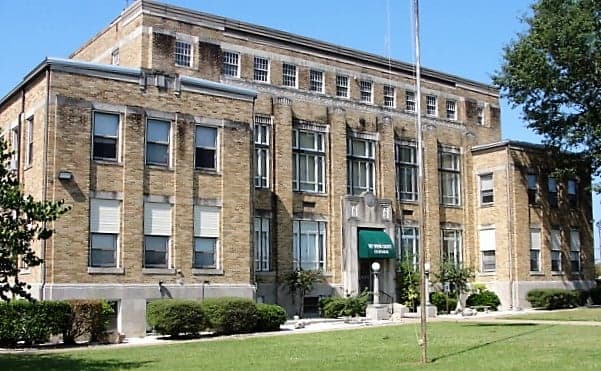
Photo: Wikipedia
Demographics of Hot Spring County
Affluence Level in Hot Spring County
A middle-class area roughly in line with national averages across income, home values, education, and employment.
People of Hot Spring County
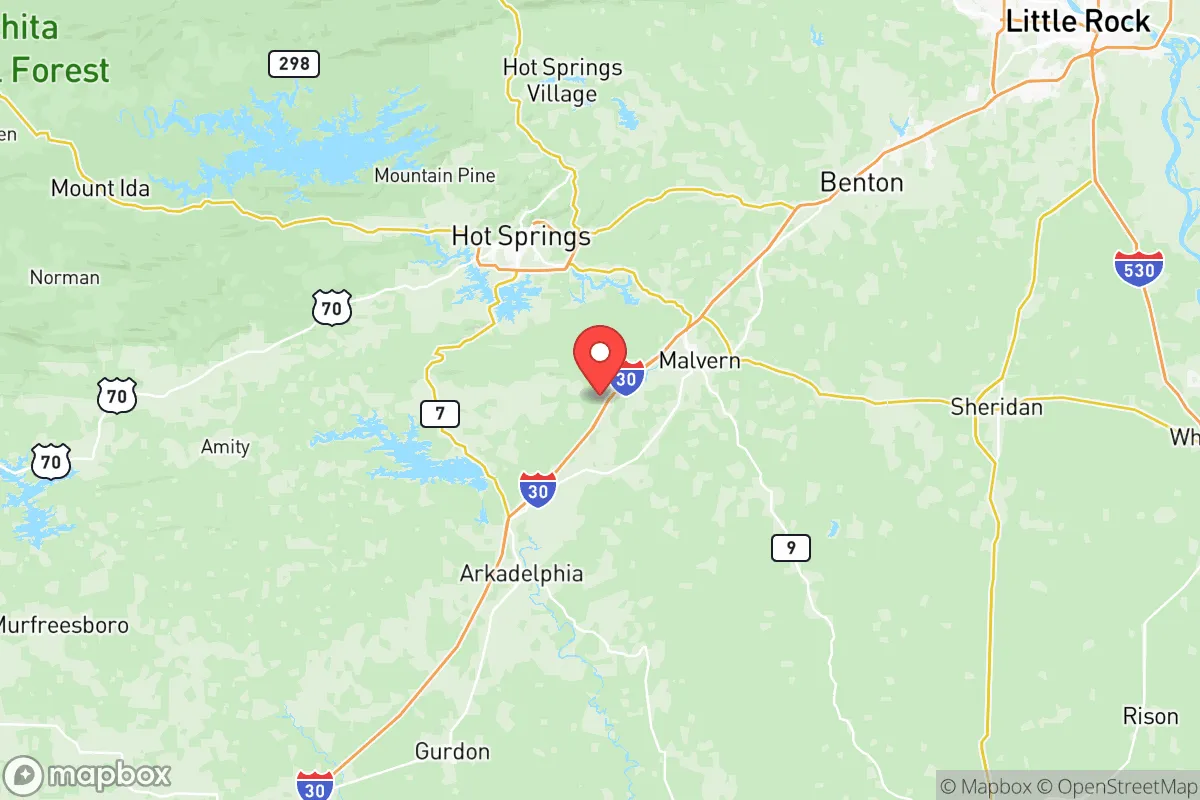
Hot Spring County, with a population of 33,142, is a rural, working-class Arkansas community defined by its deep Southern roots and remarkable stability. The county is 81.1% white and 11.5% Black, with a tiny Hispanic population of 4.0% and virtually no foreign-born residents (0.3%). Its people are overwhelmingly native-born, low-income by national standards (only 15.8% hold a college degree), and concentrated in the county seat of Malvern and the surrounding small towns of Rockport, Magnet Cove, Donaldson, and Friendship.
Settlement & growth (pre-1960)
The land now called Hot Spring County was originally inhabited by the Quapaw and Caddo nations, who used the area for hunting and gathering around the thermal springs that gave the county its name. Spanish and French explorers passed through in the 17th and 18th centuries, but no permanent European settlement took hold until after the Louisiana Purchase. The first American settlers were Scots-Irish and English pioneers from Tennessee, Kentucky, and Missouri, who arrived via the Southwest Trail in the 1810s and 1820s. They were subsistence farmers and small-scale cotton growers, drawn by cheap land and the promise of the Ouachita River valley.
The county was formally created in 1829 from part of Clark County. Malvern, founded as the county seat in the 1870s after the railroad arrived, became the commercial and transportation hub. The Cairo and Fulton Railroad (later part of the Missouri Pacific) brought a timber and mining boom. Magnet Cove, a historically significant mineral deposit, attracted miners and geologists beginning in the 1840s, producing magnetite, titanium, and other ores through the early 20th century. The timber industry pulled in additional white settlers from the Deep South during the 1880s and 1890s, while the river bottoms supported cotton plantations that relied on enslaved African American labor before the Civil War. After Emancipation, the Black population remained as sharecroppers and tenant farmers, forming communities in Malvern, Rockport, and the rural areas around Perla and Midway.
The early 20th century saw no major new immigrant waves. The county remained overwhelmingly native-born white and Black, with small numbers of displaced tenant farmers and laborers moving in from neighboring states during the Dust Bowl and Great Depression. The timber industry declined after World War II, and manufacturing — primarily in Malvern’s light industrial plants — became the main economic driver. By 1960, the population had reached roughly 22,000, and the county’s demographic character was firmly set: rural, Southern, racially binary, and isolated from the major migration flows of the era.
Modern era (post-1965)
The 1965 Hart-Cellar Act, which transformed U.S. immigration, had virtually no effect on Hot Spring County. With a foreign-born share of only 0.3%, the county remains one of Arkansas’s least diverse destinations for immigrants. No notable enclaves of East/Southeast Asian, Indian, Arab, or other post-1965 immigrant groups have formed. The tiny Hispanic population (4.0%) is mostly Mexican-American, drawn by agricultural and construction work in and around Malvern, and is scattered rather than concentrated in any single neighborhood.
Domestic migration has also been minimal. Hot Spring County has not experienced the Rust Belt-to-Sun Belt influx seen in parts of northwestern Arkansas or central Texas. Some retirees and second-home owners have been attracted to the DeGray Lake area (the DeGray community and nearby state park), bringing modest in-migration from elsewhere in the South. Suburbanization has been limited: Malvern has seen some spillover growth from Hot Springs in neighboring Garland County, but the county retains a distinctly rural character with no major suburban subdivisions or exurban developments. The Black population has declined slightly from historical highs due to out-migration for urban opportunities, settling at 11.5%, while the white share remains stable at 81.1%.
The future
The population of Hot Spring County is likely to remain stable or decline modestly over the next 10–20 years. Young adults continue to leave for college and jobs in Little Rock, Hot Springs, and other regional centers, while in-migration is limited to small numbers of retirees and a trickle of Hispanic workers in agriculture and service industries. The county is not tribalizing into distinct ethnic enclaves — it is too small and too homogeneous for that pattern. Instead, the Hispanic population, though growing slowly, is likely to assimilate into the existing rural culture rather than forming a separate community.
The cultural identity of the county remains deeply Southern, conservative, and rooted in family and church networks. In-migration is too low to shift this character. The college education rate (15.8%) may rise slowly as remote work expands and former residents return, but the county will remain one of Arkansas’s less educated areas. No major demographic shock — no refugee resettlement, no large employer relocation — appears on the horizon.
For a conservative-leaning individual or family moving into Hot Spring County now, the bottom line is clear: this is a quiet, low-cost, demographically stable place where change is slow and traditions run deep. The population is nearly all native-born, the racial binary of white and Black is long-standing, and the new Hispanic minority is small and integrated. The next decade will look much like the last one, and the people who live there — in Malvern, Rockport, Magnet Cove, Donaldson, Friendship, Perla, Midway, and DeGray — will remain who they have always been: rural, working-class, and rooted in place.

* Values derived from national, state, county, city and local statistics and may differ in a specific area. Last updated: 2026-05-21T06:00:56.000Z
Narrative content on this page is AI-generated and may contain mistakes. Verify any details that matter before acting on them.
ReloMaps may earn a commission from affiliate links at no extra cost to you.

