
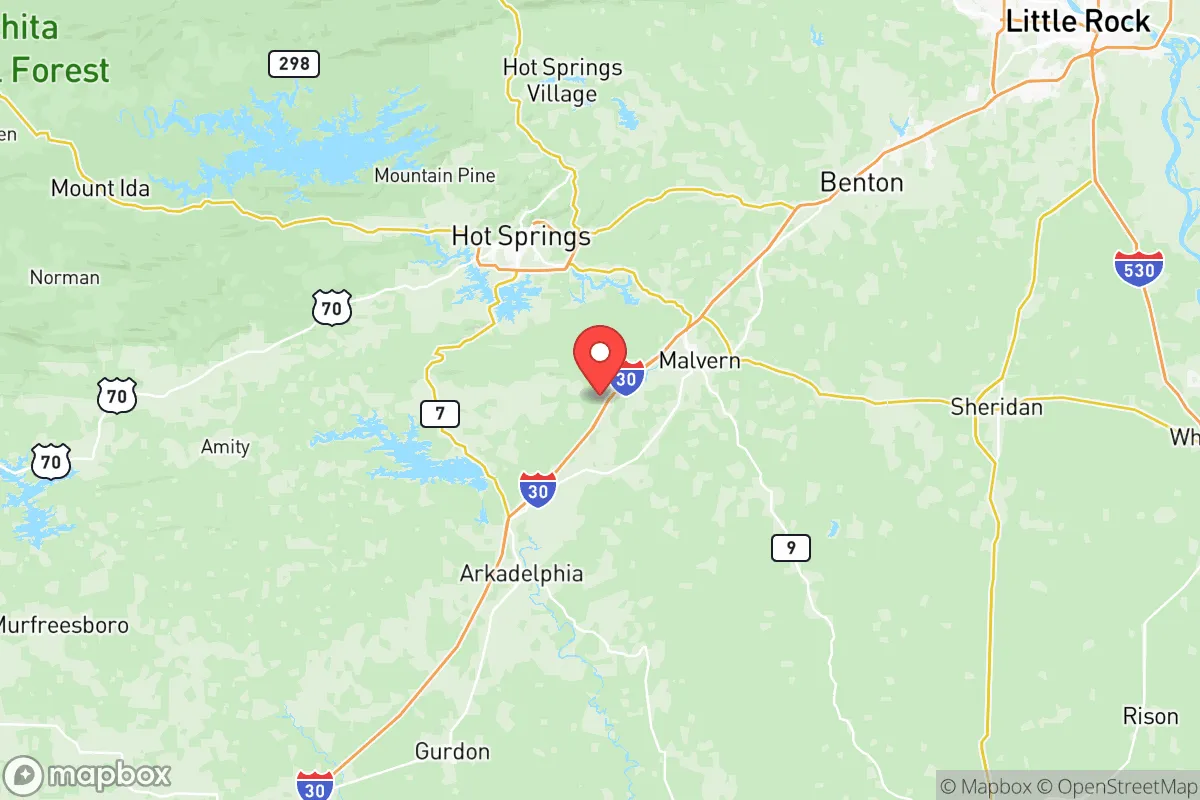
Photo: Wikipedia
Personal Sovereignty in Hot Spring County
Viable for self-reliance. Generally workable, though some barriers may limit total independence.
What does Personal Sovereignty tell us?
Personal Sovereignty measures your capacity for self-reliance and independence with minimal government friction. Higher scores mean fewer barriers between you and the way you want to live... but it assumes you have the space you need and good neighbors.
What does this tell us?
Personal Sovereignty measures your capacity for self-reliance and independence with minimal government friction. Higher scores mean fewer barriers between you and the way you want to live... but it assumes you have the space you need and good neighbors.
State Policy
Energy independence: Importer (35% of energy produced in-state)
Personal Liberty
Homesteading

Personal Liberty Analysis
Hot Spring County, Arkansas, provides a legal and cultural environment that strongly prioritizes personal sovereignty, sitting firmly within a state that has consistently pushed back against federal overreach. With no county-level zoning in unincorporated areas and a property tax millage rate averaging around 40-50 for the county (compared to over 100 in many urban jurisdictions), residents in places like Bismarck, Friendship, and Social Hill enjoy a degree of autonomy that is increasingly rare. This is a jurisdiction where the default posture is "you are free unless a specific law says otherwise," a stark contrast to the regulatory grip found in states like California or New York, making it a serious consideration for anyone valuing self-determination in their daily lives.
Tax burden and regulatory climate in Hot Spring County
Arkansas levies a state income tax with a top marginal rate of 4.4% as of 2026, and Hot Spring County adds a local county sales tax of 1.5% on top of the state's 6.5%, bringing the combined rate to 8% in Malvern and most incorporated towns. Property taxes are exceedingly low by national standards—typically under 0.6% of assessed value—and the county assessor's office in Malvern is known for practical, no-nonsense valuations that do not inflate homestead values aggressively. The regulatory posture in unincorporated areas is minimal: you can build a shed, park an RV, or keep livestock on your own land without applying for conditional-use permits or variance hearings. The cities of Rockport and Perla have their own municipal codes, but even these are light compared to the zoning ordinances seen in neighboring Garland County (Hot Springs) or Pulaski County (Little Rock). If your concern is government nibbling at your property rights through endless permitting and code enforcement, Hot Spring County is a jurisdiction where the county government largely stays out of your business.
Self-defense and gun laws in Arkansas
Arkansas has been a constitutional carry state since 2021, meaning no permit is required to carry a concealed handgun for anyone legally allowed to possess a firearm. Hot Spring County is particularly friendly to this posture: the Hot Spring County Sheriff's Office in Malvern issues enhanced concealed carry permits (which reciprocate with more states) in under 30 days, and the sheriff has publicly stated he will not enforce any federal gun control measures he deems unconstitutional. The county has a strong hunting culture, with the Ouachita National Forest bordering the western edge, and gun ranges such as the one near Magnet Cove provide zero-hassle shooting access. Local gun dealers in Malvern report steady sales with no waiting periods beyond the federal NICS check. Stand-your-ground laws apply statewide, and the use of deadly force in defense of home or person is broadly protected. For anyone prioritizing the uninfringed right to keep and bear arms, this county offers a permissive environment where the legal default favors the citizen, not the regulator.
Self-reliance and homesteading viability in Hot Spring County
The physical geography of Hot Spring County makes it a practical location for off-grid living and homesteading. Unincorporated areas like the communities around Bismarck, Social Hill, and Friendship offer 5- to 40-acre parcels at prices well under $5,000 per acre, with many properties having existing wells or easy access to groundwater. County zoning does not regulate solar panel installation, rainwater collection, or composting toilets in rural areas, so going off-grid is a simple property-rights decision rather than a regulatory battle. The city of Malvern does enforce building codes on new construction within city limits, but outside those boundaries—which is most of the county—you can build your own dwelling using owner-builder exemptions under Arkansas law. The county's position along the Ouachita River corridor provides reliable groundwater and strong growing seasons, and locals in Magnet Cove have a reputation for canning, hunting, and small-scale agriculture that predates modern grocery supply chains. If your vision of personal sovereignty includes being able to produce your own food, water, and energy without asking permission, Hot Spring County's rural tracts are some of the most accessible in the mid-South for homesteading feasibility.
Personal liberties in education, medicine, and speech
Arkansas passed the Parental Rights in Education law in 2023 (sometimes called the "Parents' Bill of Rights"), and school districts in Hot Spring County—including Malvern, Bismarck, and Magnet Cove—have generally aligned with that framework, limiting intrusive curriculum and giving parents opt-out authority for sensitive materials. The county also sits within a state that banned COVID-19 vaccine mandates for state employees and contractors, and local medical providers in Malvern offer direct primary care arrangements for those who want to opt out of the traditional insurance-medical complex. Property rights are protected by Arkansas's strong anti-eminent-domain stance, and the county's planning board in Rockport has repeatedly rejected federal grant money that would require local land-use restrictions. Freedom of speech is robust: county commission meetings are open, public comment is rarely limited, and the local newspaper, the Malvern Daily Record, covers community issues without the ideological slant found in larger metro outlets. For parents and individuals concerned about government intrusion into family, health, and property decisions, Hot Spring County operates on a default of personal autonomy rather than bureaucratic oversight.
Compared to the regulatory environments of Little Rock's Pulaski County or the more tourist-driven Garland County, Hot Spring County stands out as a sovereignty-friendly middle ground—close enough to urban resources (a 45-minute drive to Hot Springs or 90 minutes to Little Rock) but far enough to maintain low taxes, minimal zoning, and a cultural expectation that government stays limited. If you are evaluating relocation with personal sovereignty as a primary filter, this county ranks favorably against nearly all of its neighboring jurisdictions, particularly for those willing to live outside Malvern's city limits and embrace the self-reliant lifestyle that the rural parts of the county make possible.

* Values derived from national, state, county, city and local statistics and may differ in a specific area. Last updated: 2026-05-21T06:00:56.000Z
Narrative content on this page is AI-generated and may contain mistakes. Verify any details that matter before acting on them.
ReloMaps may earn a commission from affiliate links at no extra cost to you.

