 Popular
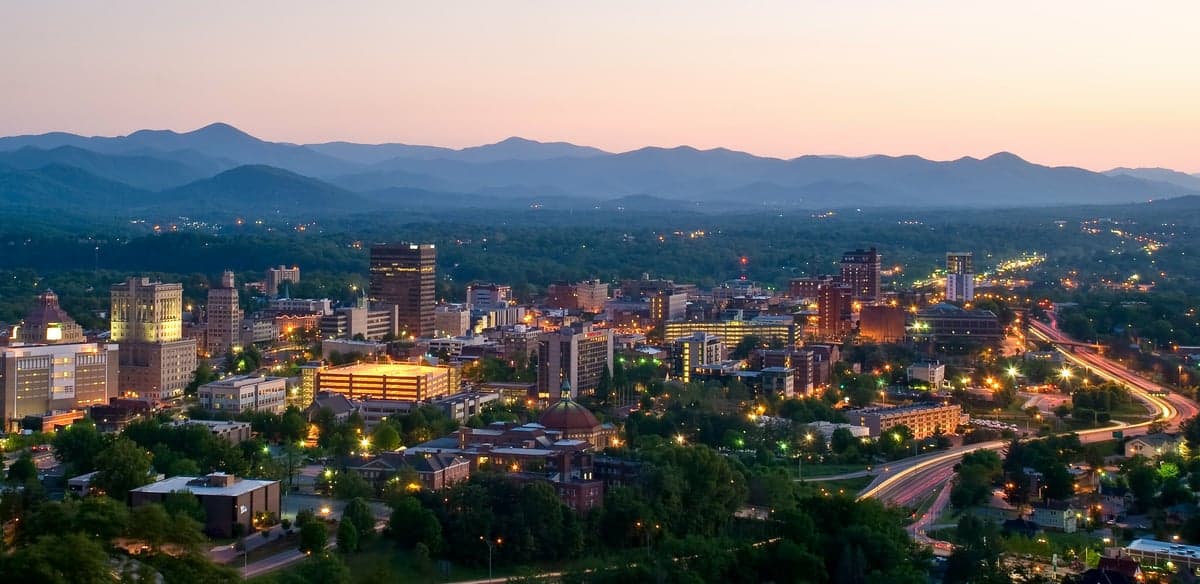
Photo: Wikipedia
Demographics of Asheville, NC
Affluence Level in Asheville, NC
A middle-class area roughly in line with national averages across income, home values, education, and employment.
People of Asheville, NC
Asheville, North Carolina, is home to roughly 94,400 residents, a population that is 78.4% white, 9.7% Black, 7.1% Hispanic, and 0.9% East/Southeast Asian, with a separate Indian-subcontinent community of 0.4%. The city is notably highly educated — 52.0% of adults hold a bachelor’s degree or higher — and has a distinctly progressive cultural character that contrasts with the more conservative surrounding Buncombe County. Only 4.2% of residents are foreign-born, making Asheville a predominantly native-born city shaped more by domestic in-migration than by international immigration.
How the city was settled and grew
Asheville was founded in 1797 on land originally inhabited by the Cherokee people, who were forcibly removed along the Trail of Tears in the 1830s. The earliest white settlers were Scots-Irish and English farmers drawn by land grants in the fertile Swannanoa Valley. The arrival of the railroad in the 1880s transformed Asheville into a health resort and tourist destination, attracting wealthy Northerners who built grand summer homes in the Montford and Grove Park neighborhoods. These areas remain among the city’s most architecturally historic and affluent districts. During the same period, African Americans — many formerly enslaved or their descendants — settled in the East End/Valley Street neighborhood, which became the heart of Asheville’s Black community, with its own businesses, churches, and a vibrant commercial corridor along Eagle Street. The early 20th century saw a modest influx of German and Eastern European Jewish families, who established themselves in the Downtown area and in West Asheville, then a working-class streetcar suburb. By 1950, Asheville’s population was roughly 75% white and 25% Black, with virtually no Hispanic or Asian presence.
Modern era (post-1965)
The 1965 Hart-Cellar Act had minimal direct impact on Asheville’s demographics; the city’s foreign-born share remains low at 4.2%. Instead, the major post-1965 shift has been domestic: a steady influx of white retirees, artists, and remote workers from the Northeast and Midwest, drawn by the Blue Ridge Mountains, a lower cost of living (historically), and a perceived progressive haven in a conservative state. This wave has concentrated in Downtown, West Asheville, and the River Arts District, driving rapid gentrification. The Black population, which was 25% in 1950, has fallen to 9.7% today, as rising property values and displacement pushed many Black families out of East End/Valley Street and into outlying areas of Buncombe County. The Hispanic population grew from near zero in 1980 to 7.1% today, largely driven by Mexican and Central American immigrants working in construction, hospitality, and agriculture; they are most concentrated in West Asheville and the Oakley neighborhood. The East/Southeast Asian community (0.9%) is small and dispersed, with no single ethnic enclave, while the Indian-subcontinent community (0.4%) is even smaller, mostly professionals in tech and healthcare living in North Asheville near the university.
The future
Asheville’s population is homogenizing in terms of race and income, even as it grows. The white share has risen from roughly 72% in 1990 to 78.4% today, while the Black share continues a long decline. The Hispanic share is growing slowly but steadily, and is projected to reach 10-12% by 2040, driven by family reunification and labor demand. The East/Southeast Asian and Indian communities are likely to remain small, as the city lacks the large tech or university employment bases that attract these groups in larger numbers. The most significant demographic trend is the continued influx of affluent, college-educated white migrants, which is pushing housing costs up and accelerating the displacement of lower-income residents — both Black and white — to surrounding counties. Asheville is becoming a more economically stratified, culturally progressive enclave, with distinct tribalization: wealthy newcomers in Downtown and North Asheville, a shrinking Black community in East Asheville and outlying areas, a growing Hispanic working class in West Asheville and Oakley, and a long-term white working class in South Asheville and the Haw Creek area.
For a conservative-leaning individual or family considering a move, Asheville today is a city where your neighbors are likely to be highly educated, politically liberal, and culturally oriented toward environmentalism, the arts, and local food. The cost of living has risen sharply — median home prices exceed $450,000 — and the city’s politics are increasingly at odds with the surrounding county and state. If you value a walkable, mountain-town atmosphere with a strong creative scene, Asheville offers that, but you should expect to be in a clear political minority and to pay a premium for the lifestyle. The city is not becoming more diverse in the traditional sense; it is becoming whiter, wealthier, and more ideologically uniform.

* Values derived from national, state, county, city and local statistics and may differ in a specific area. Last updated: 2026-04-22T01:51:23.000Z
Narrative content on this page is AI-generated and may contain mistakes. Verify any details that matter before acting on them.
ReloMaps may earn a commission from affiliate links at no extra cost to you.

