 Popular
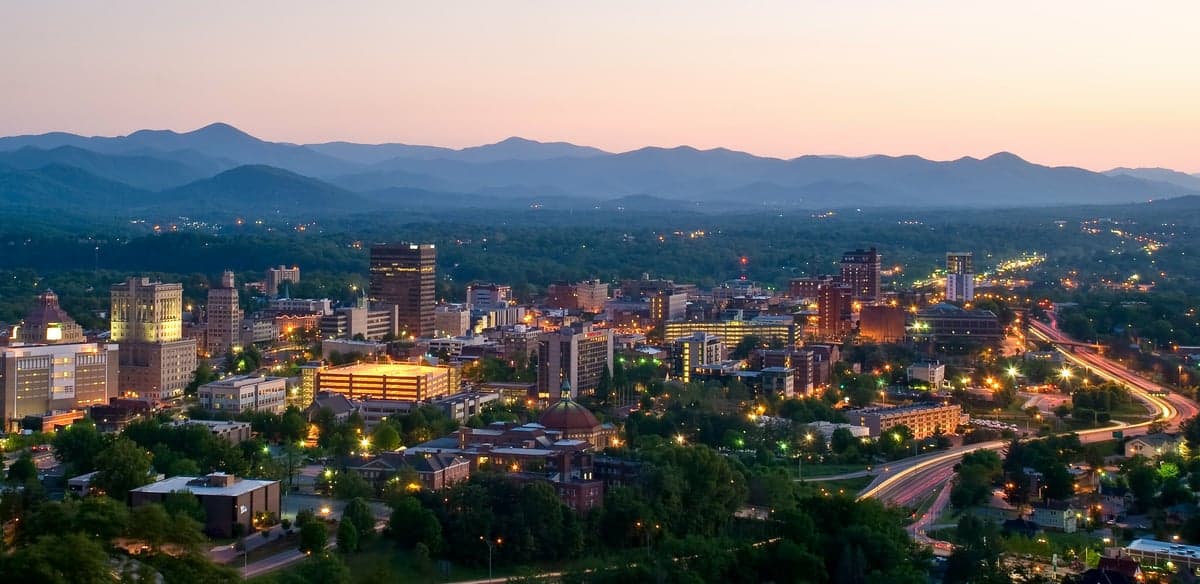
Photo: Wikipedia
Strategic Assessment of Asheville, NC
Meaningful friction. Expect exposure to either population pressure, blast zones, or natural disaster risk. Consider buying a retreat property.
What does the Strategic Assessment tell us?
Our Strategic Assessment grades tactical survivability of an area. Major population centers, military targets, fallout zones, natural disasters, and border exposure all drive risk — lower exposure means a more defensible position in a crisis.
This is heavily inspired by Joel Skousen's Strategic Relocation book. Highly recommended you checkout the book ($)What does this tell us?
Our Strategic Assessment grades tactical survivability of an area. Major population centers, military targets, fallout zones, natural disasters, and border exposure all drive risk — lower exposure means a more defensible position in a crisis.
This is heavily inspired by Joel Skousen's Strategic Relocation book. Highly recommended you checkout the book ($)Strategic Pillars

Key Distances
Regional Safe Places
Below is our recommended "safe zones" in North Carolina and the surrounding area based on our strategic heuristics. For most people, it's unrealistic to live in a “safe zone” full-time due to work, family or other personal reasons. They tend to be more rural. However, many of these areas are perfect for second homes and retreat properties that double as a vacation home or even a short-term rental.

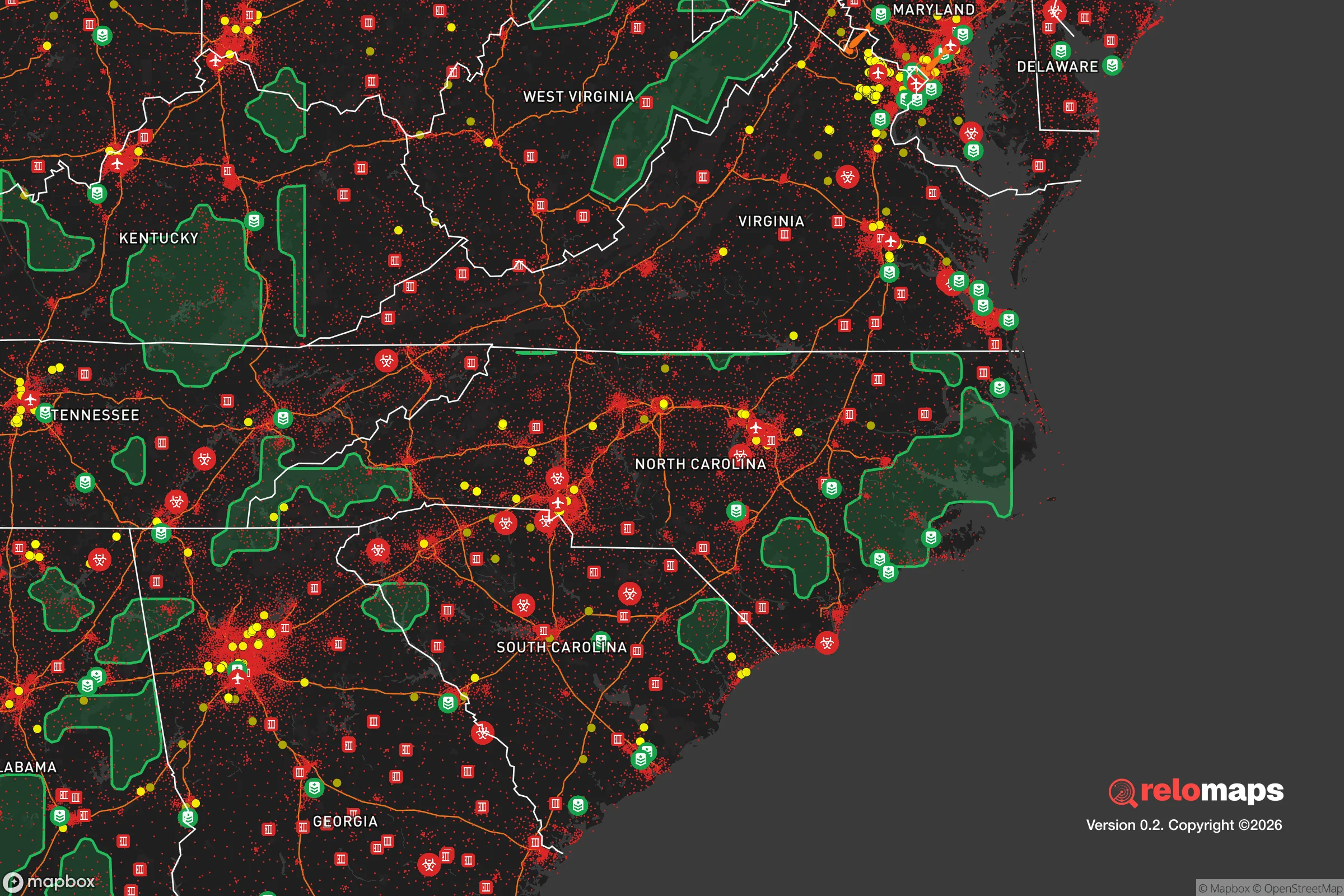


Important Note: For informational purposes only. This does not mean nothing bad ever happens in the green zones. Please use common sense. This is based on public data and modeled with AI. We tried to take a conservative approach but mistakes happen. We update this regularly as new information becomes available.
Solar Generator Recommendations
Backup power matters more here than in safer locations. We've picked three solar generators across budgets and capacity tiers — start with the budget unit if you only need a few essentials, or step up if you want to run a fridge and HVAC for days at a time.

Jackery Portable Power Station Explorer 300
Budget OptionPower on the Go: Weighing only 11 lbs, it's convenient to set up and store with book-sized foldable solar panels

BLUETTI Portable Power Station AC180
Designed for both indoor and outdoor scenarios, AC180 is highly capable as it has a robost capacity and continuous output power.

EF ECOFLOW DELTA Pro Ultra Power Station
Upgraded PickEcoFlow DELTA Pro Ultra is a whole-home energy system designed to grow with your family. Integrated with the Smart Home Panel 2, it scales to meet your evolving energy needs — keeping your home powered, intelligent, and secure through every stage of life.
We earn a commission, at no additional cost to you.
Strategic Assessment Analysis
Asheville, North Carolina, presents a complex strategic picture for the conservative prepper or survivalist. Its mountainous terrain and relative isolation from the Eastern Seaboard’s major population centers offer genuine defensive advantages, but the city’s deep-blue political culture and heavy reliance on tourism create significant vulnerabilities. For a relocator prioritizing resilience against civic unrest, grid-down scenarios, or mass casualty events, Asheville is a location that demands careful trade-off analysis rather than blind endorsement.
Geographic position and natural defensive advantages
Asheville sits in the Blue Ridge Mountains at an elevation of roughly 2,200 feet, which provides a natural buffer against the coastal flooding and storm surge threats that plague cities like Charleston or Wilmington. The surrounding Pisgah National Forest and the Blue Ridge Parkway create a rugged, sparsely populated perimeter that would be difficult for any large, disorganized group to traverse quickly. This terrain offers genuine defensibility: choke points on the interstates (I-40 and I-26) and two-lane mountain roads mean that a determined group could effectively control access to the area with relatively modest resources. The French Broad River runs through the city, but its valley is narrow enough that most residential neighborhoods sit on hillsides with good line-of-sight observation. For a relocator, the key advantage is that Asheville is not a natural thoroughfare—it’s a dead end in the mountains, which is both a blessing and a curse depending on your supply lines.
Risks, exposures, and proximity to fallout-relevant landmarks
The most glaring strategic weakness is Asheville’s proximity to the Oak Ridge National Laboratory in Tennessee, roughly 90 miles to the west. Oak Ridge is a major nuclear research and weapons-related facility, making it a potential target in any large-scale conflict or terrorist event. A worst-case scenario at Oak Ridge could produce a radioactive plume that, depending on wind patterns, could drift directly over the Asheville basin. Additionally, the city lies within 120 miles of the Savannah River Site (a nuclear weapons facility in South Carolina) and roughly 150 miles from the Tennessee Valley Authority’s Sequoyah and Watts Bar nuclear plants. While these distances provide some buffer, the mountainous terrain can trap airborne contaminants in valleys, meaning a plume event could linger longer here than on the open plains. On the civic unrest front, Asheville’s reputation as a progressive enclave means that any widespread societal breakdown would likely see the city become a flashpoint for ideological conflict. The local government’s track record—defunding the police in 2020 and maintaining a strong “sanctuary city” posture—suggests that law enforcement capacity would be strained or absent in a crisis. For a conservative relocator, this means you cannot rely on local authorities for protection; you must be self-sufficient and prepared to operate in an environment where your neighbors may hold fundamentally different views on property rights and self-defense.
Practical resilience for a relocator: food, water, energy, and defensibility
Water is Asheville’s strongest resilience asset. The city draws from the North Fork Reservoir and Bee Tree Reservoir, both fed by mountain streams with high annual rainfall (averaging 40-50 inches per year). A relocator with a property on a spring-fed creek or with a rainwater catchment system would have reliable off-grid water without deep well drilling. The growing season is short (roughly 150 frost-free days) but productive for cool-weather crops like potatoes, kale, and apples. The surrounding mountains are rich in game—white-tailed deer, wild turkey, and black bear—though hunting pressure is high due to the area’s popularity. Energy resilience is mixed. The region is served by Duke Energy, which has a mixed grid of coal, natural gas, and hydro. Solar potential is decent but not exceptional due to frequent cloud cover and tree canopy. A relocator would need a robust battery backup and possibly a small hydro turbine if they have running water on their property. The biggest practical challenge is defensibility at the neighborhood level. Asheville’s desirable in-town neighborhoods (Montford, West Asheville, the River Arts District) are dense, with narrow streets and limited escape routes. A better strategic choice is a property on the outskirts—say, in the Sandy Mush or Leicester areas—where you have acreage, a well, and a single road approach that can be monitored. The local gun culture is present but not as dominant as in rural western North Carolina counties like Madison or Yancey; expect to be your own first responder.
The overall strategic picture for a conservative relocator
Asheville offers a genuine geographic buffer and abundant natural resources, but it comes with significant ideological and proximity-based risks that a survivalist cannot ignore. The city’s location in a mountain redoubt is strategically sound for a long-term grid-down scenario, provided you are not dependent on local infrastructure or law enforcement. However, the presence of Oak Ridge and other nuclear facilities within a 150-mile radius means that a major conflict could render the area uninhabitable for months or years. For a relocator willing to live on the rural fringe, maintain a low profile, and invest in off-grid systems, Asheville’s mountains provide a defensible retreat. For anyone expecting to integrate into the local community or rely on mutual aid networks, the political and cultural divide will be a persistent friction point. The bottom line: Asheville is a viable strategic relocation option only if you are prepared to be entirely self-reliant and have a clear evacuation plan for a nuclear event. It is not a community that will rally around conservative values in a crisis—it is a place where you must build your own fortress and keep your head down.

* Values derived from national, state, county, city and local statistics and may differ in a specific area. Last updated: 2026-04-22T01:51:23.000Z
Narrative content on this page is AI-generated and may contain mistakes. Verify any details that matter before acting on them.
ReloMaps may earn a commission from affiliate links at no extra cost to you.

