Photo: Wikipedia
Demographics of Augusta, KS
Affluence Level in Augusta, KS
A middle-class area roughly in line with national averages across income, home values, education, and employment.
People of Augusta, KS
The people of Augusta, Kansas, today form a predominantly white, family-oriented community of 9,252 residents, characterized by a strong sense of local identity rooted in the city’s agricultural and oil-boom past. With a foreign-born population of just 1.6% and a Hispanic share of 7.2%, Augusta remains one of the least ethnically diverse cities in Butler County, reflecting a population that has been remarkably stable in its racial composition for decades. The city’s identity is distinctly small-town Kansan—practical, civic-minded, and anchored by local churches, the school system, and a downtown that still serves as a social hub. This is not a place of rapid demographic churn but of slow, generational continuity, where most residents trace their roots to the same Great Plains migration patterns that built the town over a century ago.
How the city was settled and grew
Augusta was founded in 1868 by settlers drawn to the fertile Walnut River valley, with the initial population consisting largely of Anglo-American homesteaders from the Midwest and Upper South. The arrival of the Missouri Pacific Railroad in 1871 turned the small farming hamlet into a regional shipping point for wheat and cattle, and by 1880 the population had reached roughly 500. The first major demographic wave came during the 1914 oil boom, when the discovery of the El Dorado oil field—one of the largest in the world at the time—brought thousands of workers, many of them transient roughnecks from Oklahoma and Texas. These oil-field workers settled in what is still called Oil Hill, a neighborhood just east of downtown that retains its working-class character and modest frame houses. A second wave of growth followed World War II, when returning veterans and their families moved into new subdivisions like Hillcrest Addition and Sunset Park, areas that today contain many of the city’s post-war ranch homes and established families. The city’s population plateaued after the 1960s, as the oil industry mechanized and younger generations began commuting to Wichita for work, leaving Augusta’s historic core—Downtown Augusta along State Street—as a stable but slowly aging neighborhood.
Modern era (post-1965)
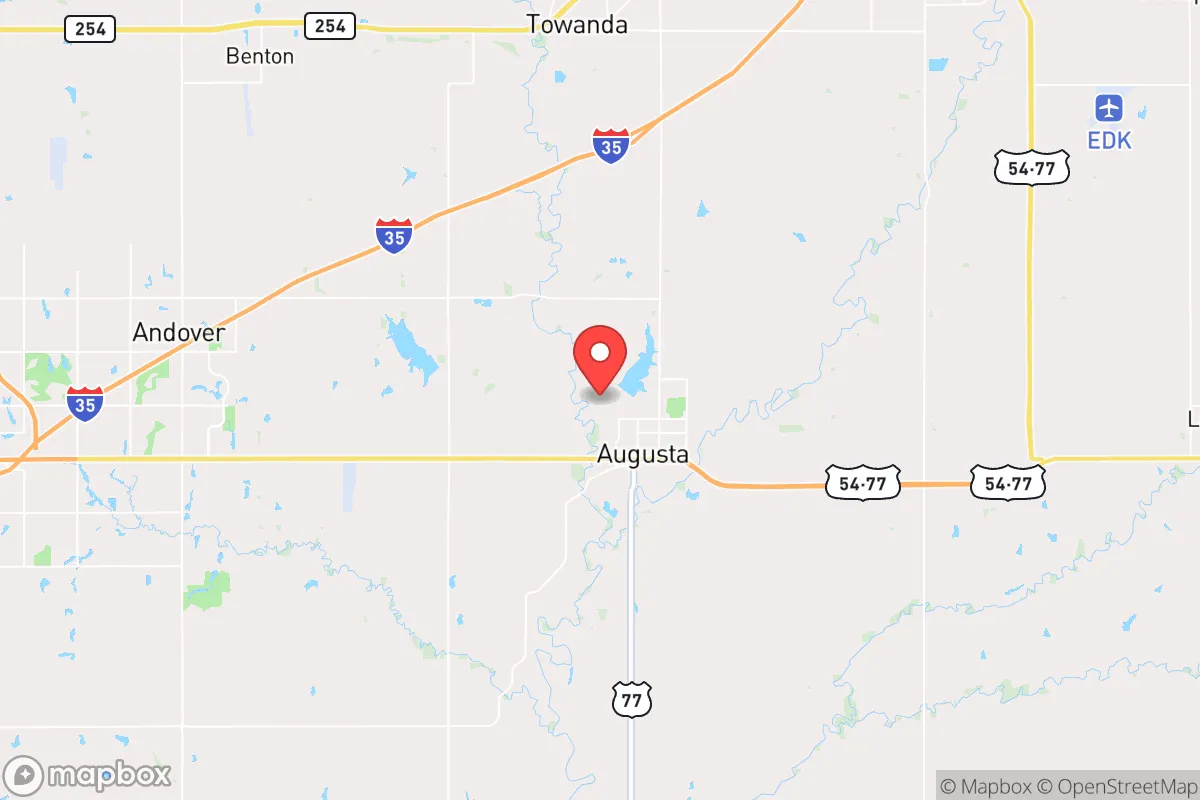
Since the 1965 Hart-Cellar Act, Augusta has experienced virtually no immigration-driven diversification. The foreign-born share has never risen above 2%, and the city’s racial composition has remained overwhelmingly white—89.5% as of the latest data. The small Hispanic population, now 7.2%, began arriving in the 1990s and 2000s, primarily as workers in the area’s agricultural and construction sectors. These families have concentrated in the West Side neighborhood, near the industrial corridor along US-54, where rental housing and mobile home parks provide affordable entry points. The Black population remains negligible at 0.1%, and there are no measurable East/Southeast Asian or Indian-subcontinent communities. The most significant domestic in-migration has been from Wichita, 20 miles west, as families seeking lower crime rates and better school ratings have moved into newer subdivisions like Prairie Ridge and Stone Creek on the city’s north and east edges. These subdivisions are overwhelmingly white and middle-class, reinforcing Augusta’s existing demographic profile rather than diversifying it.
The future
Augusta’s population is projected to grow slowly—perhaps reaching 10,000 by 2035—driven almost entirely by domestic in-migration from Wichita and rural Butler County. The city is not homogenizing in the sense of becoming more diverse; rather, it is tribalizing along income and lifestyle lines, with the older, working-class neighborhoods like Oil Hill and Downtown aging in place while the newer subdivisions attract younger families. The Hispanic share may rise modestly as second-generation families move from rural farmworker housing into town, but the foreign-born population is unlikely to exceed 3% in the next decade. The city’s school district, Augusta USD 402, remains a key draw for conservative-leaning parents, and the lack of significant immigrant or minority populations means that racial and cultural tensions are minimal. For a newcomer, Augusta offers a predictable, low-diversity environment where community life revolves around the school system, local sports, and church networks.
In short, Augusta is becoming a bedroom suburb of Wichita that retains its small-town character and demographic homogeneity. For someone moving in now, the city offers stability, affordability, and a community where most neighbors share a similar cultural and political outlook—but little of the ethnic or cultural variety found in larger Kansas cities.

* Values derived from national, state, county, city and local statistics and may differ in a specific area. Last updated: 2026-05-01T00:56:15.000Z
Narrative content on this page is AI-generated and may contain mistakes. Verify any details that matter before acting on them.
ReloMaps may earn a commission from affiliate links at no extra cost to you.

