 Popular

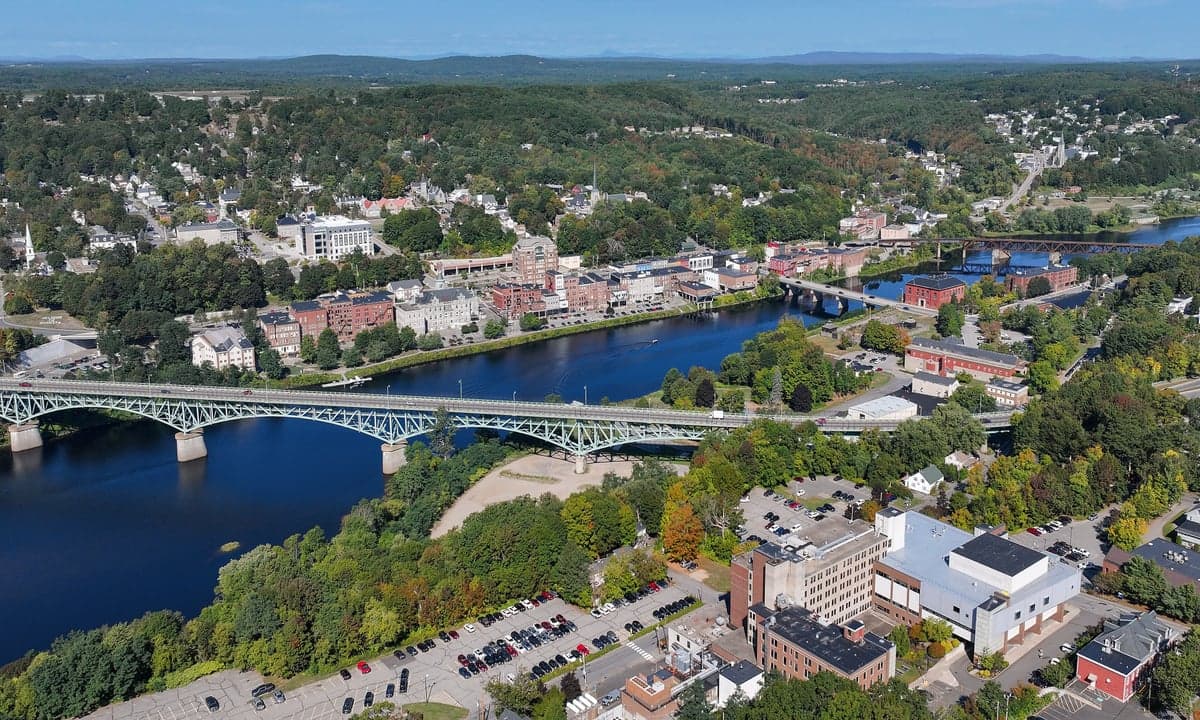
Photo: Wikipedia
Demographics of Augusta, ME
Affluence Level in Augusta, ME
A below-average socioeconomic profile. Incomes, home values, and educational attainment trail the U.S., with higher poverty and unemployment.
People of Augusta, ME
The people of Augusta, Maine, today form a predominantly white, native-born population of 18,999, characterized by a quiet stability and a deep connection to the city's role as the state capital. With 89.5% of residents identifying as white and a foreign-born share of just 0.6%, the city is notably less diverse than the national average, reflecting its history as a government and industrial hub that has seen little new immigration in recent decades. The population is older and less college-educated than many state capitals, with 28.0% holding a bachelor's degree, and the city's identity is rooted in a blend of long-standing Yankee families, state workers, and a modest working-class presence tied to the Kennebec River's industrial past.
How the city was settled and grew
Augusta's human history begins with the Kennebec River as a transportation artery for the Abenaki people, but permanent European settlement took off after the American Revolution. The city was officially incorporated in 1797, and its growth was driven by two forces: its designation as the state capital in 1827 and the rise of water-powered industry along the Kennebec. The original Yankee settlers—English-descended farmers and merchants—built the core of the city in what is now the Historic District around Water Street and the State House, establishing a civic and commercial center. A second wave arrived in the mid-19th century, when Irish immigrants fleeing the Great Famine came to build the Kennebec Dam and work in the city's sawmills and textile mills. They settled in the Sand Hill neighborhood, a working-class area near the river that remains a historically Irish enclave. Later, French-Canadian families from Quebec migrated south for mill jobs in the late 1800s, forming a distinct community in the North End around Cony Street, where French was spoken in homes and churches well into the 20th century. These three groups—Yankees, Irish, and French-Canadians—defined Augusta's population through the mid-1900s, with little additional ethnic diversity.
Modern era (post-1965)
After the 1965 Hart-Cellar Act, Augusta saw virtually no increase in immigration, unlike larger New England cities. The foreign-born population remains at 0.6%, and the city's racial composition has shifted only marginally: the Hispanic share is 2.8%, the Black share is 1.8%, and East/Southeast Asian communities account for 0.9%, while Indian-subcontinent residents make up 0.5%. These small groups are concentrated in the West Side neighborhood, near the MaineGeneral Medical Center and the University of Maine at Augusta, where professional jobs in healthcare and education have attracted a handful of immigrant families. The most significant domestic change has been suburbanization: middle-class families, particularly those working in state government, have moved to the East Side and South Parish areas, where newer single-family homes and lower taxes drew residents away from the older, denser neighborhoods near the river. The city's population has declined from a peak of roughly 21,000 in the 1970s to 18,999 today, as younger adults leave for Portland or out of state, and the remaining population has aged in place.
The future
Augusta's population is trending toward further homogenization and slow decline. The city is not tribalizing into distinct ethnic enclaves—the small Hispanic, Black, and Asian populations are too scattered to form concentrated neighborhoods—but it is becoming more economically stratified, with the Sand Hill and North End areas seeing higher poverty rates while the East Side grows more affluent. Immigrant communities are plateauing rather than growing, as the city lacks the job base or social networks to attract new arrivals. The next 10-20 years will likely see continued population stagnation or slight shrinkage, with the white share remaining above 85% and the foreign-born share staying below 1%. The city's future depends on whether state government employment stabilizes or expands, and whether efforts to attract remote workers or retirees succeed.
For someone moving in now, Augusta is becoming a stable, older, and predominantly white capital city with a modest government and healthcare economy. It offers low crime, affordable housing, and a quiet lifestyle, but little ethnic diversity or demographic dynamism. New residents should expect a community where long-established families and state workers set the tone, and where the population is more likely to age in place than to diversify rapidly.

* Values derived from national, state, county, city and local statistics and may differ in a specific area. Last updated: 2026-05-02T01:26:07.000Z
Narrative content on this page is AI-generated and may contain mistakes. Verify any details that matter before acting on them.
ReloMaps may earn a commission from affiliate links at no extra cost to you.

