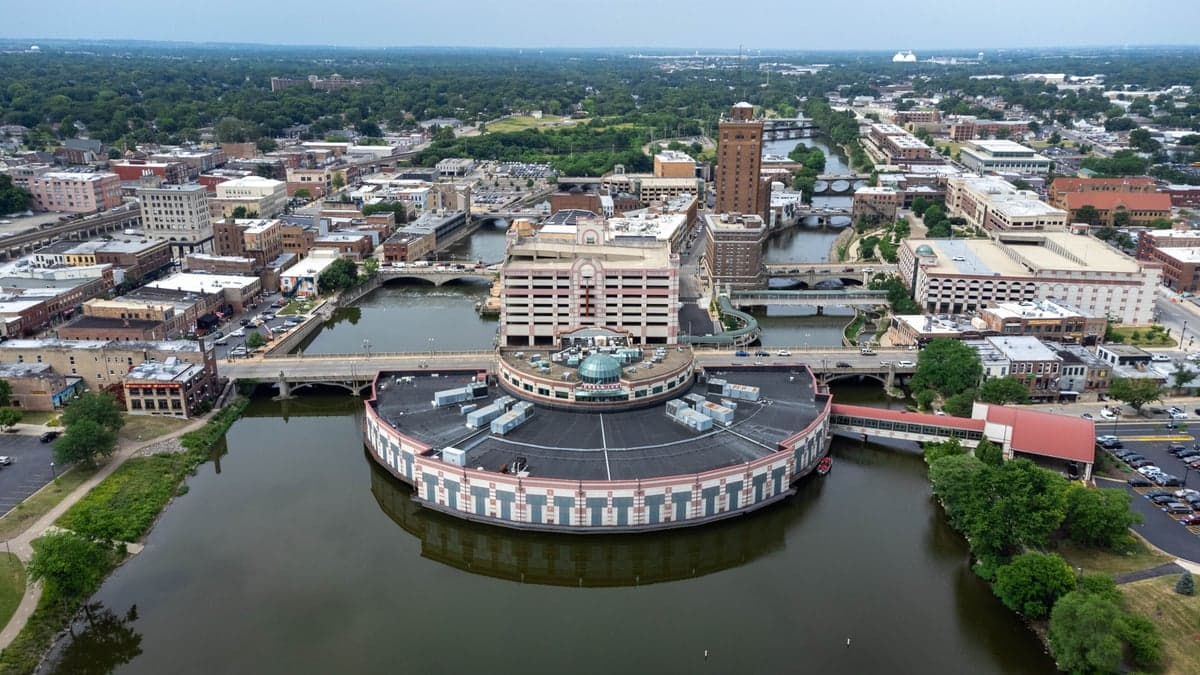
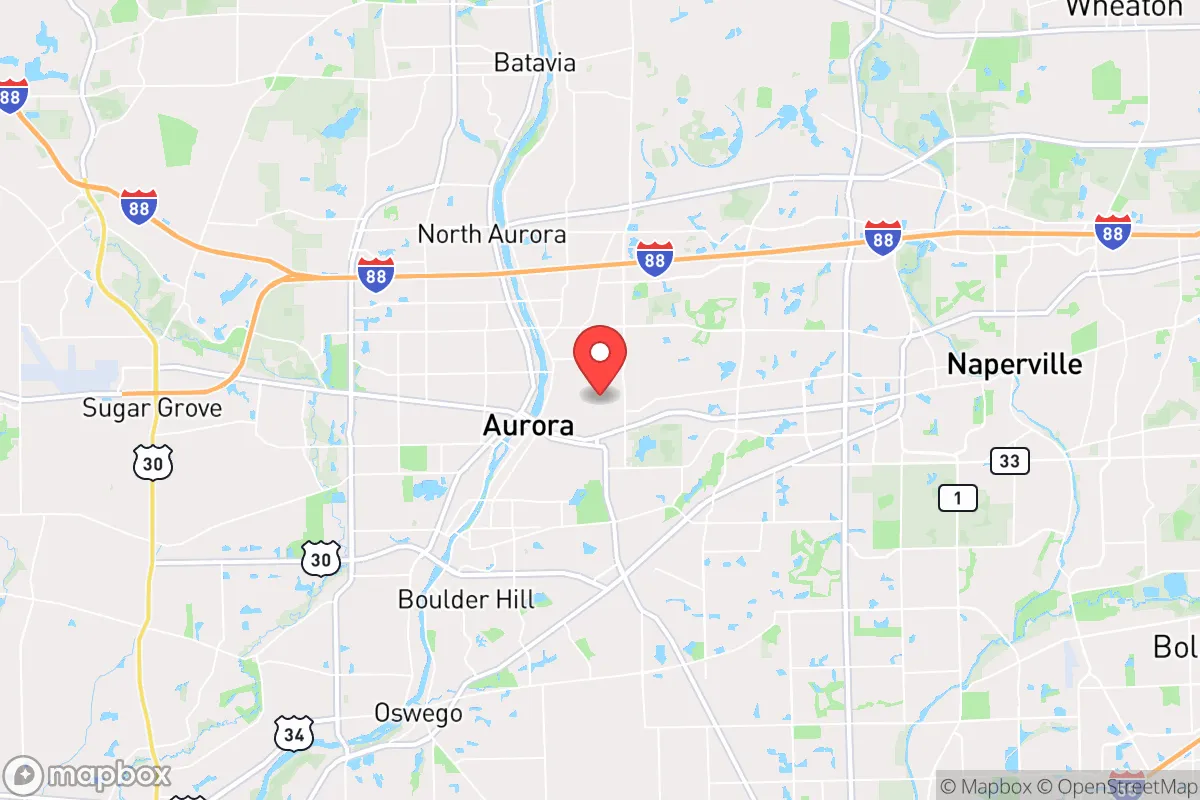
Photo: Wikipedia
Demographics of Aurora, IL
Affluence Level in Aurora, IL
A middle-class area roughly in line with national averages across income, home values, education, and employment.
People of Aurora, IL
The people of Aurora, Illinois, in 2026 form a majority-minority city of 179,867 residents, defined by its Hispanic plurality (42.8%) and significant White (32.5%), Black (10.5%), and Indian-subcontinent (7.3%) communities, with a smaller East/Southeast Asian population (3.6%). Roughly 13.7% of residents are foreign-born, and 37.2% hold a college degree, reflecting a city that has transformed from a largely white, industrial manufacturing hub into a diverse, polyglot suburb with distinct ethnic enclaves. Aurora’s identity today is less a single melting pot and more a collection of neighborhoods with separate histories, languages, and economic trajectories, anchored by a strong working-class ethos and a growing professional class drawn to the Fox River valley’s affordability relative to Chicago.
How the city was settled and grew
Aurora was founded in 1834 by Joseph McCarty and Samuel McCarty, who saw water power potential in the Fox River. The city’s early growth was driven by the arrival of the Galena and Chicago Union Railroad in 1849, which turned Aurora into a manufacturing center for railroad cars, farm equipment, and later, the iconic Aurora Watch Company. The original white settlers were largely Yankee Protestants from New England and New York, followed by a wave of German and Irish immigrants in the 1850s and 1860s who built the city’s factories and laid its brick streets. These groups settled in the near-downtown wards—particularly the West Side around Galena Boulevard and the East Side near the railroad yards—where their descendants remained through the mid-20th century. A smaller but notable Swedish community arrived after the 1871 Chicago fire, clustering in the Stolp Island area and founding the Swedish Lutheran Church. By 1900, Aurora was the second-largest city in Illinois, with a population of 24,000 that was overwhelmingly white and native-born, sustained by the heavy industry of the Burlington Northern Railroad and the Lyon Metal Works.
Modern era (post-1965)
The post-1965 era reshaped Aurora’s population dramatically. The 1965 Hart-Celler Act opened immigration from Asia and Latin America, while the decline of heavy manufacturing in the 1970s and 1980s pushed white families toward outer suburbs like Naperville and Oswego. The first major Hispanic wave arrived in the 1970s, primarily Mexican immigrants drawn to construction, food processing, and the remaining factory jobs. They settled in the near-east side along New York Street and in the Pigeon Hill neighborhood, where Spanish-language storefronts and Catholic parishes anchored the community. By 2000, Hispanics had reached 32% of the population. The Black population grew more slowly, rising from 5% in 1980 to 10.5% today, concentrated in the Far East Side around Farnsworth Avenue and the Lakewood Place area, driven by domestic migration from Chicago’s South Side seeking affordable housing. The most striking recent shift is the Indian-subcontinent community, which grew from negligible in 1990 to 7.3% today, fueled by tech and healthcare professionals working at nearby employers like Fermi National Accelerator Laboratory and Rush-Copley Medical Center. This group has concentrated in the southeast side near Route 59 and the Stonebridge subdivision, where new construction homes and top-rated schools (like Waubonsie Valley High School) attracted families. The East/Southeast Asian population (3.6%) is smaller and more dispersed, with a notable Vietnamese cluster in the West Side near the Fox Valley Mall.
The future
Aurora’s population is likely to continue its trajectory toward a Hispanic-plurality majority, with the White share declining gradually as older generations age out and younger Hispanic families have higher birth rates. The Indian-subcontinent community is still growing, driven by continued professional migration, but may plateau as housing prices rise and competition from Naperville and Plainfield intensifies. The Black population has been stable for a decade, suggesting little net in-migration. The city is not homogenizing; instead, it is tribalizing into distinct enclaves—the Hispanic east side, the Indian southeast, the Black far east, and the older white west side—with limited cross-neighborhood mixing. The next 10-20 years will likely see the Hispanic share approach 50%, the Indian share stabilize around 8-9%, and the White share fall below 30%. The foreign-born rate may rise slightly but will be tempered by second-generation assimilation.
For someone moving in now, Aurora is a city of separate worlds under one municipal roof. It offers affordable housing compared to its western suburbs, a strong industrial and logistics job base, and a growing professional sector, but the experience of living here depends heavily on which neighborhood you choose. The city is becoming more Hispanic and more Indian, less white, and more economically stratified—a place where newcomers can find a ready-made community of their own background, but where the broader civic identity remains a work in progress.

* Values derived from national, state, county, city and local statistics and may differ in a specific area. Last updated: 2026-04-30T00:20:53.000Z
Narrative content on this page is AI-generated and may contain mistakes. Verify any details that matter before acting on them.
ReloMaps may earn a commission from affiliate links at no extra cost to you.

