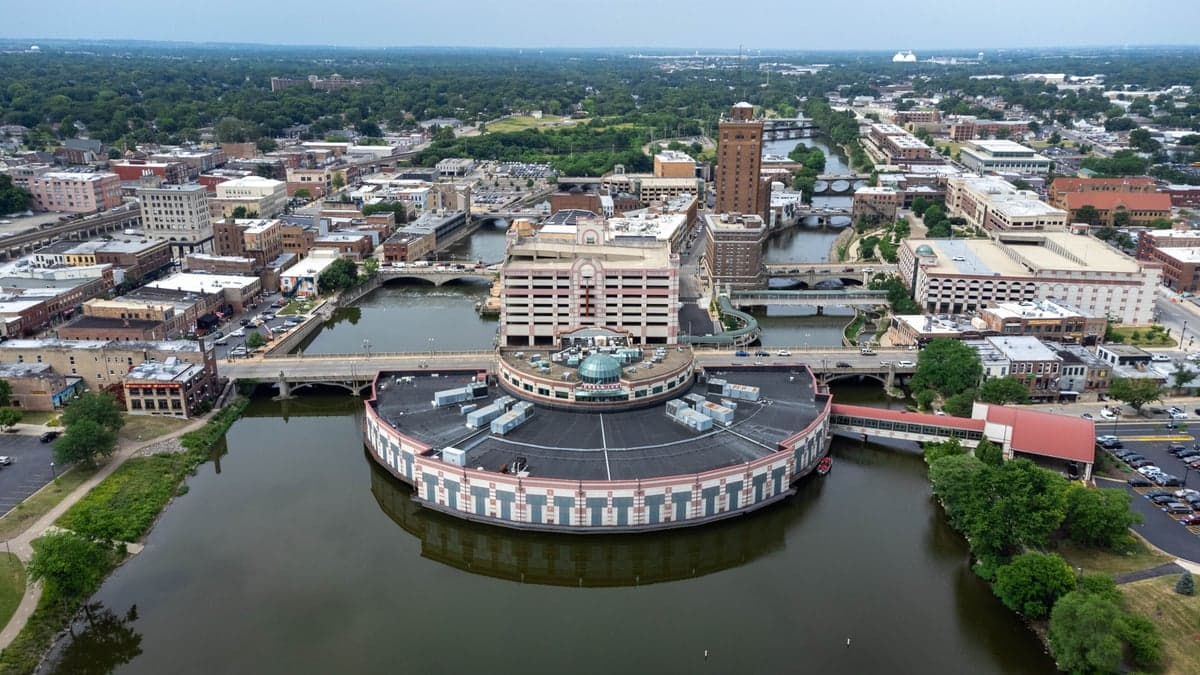
Photo: Wikipedia
Political ClimatePolitical Climate in Aurora, IL
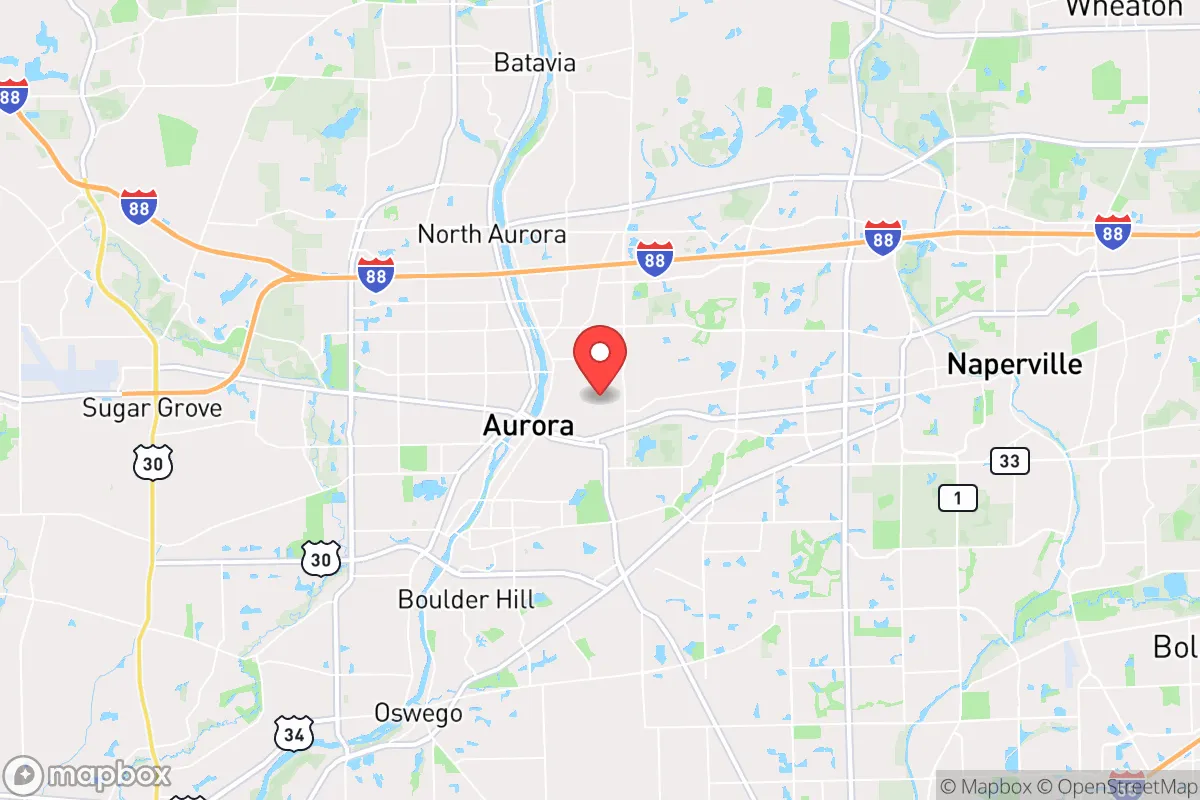
District shown is the primary district for this city’s centroid. Cities may span multiple districts.
Local Political AnalysisPolitical Analysis of Aurora, IL
Aurora, Illinois, has shifted noticeably leftward over the past decade, and if you’ve lived here as long as I have, you’ve felt it. The city’s Cook Partisan Voting Index (PVI) now sits at D+6, meaning it leans about six points more Democratic than the national average. That’s a far cry from the more balanced, common-sense community I remember from the 1990s and early 2000s, when local elections were genuinely competitive and your vote actually felt like it could swing things. Today, the city council and mayor’s office are firmly in progressive hands, and the trend line doesn’t look like it’s reversing anytime soon.
How it compares
To understand Aurora’s political drift, you have to look at the map around it. Drive 15 minutes west to Montgomery or Oswego, and you’ll find towns that still vote reliably red—Kendall County went +18 for Trump in 2020. Head north to Batavia or Geneva, and you get a mixed bag, with Kane County overall trending purple but still holding onto some fiscal conservatism. But Aurora itself? It’s become an island of progressive policy in a sea of relative moderation. The city’s annexation of more diverse, lower-income neighborhoods over the years, combined with an influx of younger professionals from Chicago, has tilted the electorate hard. Where you once had a healthy split between blue-collar union Democrats and small-business Republicans, now you see a near-monolithic voting bloc that rubber-stamps tax hikes and social programs without much debate.
What this means for residents
For those of us who value personal freedom and limited government, the practical effects are hard to ignore. Property taxes in Aurora have climbed steadily—Kane County’s average effective rate is around 2.3%, one of the highest in the state—and the city council has shown little appetite for cutting spending. New ordinances on rental inspections, business licensing fees, and even noise complaints have expanded the city’s footprint into daily life. The push for “equity” initiatives in local schools and policing has also raised eyebrows, with some residents feeling that merit and accountability are being traded for ideological conformity. If you run a small business here, you’ve probably noticed more red tape than a decade ago, and the city’s willingness to entertain sanctuary policies and other progressive priorities only adds to the sense that your voice is being drowned out.
Culturally, Aurora has embraced a “big tent” approach that can feel more like government overreach than genuine community building. The city’s official stance on everything from environmental mandates to diversity training for contractors signals a shift toward top-down social engineering. Longtime residents, especially those who remember when Aurora was a manufacturing hub with a live-and-let-live attitude, often express frustration at how much has changed. The near-term outlook? Expect more of the same—higher taxes, more regulations, and a local government that sees its role as reshaping society rather than just keeping the lights on. If that doesn’t sit right with you, you’re not alone, but the political math here makes it an uphill battle to turn things around.

State Political ClimatePolitical Climate in Illinois
State Political AnalysisPolitical Environment in the State
Illinois has been a reliably blue state for decades, but its political landscape is far more complex than a simple partisan label. The Democratic stronghold is powered almost entirely by Chicago and its inner suburbs, while the rest of the state—from the Mississippi River towns to the southern tip—votes overwhelmingly Republican. Over the last 20 years, the state has shifted leftward on social and economic policy, driven by a shrinking rural population and a growing, increasingly progressive Chicago metro. For a conservative considering relocation, the key question isn’t whether Illinois is red or blue—it’s whether the areas outside Cook County offer enough breathing room from the policies made in Springfield.
Urban vs. rural divide
The political map of Illinois is a study in extremes. Cook County, home to Chicago, casts roughly 40% of the state’s total vote and delivers margins of 70-80% for Democratic candidates. The collar counties—DuPage, Lake, Kane, McHenry, and Will—have been trending blue for a decade, though McHenry and parts of Kane still hold some conservative pockets. Meanwhile, downstate Illinois is deeply red. Counties like Effingham, Macoupin, and Williamson routinely vote 70%+ Republican. The St. Louis exurbs in Madison and St. Clair counties are competitive but lean blue, while the Quad Cities area (Rock Island County) is a perennial swing zone. The real story is the exodus of conservative-leaning families from Cook and the collar counties into places like Kendall County (Oswego, Yorkville) and the far western exurbs (DeKalb, Lee County), where housing is cheaper and the local government is more restrained. This internal migration is slowly shifting the balance in those areas, but it’s not enough to flip the state.
Policy environment
Illinois’s policy environment is a mixed bag that leans heavily toward government intervention. The state has a flat income tax rate of 4.95%, but that’s after a temporary increase from 3.75% in 2017, and there’s no constitutional cap on future hikes. Property taxes are among the highest in the nation—averaging 2.1% of home value, with Cook County often exceeding 2.5%. The regulatory climate is business-unfriendly: the state has a $15 minimum wage (indexed to inflation), strict environmental rules, and a powerful union presence that drives up construction and labor costs. On education, Illinois funds schools through a complex formula that heavily favors Chicago Public Schools, leaving rural districts like those in Hamilton County or Pope County struggling to compete. Healthcare is dominated by large systems like Advocate Aurora and Northwestern, with Medicaid expansion under the Affordable Care Act fully embraced. Election laws are among the most liberal: automatic voter registration, no-excuse mail-in voting, and same-day registration are all in place, which conservatives view as eroding ballot integrity. The state also has a sanctuary law (the TRUST Act) that limits local cooperation with federal immigration enforcement.
Trajectory & freedom
Over the past five years, Illinois has moved decisively toward greater government control over personal and economic life. The 2021 repeal of the Parental Notice of Abortion Act removed the requirement that minors notify a parent before an abortion, a clear expansion of state authority over family decisions. In 2023, the state passed the Illinois Reproductive Health Act, codifying abortion access as a “fundamental right,” and the Healthcare Protection Act, which banned private health insurance from requiring prior authorization for mental health and substance abuse treatment—a well-intentioned but costly mandate. On gun rights, Illinois is a national outlier: the 2023 Protect Illinois Communities Act banned the sale of many semi-automatic rifles and high-capacity magazines, and the state has a Firearm Owners Identification (FOID) card system that creates a de facto registry. The 2024 SAFE-T Act eliminated cash bail, a move that law enforcement groups say has reduced public safety. Property rights are under pressure from the state’s 2021 Climate and Equitable Jobs Act, which phases out fossil fuels and mandates renewable energy targets, driving up electricity costs and limiting land use in rural areas. On the positive side for conservatives, Illinois has no right-to-work law, but it also has no state-level rent control, and the 2023 expansion of the homestead exemption offers modest property tax relief for seniors.
Civil unrest & political movements
Illinois has seen its share of political flashpoints. The 2020 George Floyd protests in Chicago resulted in widespread looting and property damage, with the city’s response criticized as slow and ineffective. The 2022 Highland Park parade shooting galvanized the gun control movement and directly led to the Protect Illinois Communities Act. On the right, the Illinois Family Institute and local chapters of Moms for Liberty have been active in school board races, particularly in suburbs like Naperville and Barrington, where curriculum and library book controversies have erupted. Immigration politics are a constant source of tension: Chicago’s sanctuary status has drawn thousands of migrants from the southern border since 2022, straining city services and sparking backlash in working-class neighborhoods. The 2020 election integrity debate was muted compared to swing states, but conservative groups have raised concerns about the state’s mail-in ballot system and the lack of voter ID requirements. Secession talk is mostly rhetorical—the “New Illinois” movement, which advocates for Cook County to break away, has gained little traction. What a new resident will notice is the visible presence of political signage and activism in suburban areas, especially during election cycles, and the stark contrast between Chicago’s progressive activism and the more traditional values of downstate communities.
Projection
Over the next 5-10 years, Illinois will likely become more Democratic and more progressive at the state level, even as its population continues to decline. The 2020 census cost Illinois one congressional seat, and the trend is accelerating: the state lost over 100,000 residents between 2020 and 2024, with most leaving Cook and the collar counties for Florida, Texas, and Indiana. Those who remain are disproportionately older, more liberal, and more reliant on government services. The 2026 gubernatorial election will be a key test: if a Republican can’t win in a midterm environment, the state’s blue lock will be near-permanent. Expect further expansion of government healthcare (a state-based public option is being discussed), tighter gun laws (including a possible ban on all handgun purchases for those under 21), and continued growth of the state’s pension liability, which already exceeds $140 billion. The influx of migrants to Chicago will shift the city’s political dynamics, potentially creating a new voting bloc that could push the state even further left on immigration and social welfare. For conservatives, the best-case scenario is that the exodus of like-minded residents continues to drain the state of its political opposition, making it harder to mount a statewide challenge.
For a conservative moving to Illinois, the bottom line is this: you can find a comfortable life in the red counties and exurbs, but you will be fighting an uphill battle against state-level policies that expand government control over your family, your property, and your business. The property tax burden alone is a dealbreaker for many, and the state’s trajectory suggests it will only get worse. If you value low taxes, gun rights, and local control, Illinois is a tough sell—but if you have family ties or a job that keeps you here, the best strategy is to settle in a county like McHenry, Kendall, or Effingham, where local government is more aligned with your values, and brace for the next round of Springfield overreach.
* Values derived from national, state, county, city and local statistics and may differ in a specific area. Last updated: 2026-04-30T00:20:53.000Z
Narrative content on this page is AI-generated and may contain mistakes. Verify any details that matter before acting on them.
ReloMaps may earn a commission from affiliate links at no extra cost to you.

